


Installation Materials That Meet 3-a Sanitary Standards
In the food, beverage, and pharmaceutical industries, the integrity of the production line is inseparable from the hygiene of the components used. Ensuring that all equipment and installation materials that meet 3-A sanitary standards are utilized is not merely a regulatory hurdle but a fundamental requirement for consumer safety and operational efficiency. For engineers and procurement teams, understanding the technical nuances of these standards is essential when selecting filtration components and the hardware required to integrate them into a process stream.
3-A Sanitary Standards, Inc. (3-A SSI) is an independent, not-for-profit corporation dedicated to advancing hygienic equipment design. Their standards focus on the "cleanability" of equipment, ensuring that surfaces can be effectively sanitized either through Clean-in-Place (CIP) or manual cleaning methods. When sourcing stainless steel filters and related hardware, verifying compliance with these standards prevents microbial niches and cross-contamination.
Technical Criteria for 3-A Compliant Materials
The selection of installation materials begins with the base metallurgy and extends to the surface treatment and sealing components. To meet 3-A standards, materials must exhibit specific physical and chemical properties that withstand aggressive cleaning cycles and prevent the leaching of contaminants into the product.
Stainless Steel Grades
Most 3-A standards specify the use of AISI 300 series stainless steel. 304 and 316L are the industry benchmarks due to their corrosion resistance and ability to maintain structural integrity under thermal stress. In filtration applications, 316L is often preferred for its superior resistance to chloride-induced pitting, which is critical when processing acidic foods or using halogenated sanitizing agents.
Surface Finish and Roughness (Ra)
A primary tenet of 3-A design is the elimination of microscopic crevices where bacteria can proliferate. This is measured by surface roughness (Ra). For most sanitary applications, a maximum Ra of 32 micro-inches (0.8 micrometers) is required on all product contact surfaces. Achieving this often involves mechanical polishing followed by electropolishing. Electropolishing not only smooths the surface but also enhances the chromium-to-iron ratio at the surface, creating a more robust passive layer against corrosion.
Elastomers and Polymers
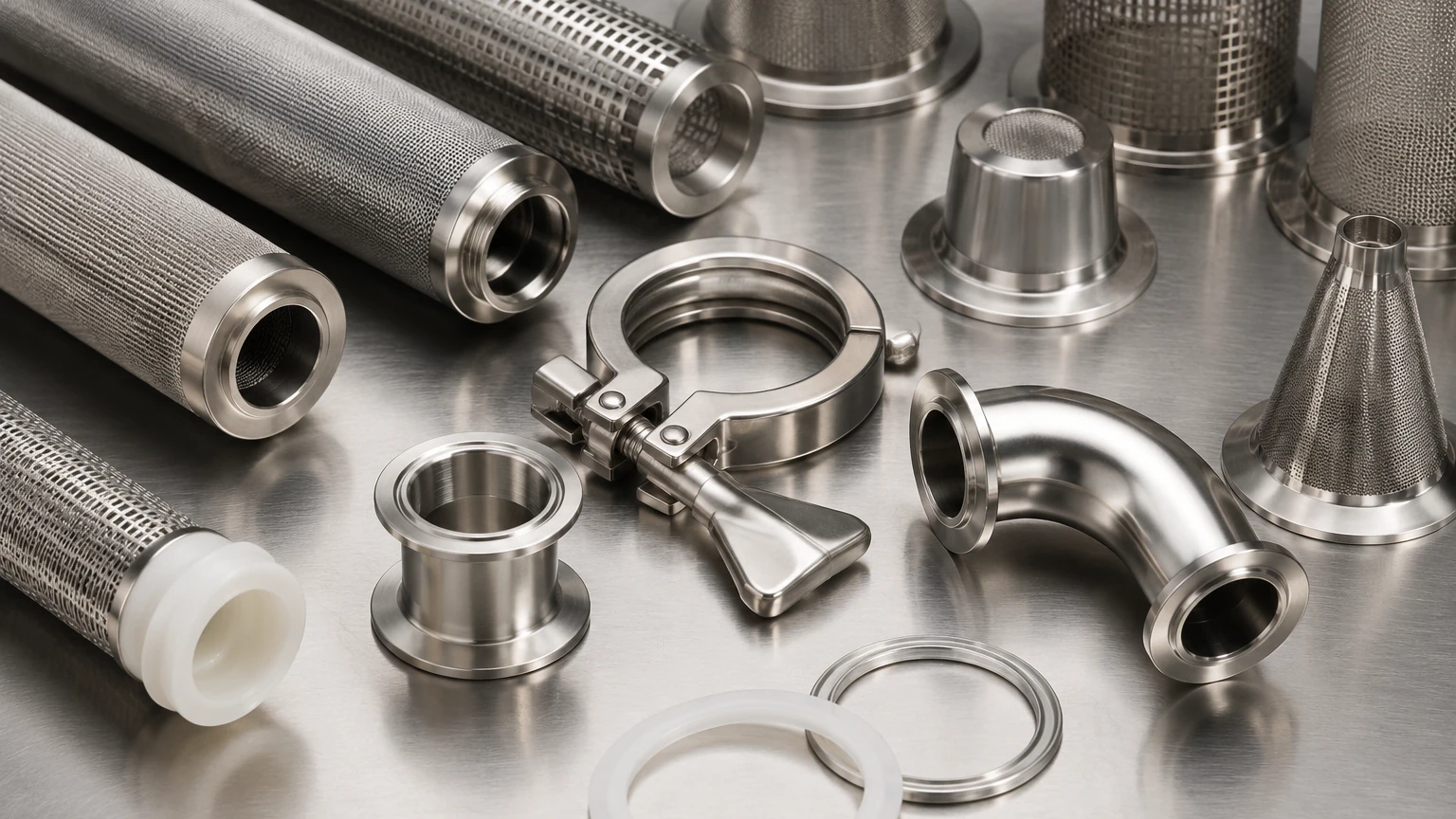
Seals, gaskets, and O-rings are integral installation materials that meet 3-A sanitary standards. These must be made from non-toxic, non-absorbent materials that do not shed particles. Common compliant materials include EPDM, Silicone, and PTFE. These elastomers must be tested for compatibility with both the process fluid and the high temperatures used during steam sterilization (SIP).
Engineering Design Principles for Sanitary Filtration
When integrating a filter cartridge or wire mesh screen into a sanitary system, the design of the housing and the connection points must adhere to strict geometric principles. Kaifil specializes in manufacturing components that respect these boundaries, ensuring that custom filtration solutions do not become the weak link in a hygienic process.
Radii and Transitions
All internal corners must have a minimum radius to ensure that cleaning fluids can reach every surface. Sharp angles are forbidden as they create "dead zones" where product can accumulate and spoil. In the context of custom filter manufacturing, this means that the transition from the filter media to the end caps or flanges must be smooth and continuous.
Absence of Threads in Product Zones
Standard NPT or ISO threads are generally prohibited in the product contact zone because they are impossible to clean effectively. Instead, 3-A compliant installations utilize Tri-Clamp (clamped) fittings or hygienic unions. These connections use a gasket that is compressed between two flanged faces, creating a flush internal surface that is easily reached by CIP spray balls.
Self-Draining Capabilities
Equipment must be designed to be self-draining. Any residual liquid left in the system after a production run or cleaning cycle can lead to bacterial growth. This requires filters to be installed in a vertical orientation or for horizontal housings to be engineered with a specific pitch toward the outlet or drain port.
Common Risks of Non-Compliant Installation Materials
Using materials that fail to meet 3-A criteria introduces significant risks to both the manufacturer and the end consumer. These risks often manifest as hidden costs that far outweigh the initial savings of purchasing non-certified components.
1. Biofilm Formation: Rough surfaces or improper welds provide a foothold for bacteria to form biofilms. Once established, biofilms are highly resistant to standard sanitization protocols and can lead to intermittent contamination batches.
2. Material Degradation: Non-compliant elastomers may swell, crack, or degrade when exposed to caustic cleaning chemicals. This can lead to seal failure or, worse, the introduction of polymer fragments into the product stream.
3. Regulatory and Audit Failure: For facilities subject to FDA or USDA inspections, the absence of 3-A documentation for critical components can result in citations, fines, or forced production halts.
4. Corrosion and Product Taint: Using lower-grade metals can lead to rouge (iron oxide) formation, which discolors products and alters flavor profiles, particularly in the beverage and pharmaceutical sectors.
Welding and Fabrication Standards
In the assembly of stainless steel filtration systems, the quality of the weld is as important as the material itself. 3-A standards require that welds in the product contact zone be continuous, smooth, and pit-free.
* TIG Welding: Tungsten Inert Gas (TIG) welding is the preferred method for sanitary components. It provides precise control and a clean weld bead.
* Purging: During the welding of stainless steel tubes or filter housings, the interior of the component must be purged with an inert gas (usually Argon) to prevent oxidation on the backside of the weld, often referred to as "sugar."
* Grinding and Polishing: After welding, the joint must be ground flush and polished to match the surrounding Ra value. Any porosity or undercut in the weld is a violation of 3-A standards.
Engineers should verify that their suppliers employ certified welders who understand the specific requirements of hygienic fabrication. For more information on technical specifications and custom manufacturing capabilities, professionals can visit the Main Page to review product options and application support.
Selection Guide: Confirming 3-A Compliance
When evaluating installation materials that meet 3-A sanitary standards, procurement teams should request specific documentation to ensure the components meet the necessary rigor.
Material Test Reports (MTRs)
An MTR provides the chemical breakdown and physical properties of the stainless steel batch used to manufacture the component. This confirms that the material is indeed 316L or 304 and meets the required standards for sulfur content (which affects weldability and surface finish).
Certificate of Conformance (CoC)
For gaskets and O-rings, a CoC verifies that the elastomer formulation is FDA-compliant and meets the 3-A Class I, II, or III requirements for repeated use in contact with food or dairy products.
Third-Party Verification (TPV)
3-A SSI requires a Third-Party Verification for equipment to display the 3-A Symbol. This involves an on-site audit by a Certified Conformance Evaluator (CCE) to ensure the design and manufacturing processes consistently meet the standards.
Customization and Integration Considerations
In many industrial settings, standard off-the-shelf filters may not meet the specific flow rates or space constraints of a facility. Customization is often necessary, but it must be handled within the boundaries of 3-A principles.
When commissioning a custom stainless steel filter, engineers must define:
* The Micron Rating: Ensuring the wire mesh or sintered metal provides the required filtration accuracy without creating excessive pressure drop.
* Connection Types: Specifying Tri-Clamp, SMS, or DIN fittings that match existing piping while maintaining a sanitary seal.
* Housing Geometry: Designing the vessel to allow for full disassembly and inspection of the internal filter element.
Kaifil provides comprehensive OEM services, working closely with global customers to develop high-performance filtration components that balance technical performance with strict hygienic requirements. Whether for chemical processing, water treatment, or food production, the focus remains on durability and precise filtration.
Maintenance and Replacement Cycles
Even the highest quality installation materials that meet 3-A sanitary standards have a finite service life. Maintenance protocols should be established based on the severity of the operating environment.
* Gasket Replacement: Elastomeric seals should be inspected during every teardown. Even if they appear intact, they may lose their elasticity over time, compromising the sanitary seal.
* Filter Cleaning: Stainless steel wire mesh filters are often reusable. However, the cleaning process (such as ultrasonic cleaning or backwashing) must be validated to ensure that no debris is trapped within the mesh layers.
* Surface Inspection: Periodically, the internal surfaces of housings and piping should be inspected for signs of pitting or mechanical damage. Any scratch deeper than the allowable Ra value can become a site for bacterial colonization.
Conclusion
Adhering to 3-A sanitary standards for installation materials is a critical component of modern industrial engineering. By prioritizing 300-series stainless steel, demanding high-quality surface finishes, and ensuring proper geometric design, facilities can significantly reduce the risk of contamination and equipment failure. When sourcing these components, partnering with a manufacturer like Kaifil ensures that technical expertise and quality control are integrated into every step of the production process. For those looking to optimize their filtration systems, visiting the Main Page offers a gateway to professional product information and customized engineering support tailored to demanding industrial environments.
Download Installation Materials That Meet 3-a Sanitary Standards as a PDF
