


Lab Scale Filter Press
In industrial process development, the transition from a bench-top concept to a full-scale production line requires rigorous testing and data validation. A lab scale filter press serves as a foundational tool in this progression, providing engineers with a controlled environment to evaluate solid-liquid separation efficiency. These compact systems are designed to simulate the hydraulic and mechanical conditions of large-scale industrial filter presses, allowing for the determination of critical parameters such as cake thickness, filtration rate, and filtrate clarity. For technical professionals and purchasing teams, understanding the engineering nuances of these units is essential for optimizing process design and ensuring long-term operational reliability.
Engineering Fundamentals of Lab Scale Filtration
The primary function of a lab scale filter press is to achieve separation through pressure filtration. Unlike vacuum filtration, which is limited by atmospheric pressure, a filter press utilizes a pump or mechanical force to drive a slurry through a filter medium. This process is governed by the principles of fluid dynamics, specifically Darcy’s Law, which relates the flow rate of a liquid through a porous medium to the pressure drop across that medium.
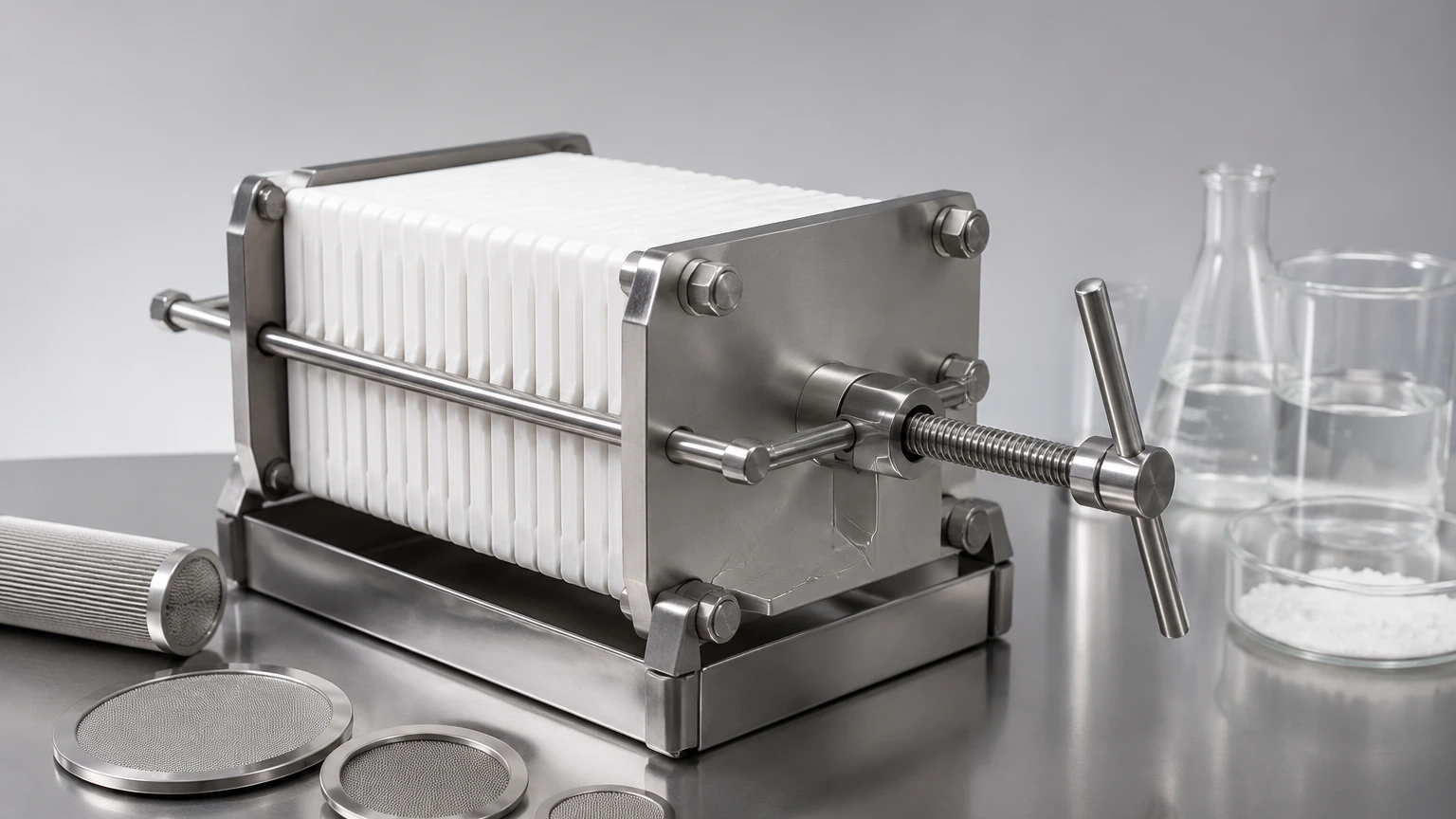
In a laboratory setting, the press typically consists of a series of plates and frames or recessed plates. As the slurry is pumped into the chambers, the solids are retained by the filter cloth or wire mesh, forming a "cake," while the liquid (filtrate) passes through. The lab scale version allows engineers to measure the specific resistance of the cake—a vital metric for predicting how a material will behave in a 500-plate industrial installation. By adjusting the feed pressure and monitoring the volume of filtrate over time, teams can establish the optimal cycle time for production.
Material Selection and Component Integrity
For industrial applications in the chemical, pharmaceutical, and food and beverage sectors, the material of construction for a lab scale filter press is non-negotiable. Stainless steel, particularly 304 and 316L grades, is the industry standard due to its corrosion resistance, thermal stability, and ease of sterilization.
The Role of Stainless Steel Filter Media
While the frame of the press provides structural support, the performance of the filtration cycle depends heavily on the filter media. In many high-precision lab environments, traditional fabric cloths are replaced or supplemented with stainless steel wire mesh or sintered metal components. These materials offer several technical advantages:
* Precision Filtration: Stainless steel mesh allows for exact pore size control, ensuring that even micron-sized particles are captured consistently.
* Durability: Unlike synthetic fabrics, metal filter components do not stretch or degrade under high pressure, maintaining the integrity of the test results.
* Chemical Compatibility: In processes involving aggressive solvents or high temperatures, stainless steel provides the necessary chemical inertness to prevent contamination of the filtrate.
When evaluating a lab scale filter press, engineers must consider the compatibility of the internal components with the slurry being tested. For those seeking specialized filtration hardware, the Main Page of a dedicated manufacturer offers detailed specifications on the types of stainless steel cartridges and mesh configurations available for custom integration.
Key Evaluation Criteria for Engineers
Selecting the right lab scale filter press involves more than just matching a volume capacity. Engineers must look at several technical specifications to ensure the unit can provide actionable data for scale-up.
Filtration Area and Cake Volume
The filtration area determines the speed of the process, while the cake volume determines how much solid material can be processed before the press needs to be cleaned. A well-designed lab unit should offer interchangeable frames or plates to allow for testing different cake thicknesses. This flexibility is crucial when dealing with slurries that have varying solid concentrations.
Operating Pressure Ratings
Most industrial processes operate at pressures between 7 and 15 bar. A lab scale filter press must be capable of reaching these pressures to accurately simulate production conditions. Units that only operate at low pressures may fail to reveal the compressibility of the filter cake, leading to significant errors in full-scale equipment sizing.
Ease of Cleaning and Maintenance
In a research and development environment, the ability to quickly disassemble and clean the equipment is vital for throughput. Features such as quick-release clamps and smooth, electropolished surfaces reduce the risk of cross-contamination between different batches or products. For pharmaceutical applications, ensuring the unit meets sanitary standards is a primary requirement.
Scaling Up: From Lab Data to Industrial Production
The ultimate goal of using a lab scale filter press is to generate a "scale-up factor." This factor is a mathematical bridge between the small-scale results and the requirements of a large-scale plant. Engineers typically focus on the following data points during lab trials:
1. Flux Rate: The volume of filtrate produced per square meter of filtration area per hour (LMH). This determines the total size of the industrial press required.
2. Cake Moisture Content: By measuring the weight of the wet cake versus the dry cake, engineers can determine if additional steps, such as air blowing or cake washing, are necessary.
3. Filtrate Quality: Using turbidimeters to measure the clarity of the liquid ensures that the chosen filter media meets the final product specifications.
If the lab trials indicate that the slurry is difficult to filter, engineers may decide to introduce filter aids or change the pore size of the stainless steel mesh. Having access to a variety of precision metal filter components allows for iterative testing until the most cost-effective solution is found.
Common Risks and Mitigation Strategies
Operating a lab scale filter press is not without its challenges. One of the most common risks is "blinding" of the filter media, where fine particles become trapped within the pores of the mesh or cloth, rapidly decreasing the flow rate. To mitigate this, engineers should test different weave patterns of stainless steel wire mesh, such as plain Dutch weave or twilled Dutch weave, which are designed to handle specific particle shapes and sizes.
Another risk is the bypass of solids around the edges of the filter plates. This is often caused by improper sealing or mechanical misalignment. High-quality lab presses utilize precision-machined stainless steel plates to ensure a perfect seal even at maximum operating pressures. Regular inspection of the gaskets and the flatness of the plates is a mandatory maintenance task for any lab supervisor.
Total Cost of Ownership and ROI
While the initial purchase price of a lab scale filter press is a factor, the total cost of ownership (TCO) should be the primary concern for purchasing teams. A low-cost unit made from inferior materials may lead to inconsistent data, which can result in the over-sizing or under-sizing of a multi-million dollar industrial filtration system.
Investing in a robust, stainless steel lab press provides long-term value through:
* Reduced Downtime: Durable metal components require less frequent replacement than plastic or fabric alternatives.
* Data Accuracy: Consistent mechanical performance ensures that scale-up calculations are reliable, preventing costly modifications to the production line later.
* Versatility: A high-spec lab unit can be used across multiple projects and different types of slurries, from chemical catalysts to food oils.
For organizations looking to optimize their filtration processes, reviewing the available technical documentation and product options on the Main Page can provide a clearer path toward selecting the right components for both lab and production environments.
Conclusion
The lab scale filter press is an indispensable instrument for any industry reliant on solid-liquid separation. By providing a technical platform for empirical testing, it removes the guesswork from process engineering. When equipped with high-quality stainless steel filtration media and precision-engineered components, these units deliver the accuracy needed to move confidently from the laboratory to the factory floor. For engineers and procurement specialists, focusing on material integrity, pressure capabilities, and ease of maintenance will ensure that the laboratory phase of a project contributes directly to the efficiency and profitability of the final industrial application.
