


Liquid Bag Filter Housing
In industrial process engineering, the selection of a liquid bag filter housing is a critical decision that impacts the efficiency, safety, and cost-effectiveness of a filtration system. These pressure vessels are designed to contain filter bags, providing a secure environment where solids are separated from liquids under varying pressures and flow rates. For engineers and procurement teams, understanding the technical nuances of housing design—ranging from material metallurgy to sealing mechanisms—is essential for optimizing long-term operational performance.
As a specialized manufacturer, Kaifil provides precision-engineered filtration solutions that address the rigorous demands of chemical processing, food and beverage production, and water treatment. By examining the structural and functional aspects of a liquid bag filter housing, technical professionals can better align equipment specifications with their specific application requirements.
Fundamental Principles of Liquid Bag Filter Housing Design
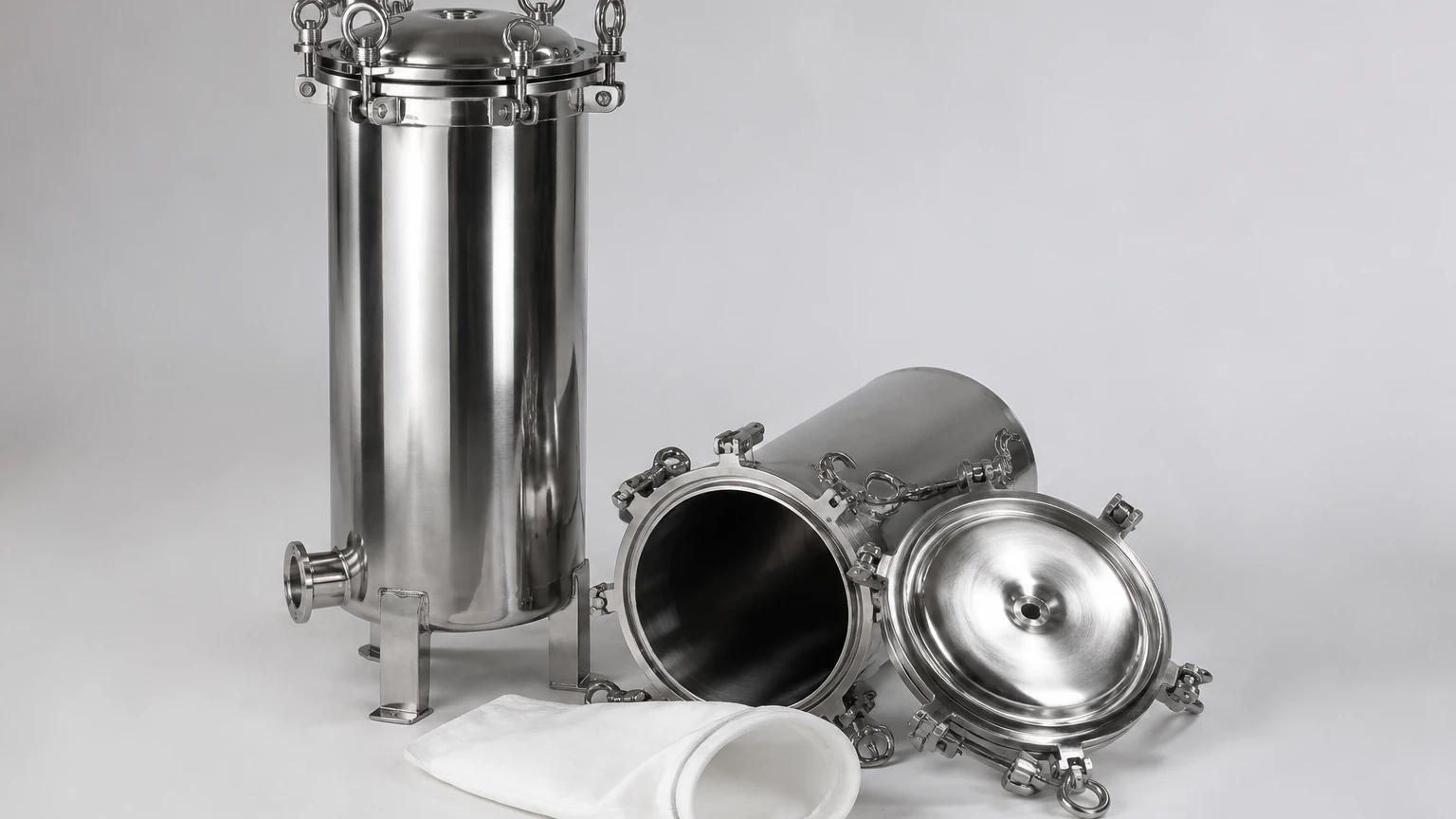
A liquid bag filter housing operates on a relatively simple mechanical principle, yet its execution requires precise engineering to prevent bypass and ensure structural integrity. The housing consists of the outer pressure vessel, a removable lid, an internal perforated support basket, and the filter bag itself.
The flow path typically enters through the top or side of the housing, passes through the filter bag (where contaminants are trapped), and exits through the bottom or side outlet. The internal support basket is a vital component; it prevents the filter bag from bursting under the pressure of the fluid flow. These baskets are often constructed from heavy-duty stainless steel wire mesh or perforated plate to provide maximum surface area while maintaining high mechanical strength.
When evaluating a liquid bag filter housing, the internal volume and the surface area of the bag are the primary drivers of capacity. Standard sizes, such as Size 1 and Size 2, are common in the industry, but custom configurations are often required for specialized flow rates or space constraints. For more information on custom filtration components, you can visit our Main Page.
Material Selection and Chemical Compatibility
The choice of material for a liquid bag filter housing is dictated by the chemical nature of the fluid being processed and the environmental conditions of the facility. Stainless steel is the industry standard due to its corrosion resistance and durability.
Stainless Steel Grades
* SS304: Suitable for general industrial applications, water treatment, and mildly corrosive environments. It offers excellent structural integrity at a lower cost point than higher-grade alloys.
* SS316/316L: Preferred for pharmaceutical, food and beverage, and aggressive chemical applications. The addition of molybdenum enhances resistance to pitting and crevice corrosion, particularly in chloride-rich environments.
Gasket and Seal Materials
Beyond the metal housing, the seals are the most vulnerable point for chemical attack. Engineers must confirm that the O-ring or gasket material is compatible with the process fluid. Common materials include:
* Buna-N (Nitrile): Good for oils and general water applications.
* EPDM: Excellent for hot water, steam, and dilute acids.
* Viton (FKM): High-temperature resistance and compatibility with a wide range of chemicals and fuels.
* PTFE (Teflon): Nearly universal chemical resistance, though with less elasticity than elastomers.
Performance Metrics: Flow Rate and Pressure Drop
Sizing a liquid bag filter housing requires a balance between the desired flow rate and the allowable pressure drop (ΔP). The "clean" pressure drop refers to the resistance of the housing and a new filter bag, while the "dirty" pressure drop indicates the point at which the bag must be replaced.
Several factors influence these metrics:
1. Viscosity: Higher viscosity fluids require larger housings or lower flow rates to maintain manageable pressure levels. As viscosity increases, the resistance to flow through the filter media rises exponentially.
2. Micron Rating: Finer filtration (lower micron ratings) creates more resistance. Engineers often compensate for this by using multi-bag housings to increase the total filtration surface area.
3. Contaminant Loading: If the fluid has a high concentration of solids, a larger housing or a pre-filtration stage may be necessary to prevent rapid clogging and excessive downtime.
It is generally recommended to size the housing so that the initial pressure drop does not exceed 2-3 PSI. This provides sufficient "headroom" for the filter bag to collect contaminants before reaching the terminal pressure drop, which is typically between 15 and 25 PSI depending on the bag material and housing design.
Structural Integrity and Safety Compliance
Because a liquid bag filter housing is a pressure vessel, safety is paramount. In many jurisdictions, housings must comply with the ASME (American Society of Mechanical Engineers) Section VIII, Division 1 code. This ensures that the vessel can safely withstand the maximum allowable working pressure (MAWP) at a specified temperature.
Key safety features to look for include:
* Pressure Relief Valves: To prevent over-pressurization in the event of a downstream blockage.
* Vent Ports: Located on the lid to allow for the safe release of air or gas before opening the vessel for maintenance.
* Drain Ports: Positioned at the lowest point of the housing to facilitate complete evacuation of the fluid during bag changes.
* Lid Closure Mechanisms: Swing bolt closures are common for high-pressure applications, providing a secure, multi-point seal. For lower-pressure or high-frequency change-out applications, quick-opening lids can reduce labor time.
Customization and OEM Solutions for Complex Applications
While standard housings meet many industrial needs, unique process requirements often necessitate customized solutions. Kaifil specializes in OEM manufacturing, allowing for modifications that improve integration into existing piping systems or enhance specific performance characteristics.
Multi-Bag Housings
For high-flow applications exceeding the capacity of a single Size 2 bag, multi-bag housings are used. These units can contain anywhere from 2 to 24 bags (or more) within a single vessel. This design reduces the footprint of the filtration system and simplifies maintenance by centralizing the change-out process.
Heating Jackets
In industries such as chocolate production or heavy oil processing, fluids must be kept at a specific temperature to maintain flowable viscosity. A liquid bag filter housing can be equipped with a steam or hot water jacket to prevent the product from cooling and solidifying within the filter.
Specialized Inlets and Outlets
Standard NPT or flanged connections may not always fit a facility's layout. Customizing the orientation (e.g., tangential inlets) or the connection type (e.g., sanitary tri-clamp fittings) ensures a seamless installation and can reduce turbulence within the housing, leading to more efficient filtration.
Maintenance and Operational Best Practices
The longevity and effectiveness of a liquid bag filter housing depend on proper maintenance protocols. The most critical aspect is the prevention of bypass—where fluid flows around the filter bag rather than through it.
Ensuring a Positive Seal
Bypass usually occurs due to improper bag installation or a damaged sealing surface. Most modern housings use a "V-ring" or a pressure-actuated seal that forces the bag rim against the housing wall as pressure increases. Operators must inspect the internal sealing flange for scratches or debris every time a bag is replaced.
Monitoring Differential Pressure
Relying on a fixed schedule for bag changes is often inefficient. Instead, differential pressure gauges should be installed across the inlet and outlet. This allows operators to change bags based on actual loading, maximizing the life of the filter media and preventing the risk of bag rupture due to excessive pressure.
Cleaning and Inspection
During bag changes, the internal support basket should be inspected for signs of wear or clogging. If the basket's mesh or perforations become restricted, it will increase the baseline pressure drop. Periodic cleaning of the housing interior is also necessary to prevent the buildup of bacteria or cross-contaminants, particularly in food-grade applications.
Evaluating Total Cost of Ownership (TCO)
When procurement teams evaluate a liquid bag filter housing, the initial purchase price (CAPEX) is only one part of the equation. The Total Cost of Ownership (TCO) includes several operational factors (OPEX):
* Labor Costs: How long does it take to change a bag? Features like quick-opening lids and ergonomic heights can significantly reduce labor hours over the life of the equipment.
* Consumable Costs: A poorly sized housing may lead to premature bag clogging, increasing the annual spend on replacement bags.
* Product Loss: Large housings hold a significant volume of fluid. If the product is high-value (such as specialty chemicals or pharmaceuticals), the amount of fluid lost during each change-out must be considered.
* Energy Consumption: A system that operates at a higher average pressure drop requires more pump energy. Sizing up the housing to reduce ΔP can result in long-term energy savings.
By selecting a high-quality, precision-manufactured liquid bag filter housing from a provider like Kaifil, companies can ensure they are investing in equipment that balances initial costs with long-term reliability and performance. Whether you require a standard unit or a complex OEM design, focusing on the engineering details—material integrity, seal quality, and flow dynamics—is the key to successful industrial filtration.
