


Liquid Coalescers
In industrial fluid processing, the separation of immiscible liquids—typically water from hydrocarbons or oil from water—is a critical requirement for maintaining equipment integrity, ensuring product purity, and meeting environmental regulations. Liquid coalescers are specialized separation devices designed to merge small droplets of a dispersed liquid phase into larger droplets, allowing them to be separated from a continuous liquid phase based on density differences. Unlike standard particulate filters that remove solid contaminants, liquid coalescers address the physical challenge of breaking emulsions and managing interfacial tension.
For engineers and procurement professionals, selecting the right coalescing technology requires a deep understanding of fluid dynamics, material compatibility, and the specific mechanical requirements of the application. High-performance liquid coalescers often utilize stainless steel components and precision-engineered media to withstand the demanding pressures and chemical environments found in processing plants.
The Fundamental Principles of Liquid-Liquid Coalescence
Liquid coalescers operate on a multi-stage physical process. The goal is to take a stable or semi-stable emulsion—where tiny droplets of one liquid are suspended in another—and force those droplets to grow until they are large enough to settle out of the flow.
1. Droplet Capture and Interception
As the contaminated fluid passes through the coalescing media, the dispersed phase droplets come into contact with the fibers or mesh of the media. This is achieved through several mechanisms: inertial impaction, where larger droplets hit the media due to their momentum; and interceptive capture, where smaller droplets follow the flow lines and touch the media surface. The choice of media is critical here; it must have a high surface area and the correct surface energy to attract the dispersed phase.
2. Attachment and Film Formation
Once a droplet contacts the media, it must attach to it. In many industrial liquid coalescers, the media is treated or selected to be "preferentially wetted" by the dispersed phase. For example, in a water-from-fuel application, the media is often hydrophilic (water-attracting). As more droplets attach, they form a thin film of liquid across the fibers of the media.
3. Coalescence (Growth)
As the fluid continues to flow, additional droplets are captured by the existing film. These droplets merge, or coalesce, into larger masses. This growth is driven by the reduction in surface free energy that occurs when multiple small droplets combine into a single larger one. The internal structure of the coalescer must provide enough residence time and surface contact for this growth to occur without the droplets being prematurely sheared back into smaller sizes by high-velocity flow.
4. Release and Gravity Separation
When the coalesced droplets reach a sufficient size, the drag force of the continuous phase flow overcomes the adhesive force holding them to the media. The large droplets are released from the downstream side of the coalescer. Because these droplets are now significantly larger, they settle (or rise) much faster according to Stokes' Law. In a horizontal vessel, the heavier phase settles to the bottom, while in a vertical configuration, the lighter phase rises to the top, where they can be effectively drained or skimmed.
Material Engineering in Industrial Coalescers
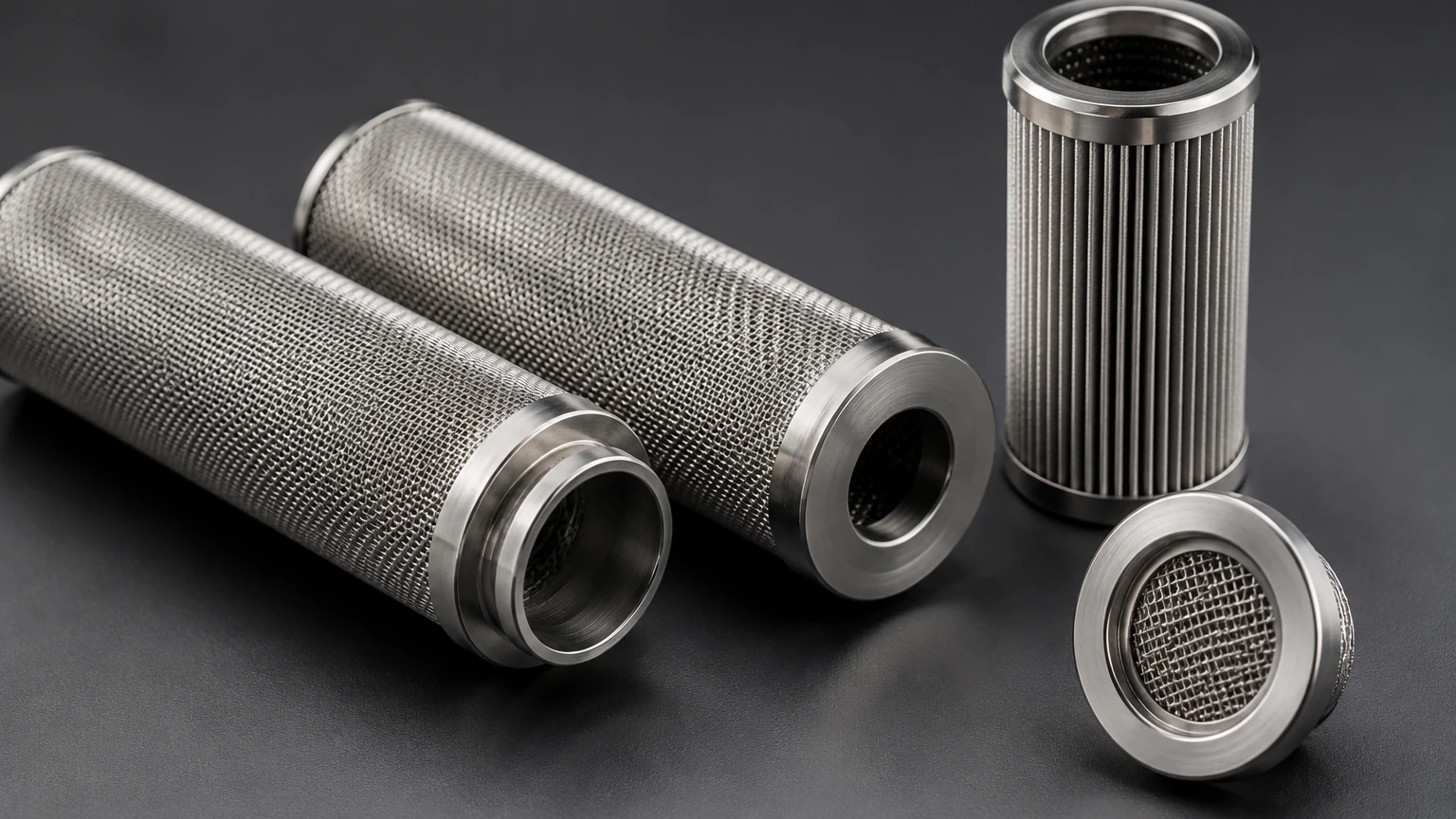
The efficiency of liquid coalescers is heavily dependent on the materials used in their construction. While synthetic fibers like fiberglass or polymers are common in light-duty applications, industrial-grade coalescers often rely on stainless steel wire mesh and sintered metal components for durability and precision.
Stainless Steel Wire Mesh
Stainless steel wire mesh is a preferred material for the structural support and primary coalescing stages in aggressive chemical environments. It offers several engineering advantages:
* Corrosion Resistance: Using 304 or 316L stainless steel ensures that the coalescer does not degrade when exposed to acidic or alkaline process streams.
* Mechanical Strength: High-pressure hydraulic systems or high-flow chemical lines generate significant mechanical stress. Stainless steel mesh maintains its pore structure and shape under these conditions, preventing "media migration" or bypass.
* Thermal Stability: In applications involving hot oils or steam-cleaned systems, stainless steel remains stable at temperatures that would melt or deform polymer-based coalescers.
Sintered Metal Media
For applications requiring extremely fine separation or high-pressure differentials, sintered metal fiber felt or sintered mesh is utilized. These materials provide a tortuous path for the fluid, maximizing the probability of droplet-to-fiber contact while maintaining high porosity for low initial pressure drops.
Key Engineering Considerations for Selection
When specifying liquid coalescers for an industrial system, engineers must evaluate several technical parameters to ensure the system performs as expected over its service life.
Fluid Viscosity and Density
The density difference between the two liquids is the primary driver for separation after coalescence. If the densities are very close, the settling velocity will be slow, requiring a larger separation vessel. Furthermore, high viscosity in the continuous phase can inhibit the movement of droplets toward the media and their subsequent settling, often requiring a reduction in flow velocity or an increase in the coalescer's surface area.
Interfacial Tension (IFT)
Interfacial tension is a measure of the force keeping the two liquids separate. Fluids with low IFT (often caused by the presence of surfactants or additives) are much harder to coalesce because the droplets do not merge easily. In these cases, specialized high-surface-energy media or multi-stage separation systems are required.
Micron Rating and Efficiency
While coalescers are not particulate filters, they are often rated by the size of the droplets they can effectively capture. A "tight" coalescer with a low micron rating can capture smaller droplets but will result in a higher pressure drop. Engineers must balance the required effluent purity (e.g., reducing water content to <10 ppm) with the allowable energy loss across the system.
Flow Rate and Flux
Flux, or the flow rate per unit area of media, is a critical design constraint. If the flux is too high, the velocity of the fluid may shear the coalesced droplets back into an emulsion as they exit the media, defeating the purpose of the coalescer. Proper sizing ensures that the velocity remains within the laminar flow regime inside the media.
Common Applications for Liquid Coalescers
Liquid coalescers are foundational components in various sectors where fluid purity is non-negotiable. Their ability to handle continuous separation makes them more efficient than batch-settling tanks.
* Petrochemical and Refining: Removing water from hydrocarbons is essential to prevent catalyst poisoning and corrosion in downstream equipment. Coalescers are used in the production of diesel, jet fuel, and gasoline.
* Chemical Processing: In liquid-liquid extraction processes, coalescers are used to separate the solvent phase from the aqueous phase after the mass transfer has occurred.
* Hydraulic and Lube Oil Systems: Water contamination in lubricating oils can lead to oil oxidation, additive depletion, and component wear. Liquid coalescers integrated into kidney-loop systems or main flow lines help maintain oil dry and extend equipment life.
* Wastewater Treatment: Separating free and dispersed oil from industrial runoff or process water before discharge is a common environmental application, often utilizing stainless steel mesh coalescers for their ability to be cleaned and reused.
Maintenance and Performance Monitoring
To ensure the long-term reliability of a coalescing system, technical teams must implement a robust monitoring strategy. The most common indicator of coalescer health is the differential pressure ($ΔP$).
Differential Pressure Management
As the coalescer captures solid particulates (which are often present alongside the liquid contaminants), the pores in the media begin to clog, leading to an increase in $ΔP$. While some liquid coalescers are designed to be backwashed, many industrial cartridges are considered consumable or require professional cleaning. A sudden drop in $ΔP$ can indicate media rupture or seal failure, leading to bypass and poor separation efficiency.
Effluent Quality Analysis
Regular sampling of the downstream fluid is necessary to confirm that the coalescer is meeting its performance targets. For water-in-fuel applications, this might involve Karl Fischer titration to measure precise water content. If the effluent quality degrades while $ΔP$ remains normal, it may indicate that the fluid chemistry has changed (e.g., increased surfactants) or that the media has become "disarmed" and can no longer attract the dispersed phase.
Customization and OEM Integration
Every industrial process has unique constraints regarding space, flow rate, and chemical exposure. Off-the-shelf solutions may not always meet the rigorous standards of specialized engineering projects. This is where working with a manufacturer capable of custom fabrication becomes essential. For those seeking high-quality, customized stainless steel filtration and separation components, you can Review product options and application support to find solutions tailored to specific industrial requirements.
Customization options often include:
* Bespoke Housing Designs: Fitting coalescer elements into existing vessel footprints.
* Alloy Selection: Utilizing specialized stainless steel grades for high-chloride or high-temperature environments.
* Layered Media Configurations: Combining particulate filtration layers with coalescing layers in a single cartridge to save space and reduce maintenance complexity.
Conclusion
Liquid coalescers are sophisticated engineering tools that go beyond simple filtration. By leveraging the physical properties of liquids and the surface science of specialized media, they provide a reliable method for maintaining fluid purity in the world's most demanding industries. For engineers, the key to success lies in the careful evaluation of fluid properties, the selection of durable materials like stainless steel, and a commitment to regular performance monitoring. Whether protecting a high-speed turbine or ensuring the quality of a chemical product, the right liquid coalescer is an investment in process stability and operational efficiency.
