


Types of Pool Filter Cartridges
In industrial and commercial aquatic environments, the efficiency of a filtration system is directly tied to the selection of the filter media. While residential pools often prioritize low initial costs, industrial-scale applications—such as those found in large public aquatic centers, pharmaceutical grade water systems, and specialized chemical processing—require a deeper understanding of the various types of pool filter cartridges. Selecting the appropriate cartridge involves evaluating material compatibility, micron ratings, structural integrity, and long-term operational costs.
This guide examines the technical specifications and engineering considerations for different types of pool filter cartridges, providing the necessary data for procurement teams and facility engineers to optimize their filtration performance.
The Engineering Fundamentals of Pool Filtration
Before detailing specific types of pool filter cartridges, it is essential to understand the mechanical principles they utilize. Most cartridge filters operate on the principle of surface filtration. As water is forced through the media, particles larger than the pore size are trapped on the outer surface. Over time, these particles form a "filter cake," which can actually increase filtration efficiency but also increases the pressure drop across the system.
In high-demand environments, the relationship between flow rate and surface area is critical. A higher surface area allows for lower face velocity (the speed at which water passes through the media), which reduces the depth of particle penetration into the media and extends the cleaning cycle. For engineers, calculating the required square footage of filtration area is the first step in selecting between various cartridge configurations.
Classification by Material Composition
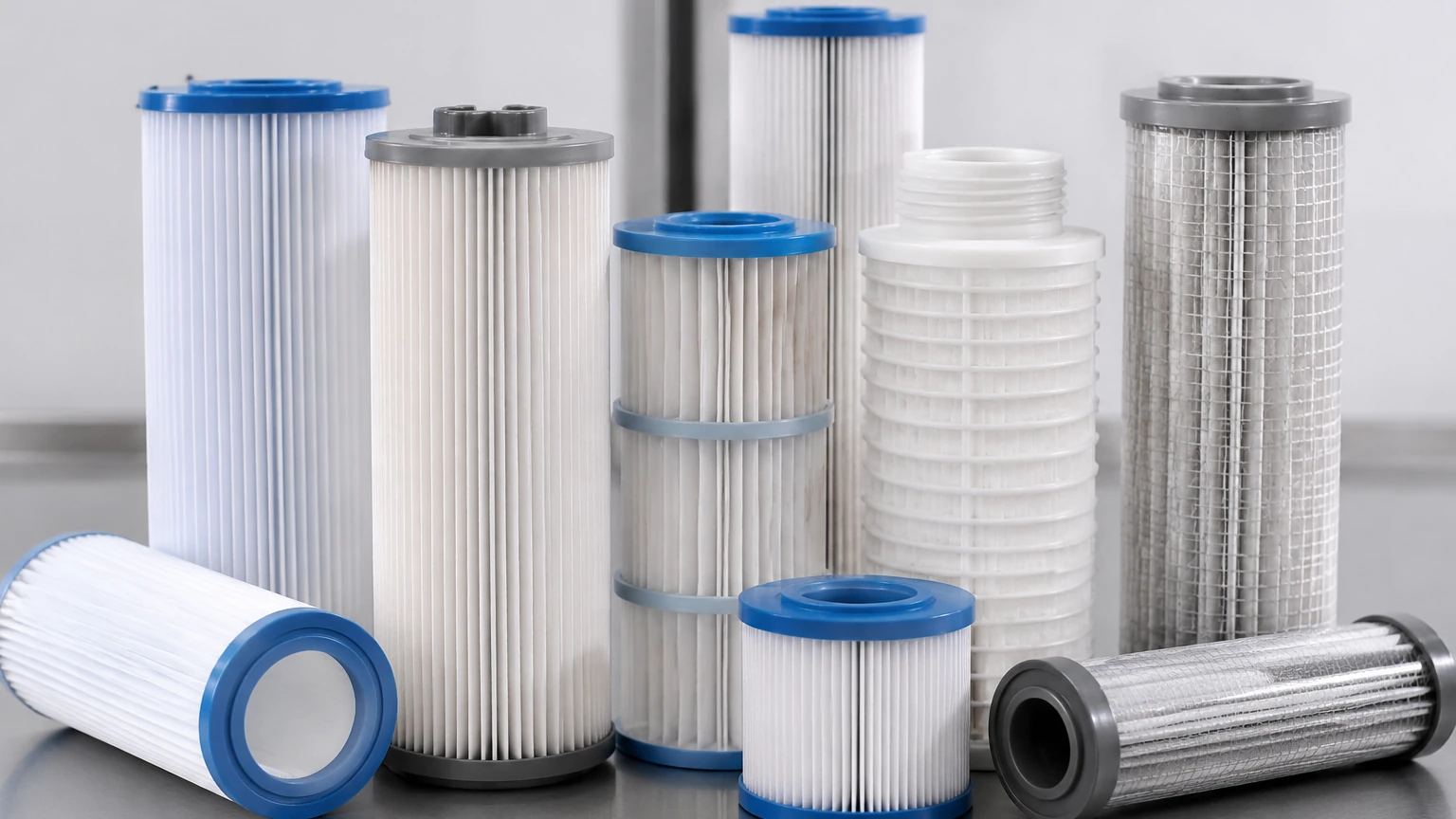
The performance characteristics of a filter are primarily dictated by its construction material. When evaluating types of pool filter cartridges, materials generally fall into three categories: synthetic polymers, natural fibers, and metallic alloys.
1. Polyester Pleated Cartridges
Polyester is the most common material used in commercial pool filtration. These cartridges utilize a non-woven, spunbond polyester fabric pleated around a central core. The pleating significantly increases the surface area within a compact footprint.
* Technical Advantage: High chemical resistance to chlorine and bromine.
* Limitations: While effective for standard debris, polyester fibers can eventually degrade under high-pressure spikes or extreme pH imbalances. They are typically considered semi-disposable, lasting between one and three years depending on the bather load and water chemistry maintenance.
2. Cellulose and Synthetic Blends
Often used in applications requiring higher clarity, cellulose-based cartridges or cellulose-polyester blends offer tighter pore structures. These are frequently found in specialized industrial water treatment where fine particulate removal is paramount.
* Technical Advantage: Superior fine-particle retention compared to standard polyester.
* Limitations: Cellulose is more susceptible to biological fouling and structural collapse if the pressure differential (delta P) exceeds recommended limits. They generally cannot be cleaned as aggressively as pure synthetic or metal filters.
3. Stainless Steel Wire Mesh Cartridges
For demanding industrial applications where durability and reusability are prioritized, stainless steel wire mesh cartridges represent the premium tier of filtration. Manufacturers like Kaifil specialize in these precision-engineered components, often utilizing 304 or 316L stainless steel.
* Technical Advantage: Unlike fabric filters, stainless steel cartridges are virtually immune to chemical degradation from high-concentration sanitizers. They can withstand significantly higher temperatures and pressure differentials without deforming. Most importantly, they are fully cleanable and reusable, offering a service life that can span a decade or more.
* Application: Ideal for facilities using ozone or UV sterilization systems, which can accelerate the degradation of synthetic fibers.
Performance Metrics: Micron Ratings and Flow Dynamics
When comparing types of pool filter cartridges, the "micron rating" is the most cited specification. However, B2B buyers must distinguish between nominal and absolute micron ratings.
* Nominal Micron Rating: This indicates the filter's ability to retain the majority of particles of a specific size (usually 60% to 80%). Most polyester pool cartridges are rated at 10 to 20 microns nominally.
* Absolute Micron Rating: This refers to the diameter of the largest hard spherical particle that will pass through the filter under specified test conditions. Stainless steel mesh filters provide much more predictable absolute ratings, making them the preferred choice for technical applications where bypass is unacceptable.
Flow dynamics also play a role in selection. A cartridge with a high-density pleat pack may offer more surface area but can also create higher initial resistance to flow. Engineers must balance the Total Dynamic Head (TDH) of the pump system with the clean-filter pressure drop to ensure the system operates within its efficient range. To explore specific performance data for various industrial configurations, technical teams can refer to the Main Page of specialized manufacturers for detailed flow-rate charts.
Comparative Analysis: Disposable vs. Cleanable Stainless Steel
The choice between disposable synthetic cartridges and cleanable stainless steel options is often a matter of Total Cost of Ownership (TCO). While the initial capital expenditure for a stainless steel filtration system is higher, the operational savings can be substantial.
| Feature | Polyester Pleated | Stainless Steel Wire Mesh |
| :— | :— | :— |
| Initial Cost | Low to Moderate | High |
| Service Life | 1–3 Years | 10+ Years |
| Cleaning Method | Low-pressure hose | Backwashing, Ultrasonic, or Chemical Soak |
| Chemical Resistance | Good | Excellent (316L) |
| Pressure Tolerance | Moderate | Very High |
| Environmental Impact | High (Frequent disposal) | Low (Reusable) |
In a B2B context, the labor costs associated with frequent cartridge replacement and the environmental impact of disposing of large quantities of synthetic waste are increasingly important factors. Stainless steel cartridges provide a sustainable alternative that aligns with corporate ESG (Environmental, Social, and Governance) goals while ensuring consistent filtration performance.
Industrial Selection Factors for High-Capacity Systems
When specifying types of pool filter cartridges for high-capacity systems, such as those in water parks or industrial cooling towers, several secondary factors must be confirmed:
1. Core Strength: In high-flow applications, the internal core of the cartridge must resist collapse. Reinforced polypropylene or stainless steel cores are required to prevent the media from imploding under high differential pressure.
2. End Cap Integrity: The seal between the filter media and the end cap is a common point of failure. Thermally bonded end caps are superior to those using adhesives, as they eliminate the risk of chemical leaching and bypass.
3. Gasket Material: Ensure that the gaskets (typically EPDM or Viton) are compatible with the specific chemicals used in the water treatment process. For example, EPDM is generally preferred for its resistance to heat and aging in chlorinated water.
4. Customization Requirements: Many industrial systems utilize non-standard housing sizes. Working with a manufacturer that offers custom OEM solutions allows for the retrofitting of older systems with modern, high-efficiency media without replacing the entire filter vessel.
Maintenance Protocols and Service Life Optimization
Regardless of the types of pool filter cartridges selected, the longevity of the media is dependent on proper maintenance. In industrial settings, maintenance should be data-driven rather than scheduled by time.
* Differential Pressure Monitoring: Cartridges should be cleaned when the pressure gauge indicates a rise of 8–10 PSI over the "clean" starting pressure. Allowing the pressure to rise too high can force contaminants through the media (bridging) or cause permanent structural damage.
* Degreasing: In commercial pools, body oils and sunscreens can clog synthetic fibers more quickly than mineral debris. Periodic soaking in a specialized degreaser is necessary to restore flow rates.
* Acid Washing: For systems in hard water areas, calcium scale can build up on the filter surface. A mild acid soak can dissolve these deposits, though this must be done carefully with synthetic media to avoid weakening the fibers.
For stainless steel cartridges, maintenance is more robust. These units can often handle high-pressure cleaning and even ultrasonic baths to remove deeply embedded particulates, ensuring that the filtration system returns to its baseline performance after every service cycle.
Conclusion: Making an Informed Procurement Decision
Selecting from the various types of pool filter cartridges requires a balance between filtration precision, durability, and budget. While polyester pleated cartridges remain the standard for many general-purpose applications, the industrial sector is increasingly turning toward high-performance materials like stainless steel for their longevity and reliability in harsh environments.
Engineers and purchasing managers should prioritize manufacturers who provide transparent technical data regarding micron ratings, material grades, and flow capacities. By focusing on the specific demands of the application—whether it be high chemical exposure, extreme pressure, or a need for absolute filtration—facilities can ensure water quality while minimizing downtime and long-term costs.
For those seeking customized filtration components or high-durability metal mesh solutions, reviewing technical specifications on a manufacturer's Main Page is a critical step in the engineering design process. Proper selection today prevents costly system failures and ensures the continued efficiency of industrial aquatic operations.
