


Lubricating Oil Filter
In industrial machinery, the lubricating oil filter serves as the primary defense against premature component wear and system failure. Lubrication systems are designed to reduce friction between moving parts, but the oil itself can become a carrier for destructive contaminants if not properly managed. From high-speed turbines to heavy-duty hydraulic presses, the selection of an appropriate lubricating oil filter is a critical engineering decision that impacts the reliability, efficiency, and total lifecycle cost of the equipment.
Industrial lubrication environments present unique challenges that differ significantly from automotive or light-duty applications. High operating pressures, fluctuating temperatures, and varying fluid viscosities require filtration solutions that maintain structural integrity while providing precise particle retention. For engineers and maintenance professionals, understanding the technical nuances of filter media, housing design, and performance metrics is essential for optimizing system uptime.
The Role of Lubricating Oil Filtration in Industrial Systems
The primary function of a lubricating oil filter is to remove solid contaminants—such as metal shavings, silica, carbon soot, and seal elastomers—from the oil stream before it reaches sensitive components like bearings, gears, and valves. Contamination is typically categorized into three types: built-in (from manufacturing), ingressed (from the environment), and generated (from internal wear).
Effective filtration directly influences the ISO 4406 cleanliness levels of a system. By maintaining oil at a specific cleanliness code (e.g., 16/14/11), engineers can extend the fatigue life of bearings by several factors. Without an efficient lubricating oil filter, even microscopic particles can cause abrasive wear, surface fatigue, and adhesive transfer, leading to catastrophic mechanical failure. Furthermore, clean oil maintains its chemical stability longer, as certain metal particles act as catalysts for oil oxidation and sludge formation.
Engineering Characteristics of Metal Mesh Filters
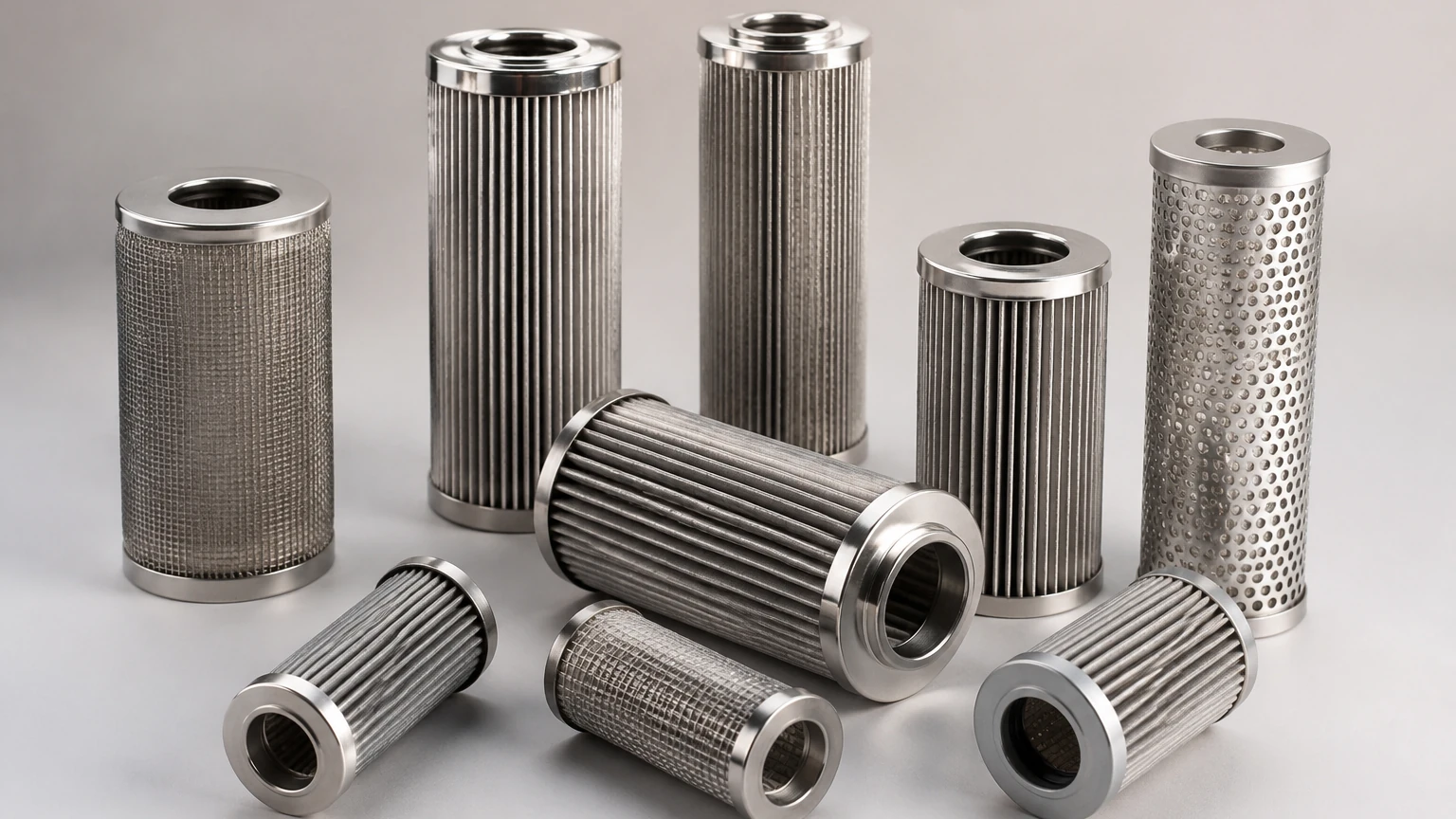
While many industries utilize disposable cellulose or fiberglass elements, stainless steel wire mesh filters have become the standard for demanding industrial lubrication applications. As a specialist in custom stainless steel filtration, Kaifil provides solutions that leverage the inherent strengths of metal media.
Durability and Pressure Resistance
Stainless steel filters are engineered to withstand high differential pressures ($ΔP$) that would cause conventional media to collapse or bypass. In systems where cold starts are frequent, the high viscosity of the oil can create a significant pressure spike. Metal mesh filters provide the structural rigidity necessary to handle these transients without compromising the filtration barrier.
Thermal Stability
Industrial lubricants often operate at elevated temperatures, particularly in power generation and chemical processing. Stainless steel (typically Grade 304 or 316L) maintains its mechanical properties at temperatures far exceeding the limits of synthetic or organic fibers. This prevents media migration—a common failure where the filter material itself breaks down and enters the oil stream.
Cleanability and Reusability
One of the most significant advantages of stainless steel lubricating oil filters is their cleanability. Unlike disposable elements that contribute to industrial waste and recurring procurement costs, metal mesh cartridges can be cleaned via ultrasonic baths or backwashing. This makes them an ideal choice for high-flow systems where filter replacement frequency would otherwise be cost-prohibitive.
Key Selection Criteria for Engineers
Selecting the right lubricating oil filter requires a deep dive into several technical parameters. An undersized filter will lead to frequent bypass events, while an oversized filter may introduce unnecessary costs and space constraints.
1. Micron Rating: Absolute vs. Nominal
It is vital to distinguish between nominal and absolute micron ratings. A nominal rating is an indicative value, often representing the filter's ability to trap a certain percentage of particles of a given size. An absolute rating, typically determined through the Multi-Pass Test (ISO 16889), indicates the diameter of the largest hard spherical particle that will pass through the filter under specified test conditions. For critical lubrication, engineers should prioritize absolute-rated media to ensure consistent protection.
2. Beta Ratio (β)
The Beta ratio is the standard measure of filtration efficiency. It is defined as the ratio of the number of particles of a specific size upstream of the filter to the number of particles of the same size downstream. For example, a $β_{10} = 200$ means that for every 200 particles of 10 microns entering the filter, only one passes through. This equates to a 99.5% efficiency. High-performance industrial filters often target Beta ratios of 1000 or higher for critical particle sizes.
3. Viscosity and Flow Rate
Lubricating oil viscosity changes dramatically with temperature. A filter must be sized based on the "worst-case" viscosity (usually at the lowest expected startup temperature). High viscosity increases the pressure drop across the media. If the clean pressure drop is too high, the system may operate in bypass mode prematurely, allowing unfiltered oil to circulate. Engineers must calculate the flux rate (flow per unit of surface area) to ensure the velocity through the media remains within safe limits to prevent particle shedding or media deformation.
Operational Challenges and Risk Mitigation
Implementing a lubricating oil filter is not a "set and forget" task. Several operational risks must be managed to ensure long-term system health.
Managing Differential Pressure
Differential pressure (ΔP) is the most reliable indicator of filter condition. As the filter captures contaminants, the resistance to flow increases. Industrial housings should be equipped with differential pressure gauges or electronic sensors that trigger an alarm when the limit is approached. It is standard practice to set the alarm point at approximately 75% of the bypass valve setting to allow maintenance teams time to react.
Bypass Valve Integrity
Most lubricating oil filter assemblies include an internal bypass valve. This safety feature ensures that the engine or machine is never starved of oil, even if the filter is completely plugged. However, a bypass valve that opens too easily or fails to reseat properly will allow contaminated oil to bypass the filter continuously. Regular inspection of the bypass mechanism is essential, especially in high-vibration environments.
Chemical Compatibility
Modern industrial lubricants contain complex additive packages, including detergents, anti-wear agents, and extreme pressure (EP) additives. Furthermore, synthetic oils like polyalphaolefins (PAO) or esters can interact with certain sealing materials. When specifying a filter, it is crucial to ensure that the gaskets (e.g., Viton, Buna-N, or PTFE) and the filter media itself are chemically compatible with the specific oil grade in use.
Total Cost of Ownership: Disposable vs. Cleanable Filters
When evaluating filtration solutions, purchasing departments often focus on the initial acquisition cost. However, a Total Cost of Ownership (TCO) analysis frequently reveals that high-quality stainless steel filters offer superior value over the equipment's lifespan.
* Consumable Costs: Disposable filters require constant purchasing, inventory management, and shipping.
* Disposal Costs: Used oil filters are often classified as hazardous waste, requiring specialized and expensive disposal protocols.
* Downtime: Frequent filter changes require system shutdowns. Cleanable stainless steel elements can often be integrated into duplex systems, allowing for cleaning while the system remains operational.
* Equipment Longevity: The superior precision and durability of metal mesh filters provide better protection for the primary machinery, reducing the frequency of expensive overhauls.
Customization and OEM Integration
Many industrial applications involve space constraints or specific flow geometries that standard off-the-shelf filters cannot accommodate. This is where custom manufacturing becomes essential. For OEM equipment manufacturers, integrating a bespoke lubricating oil filter allows for optimized performance tailored to the specific mechanical tolerances of their machine.
Customization options include:
* Pleated vs. Cylindrical Designs: Pleating significantly increases the surface area, allowing for higher dirt-holding capacity in a compact footprint.
* Reinforced Support Layers: For high-pressure applications, multiple layers of coarse mesh can be used to support the fine filtration layer, preventing fatigue under cyclic flow conditions.
* Specific End-Cap Configurations: Custom housings may require unique threading, flange connections, or sealing surfaces to integrate seamlessly into the existing lubrication circuit.
Kaifil works closely with engineering teams to develop these specialized components, ensuring that the filtration solution is a perfect match for the application's mechanical and fluid dynamics. To explore the full range of custom stainless steel filtration capabilities, professionals can Review product options and application support on the Kaifil Main Page.
Conclusion
The lubricating oil filter is a fundamental component in the pursuit of industrial reliability. By moving beyond basic filtration and embracing high-performance materials like stainless steel mesh, facilities can achieve higher cleanliness standards, reduce waste, and protect their most valuable assets. Whether you are designing a new hydraulic system or upgrading the filtration on a legacy turbine, focusing on absolute micron ratings, Beta ratios, and structural durability will ensure that your lubrication system performs as intended under the most demanding conditions. For technical guidance and high-quality manufactured filtration components, visiting the Main Page provides access to the expertise needed to solve complex industrial filtration challenges.
