


Magnet Filter
In industrial fluid processing, the presence of ferrous contaminants—ranging from large scale to sub-micron particles—poses a significant threat to equipment integrity and product purity. A magnet filter, also known as a magnetic separator or magnetic trap, is a specialized filtration component designed to remove iron and steel particles from liquids or powders. Unlike traditional mechanical filtration, which relies on a physical barrier or pore size to intercept particles, magnetic filtration utilizes high-intensity magnetic fields to attract and retain paramagnetic and ferromagnetic materials.
For engineers and procurement teams in the chemical processing, hydraulic, and food and beverage sectors, understanding the technical nuances of magnetic filtration is essential. These systems are rarely used in isolation; rather, they serve as a critical primary or secondary stage alongside stainless steel wire mesh and cartridge filters to ensure a comprehensive contamination control strategy.
Principles of Magnetic Filtration Engineering
The efficacy of a magnet filter is determined by the magnetic flux density and the magnetic field gradient. The flux density, typically measured in Gauss or Tesla, indicates the strength of the magnet, while the gradient refers to the rate of change in magnetic strength over a distance. A high gradient is what actually "pulls" a particle toward the magnetic surface.
Magnetic Materials and Temperature Stability
Industrial magnet filters generally utilize one of three primary magnetic materials:
1. Neodymium Iron Boron (NdFeB): These are the most common in modern industrial applications due to their extremely high energy product. They can achieve surface readings of 10,000 to 12,000 Gauss, making them effective at capturing micron-sized ferrous dust. However, standard NdFeB magnets have a maximum operating temperature of around 80°C (176°F). High-temperature grades are available but come at a higher cost.
2. Samarium Cobalt (SmCo): While slightly less powerful than Neodymium, SmCo magnets offer superior thermal stability, often performing reliably at temperatures up to 350°C (662°F). These are preferred in high-temperature chemical processing or steam-cleaned food production lines.
3. Ceramic (Ferrite): These are lower-cost options with lower magnetic strength. They are primarily used for capturing large tramp iron in high-volume, low-precision applications.
Technical Design and Configuration Options
A magnet filter is not a one-size-fits-all component. The physical configuration must be matched to the flow characteristics and the nature of the contaminant. At Main Page, the focus is on integrating these magnetic elements into robust stainless steel housings that meet industrial durability standards.
Magnetic Rods and Grates
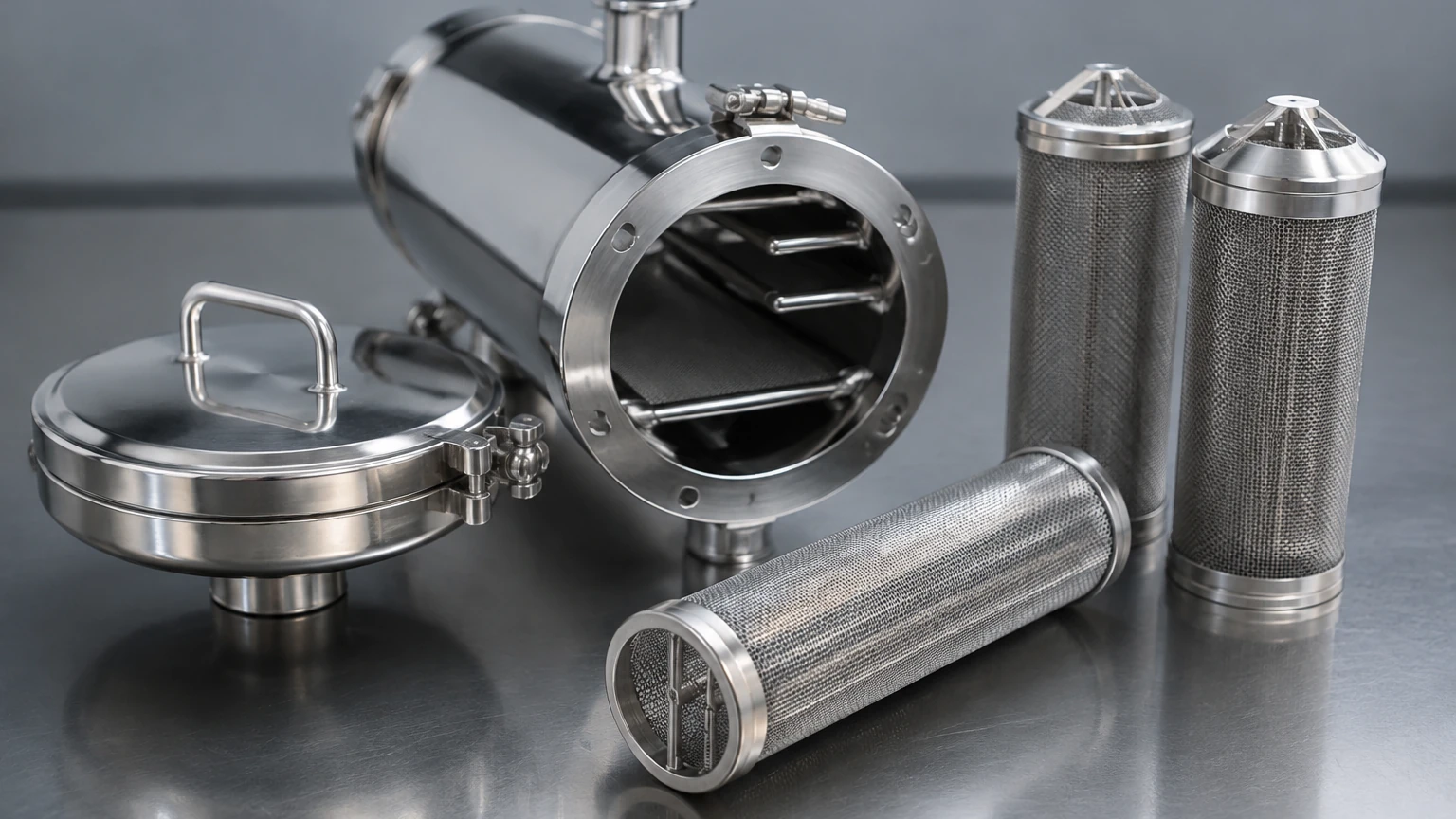
Magnetic rods are the fundamental building blocks. These consist of a core of permanent magnets encased in a sealed 304 or 316L stainless steel tube. The stainless steel casing protects the magnets from corrosion and mechanical impact while providing a smooth surface for cleaning. These rods can be arranged in a "grate" or "grid" configuration within a hopper or chute to filter dry powders or granules.
Inline Magnetic Traps
For liquid applications, such as hydraulic oils, coolants, or liquid food products, inline magnetic traps are used. These feature a pressure-vessel housing—usually made of precision-machined stainless steel—containing a series of magnetic rods. The fluid is forced to flow through the magnetic field, ensuring that even fine particles are diverted from the stream and held against the rods.
High-Gradient Filter Elements
In applications requiring the removal of extremely fine or weakly magnetic particles (such as work-hardened stainless steel fragments), high-gradient filters use a magnetic matrix. This matrix, often made of expanded metal or specialized wire mesh, becomes magnetized in the presence of an external magnetic field, creating thousands of high-gradient collection points.
Selection Criteria for Industrial Applications
When specifying a magnet filter for a new or existing system, engineers must evaluate several performance variables to avoid flow restriction or bypass issues.
Flow Velocity and Viscosity
The residence time—the duration the fluid stays within the magnetic field—is critical. If the flow velocity is too high, the hydrodynamic drag forces of the fluid may exceed the magnetic attraction force, causing captured particles to be "washed off" the magnet and re-introduced into the system. High-viscosity fluids, such as heavy oils or syrups, require stronger magnetic fields and slower flow rates to overcome the fluid's resistance to particle movement.
Particle Size and Concentration
Large particles are easily captured but can quickly saturate the magnetic surface. Conversely, sub-micron particles require high-intensity magnets (10,000+ Gauss) to be effectively pulled from the flow. Engineers must estimate the "dirt load" to determine the appropriate cleaning interval and the surface area required for the magnetic elements.
Chemical Compatibility
The housing and the magnet casing must be compatible with the process fluid. In the pharmaceutical and food industries, 316L stainless steel is the standard due to its corrosion resistance and ease of sterilization. For highly corrosive chemical environments, specialized coatings or higher-grade alloys may be necessary.
Integration with Stainless Steel Filtration Systems
One of the most effective uses of a magnet filter is as a pre-filter for high-precision mechanical filters, such as stainless steel wire mesh or pleated cartridges. In many industrial processes, ferrous particles make up a significant portion of the total contaminant load.
By installing a magnetic trap upstream of a 10-micron stainless steel cartridge, the majority of the metal debris is captured by the magnets. This prevents the mechanical filter from blinding prematurely, significantly extending its service life. This hybrid approach is particularly valuable in hydraulic systems and metal-working coolant loops, where fine metal shavings are the primary source of wear and tear.
Furthermore, magnetic filters provide a unique advantage: they do not have a fixed "pore size." While a mechanical filter might allow a long, thin needle-like particle to pass through if it is oriented correctly, a magnet filter will capture it regardless of orientation, provided it is ferrous.
Maintenance, Cleaning, and Safety Protocols
Unlike disposable cartridge filters, a magnet filter is a permanent asset that can be cleaned and reused indefinitely. However, maintenance is critical to performance.
Manual vs. Automatic Cleaning
* Manual Cleaning: Requires the operator to stop the flow, open the housing, and pull the magnetic rods out. In many designs, the rods are equipped with a "wiper" or a removable sleeve. When the magnetic core is pulled out of the sleeve, the captured metal falls off, making cleaning quick and hygienic.
* Automatic Cleaning: Used in high-volume or continuous-process industries. These systems use pneumatic or mechanical scrapers to periodically clean the magnets without interrupting the flow.
The Risk of Saturation
As a magnet filter captures more debris, the layer of particles builds up on the surface. This layer can eventually act as an insulator, reducing the effective magnetic field strength for the remaining fluid. More importantly, if the buildup becomes too thick, it can restrict the flow path, leading to a pressure drop or the aforementioned "wash-off" effect. Regular inspection intervals should be established based on the specific contamination levels of the process.
Safety Considerations
High-intensity magnets pose specific safety risks. They can interfere with pacemakers and other medical implants. They can also damage sensitive electronic equipment, such as hard drives or credit cards, if brought into close proximity. Maintenance personnel should be trained in the safe handling of high-strength magnetic assemblies.
Performance Expectations and Total Cost of Ownership
From a procurement perspective, the initial capital expenditure for a high-quality magnet filter is higher than that of a standard bag or cartridge filter housing. However, the total cost of ownership (TCO) is typically much lower over a 3-to-5-year period.
1. Zero Consumable Costs: There are no bags or cartridges to purchase, stock, or dispose of for the magnetic stage itself.
2. Reduced Waste: Because the collected material is simply metal, it can often be recycled, and there is no contaminated filter media to send to a landfill.
3. Downstream Protection: By removing sharp ferrous particles, magnet filters protect expensive downstream equipment like high-pressure pumps, valves, and precision nozzles from abrasive wear.
4. Energy Efficiency: Unlike mechanical filters, which create an increasing pressure drop as they clog, a well-sized magnet filter maintains a consistent and negligible pressure drop until it reaches extreme saturation.
Conclusion: Confirming Technical Requirements
Before selecting a magnet filter, engineers should confirm the following data points with their manufacturer:
* The specific Gauss rating required at the surface of the rod versus the center of the flow path.
* The maximum operating pressure and temperature of the housing.
* The flow rate and viscosity of the fluid to ensure sufficient residence time.
* The cleaning mechanism (manual vs. easy-clean vs. automatic) that best fits the operational workflow.
By integrating magnetic filtration into a broader strategy that includes high-performance stainless steel components, industrial facilities can achieve higher levels of purity and significantly reduce maintenance-related downtime. For detailed specifications on custom filtration housings and precision metal components that support these systems, visiting the Main Page provides a comprehensive look at the engineering capabilities available for demanding industrial environments.
