


Panel Filter
In the landscape of industrial filtration, the panel filter serves as a fundamental component for both air and liquid separation processes. Unlike standard commercial HVAC filters designed for light-duty residential or office use, industrial-grade panel filters—particularly those constructed from stainless steel and specialized metal alloys—are engineered to withstand extreme temperatures, corrosive chemicals, and high-pressure differentials. For engineers and procurement specialists, selecting the correct panel filter involves a deep understanding of media velocity, pressure drop, and material compatibility to ensure process integrity and long-term cost-efficiency.
As a specialized manufacturer of stainless steel filtration solutions, Kaifil provides precision-engineered panel filters designed for demanding industrial environments. These components are often the first line of defense in complex filtration trains or the primary barrier in heavy-duty extraction systems. This guide explores the technical specifications, engineering considerations, and application-specific criteria essential for integrating panel filters into industrial workflows.
Technical Architecture of Industrial Panel Filters
The performance of a panel filter is dictated by its structural design and the configuration of its internal media. In industrial settings, the "panel" refers to the flat, rectangular, or square geometry of the filter housing, which is designed to fit into standardized or custom-built holding frames.
Frame Construction
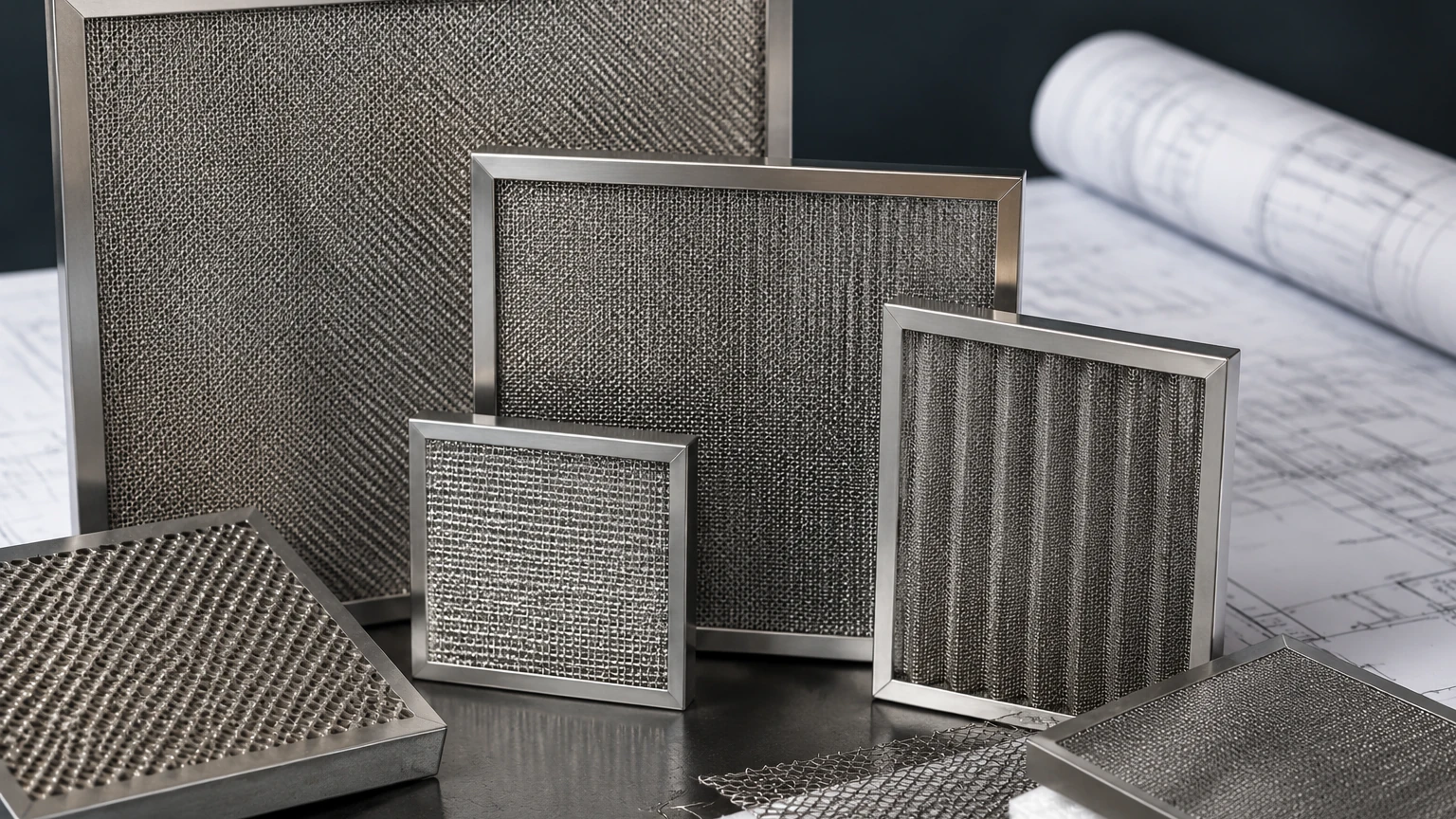
Industrial panel filters typically utilize a rigid U-channel or box frame. For applications involving moisture or chemical exposure, stainless steel (Grade 304 or 316L) is the preferred material. The frame must provide sufficient structural rigidity to prevent "bypass"—the phenomenon where unfiltered fluid or air escapes around the edges of the filter media due to frame warping under high pressure. High-performance panels often feature mitered corners and welded joints to ensure a leak-proof seal.
Filter Media Variations
The internal media is where the actual separation occurs. Depending on the required filtration accuracy, the media may consist of:
* Multi-layered Wire Mesh: Successive layers of stainless steel wire cloth, often graduated from coarse to fine, to provide depth filtration and high dust-holding capacity.
* Pleated Metal Mesh: By pleating the wire mesh, the effective surface area is significantly increased. This reduces the face velocity across the media, lowering the initial pressure drop and extending the service interval.
* Expanded Metal: Often used as a pre-filter or a support grid, expanded metal provides structural reinforcement for finer mesh layers, preventing media migration or collapse under heavy loads.
Engineering Considerations: Efficiency vs. Pressure Drop
One of the most critical challenges in filtration engineering is balancing filtration efficiency (the ability to capture specific particle sizes) with the pressure drop (the resistance the filter offers to the flow).
Resistance and Energy Consumption
A panel filter with a high resistance to flow requires more energy from pumps or fans to maintain the desired throughput. This resistance, known as differential pressure ($ΔP$), increases as the filter accumulates contaminants. Engineers must specify the "clean" pressure drop and the "terminal" pressure drop—the point at which the filter must be cleaned or replaced to prevent system failure or excessive energy costs.
Face Velocity and Laminar Flow
Face velocity refers to the speed at which the fluid or air approaches the face of the filter. For optimal efficiency, especially in grease extraction or moisture separation, the velocity must be maintained within a specific range. If the velocity is too high, particles may be "pulled through" the media; if it is too low, impingement-based filtration (where particles hit and stick to the mesh) may lose effectiveness.
Material Selection for Harsh Environments
In B2B industrial sectors, such as chemical processing or pharmaceutical manufacturing, the material of the panel filter is as important as its micron rating. Standard aluminum or galvanized steel filters often fail prematurely due to oxidation or chemical degradation.
Stainless Steel 304 vs. 316L
* Type 304: Suitable for most general industrial applications, including food and beverage processing, where high-temperature resistance and basic corrosion protection are required.
* Type 316L: Contains molybdenum, providing superior resistance to chlorides and acids. This is the standard for marine environments, pharmaceutical cleanrooms, and aggressive chemical filtration.
Thermal Stability
Metal panel filters are uniquely suited for high-temperature applications, such as oven exhaust systems or steam filtration, where synthetic or paper-based filters would incinerate. Stainless steel panels can typically operate in temperatures exceeding 500°C (932°F), depending on the gasket materials used.
Key Applications in Industrial Sectors
Panel filters are utilized across a broad spectrum of industries, each with unique performance requirements. Understanding these applications helps in selecting the right configuration from the Main Page of a technical provider.
1. Food and Beverage Processing
In commercial kitchens and industrial food production, stainless steel panel filters are used for grease extraction. The metal mesh acts as a flame barrier and a coalescing surface for oil mist. Because these environments require frequent sanitization, the filters must be able to withstand caustic cleaning agents and high-pressure wash-downs.
2. Chemical and Petrochemical
Panel filters serve as intake filters for compressors and turbines, protecting sensitive machinery from airborne particulates. They are also used in fume scrubbing systems where they capture droplets or solid particles from process gas streams.
3. Pharmaceutical and Cleanrooms
In these highly regulated environments, metal panel filters often serve as pre-filters for HEPA systems. By capturing larger particulates (5–10 microns), they extend the life of the more expensive final-stage filters. The non-shedding nature of stainless steel wire mesh is critical here to prevent media migration from contaminating the cleanroom.
4. Hydraulic and Lubrication Systems
While many hydraulic filters are cylindrical, panel-style breathers are used on large reservoirs to prevent atmospheric contaminants from entering the system as fluid levels fluctuate. These panels must be robust enough to handle the vibration and pressure pulses common in heavy machinery.
Maintenance, Cleaning, and Total Cost of Ownership (TCO)
A primary advantage of stainless steel panel filters over disposable alternatives is their cleanability. While the initial capital expenditure (CAPEX) for a metal panel filter is higher, the total cost of ownership is often much lower due to the elimination of recurring replacement costs and disposal fees.
Cleaning Protocols
To maintain performance, industrial panel filters should be cleaned according to a scheduled maintenance cycle or when the terminal pressure drop is reached. Common cleaning methods include:
* Ultrasonic Cleaning: High-frequency sound waves create cavitation bubbles that dislodge fine particles from deep within the mesh layers.
* Steam Cleaning: Effective for removing organic fats, oils, and greases.
* Chemical Soaking: Uses specialized solvents or alkaline solutions to dissolve stubborn scale or chemical deposits. It is vital to ensure the cleaning agent is compatible with the filter's alloy.
When to Replace
Despite their durability, metal panel filters are not infinite. Permanent deformation of the mesh, chemical pitting, or frame damage that allows bypass are indicators that the filter has reached the end of its service life. Regular inspection of the gaskets and seals is also necessary, as these components often wear out before the metal media itself.
Customization and OEM Integration
Every industrial facility has unique spatial and performance constraints. Off-the-shelf panel filters rarely meet the exact needs of specialized machinery. Customization options typically include:
* Variable Thickness: Panels can range from 10mm to over 100mm in depth to fit existing housing tracks.
* Layer Configuration: Engineers can specify the exact number and density of mesh layers to achieve a specific micron rating while managing pressure drop.
* Specialty Coatings: In some cases, coatings such as PTFE can be applied to the mesh to improve cake release or enhance chemical resistance.
For engineers developing new equipment, partnering with an OEM manufacturer like Kaifil allows for the integration of custom filtration components that are optimized for the specific flow rates and contaminant profiles of the intended application. This collaborative approach ensures that the filtration system does not become a bottleneck in the production process.
Conclusion: Making an Informed Selection
Selecting a panel filter for industrial use is a technical decision that impacts the efficiency, safety, and operational cost of a facility. By prioritizing high-quality materials like stainless steel and focusing on engineering metrics such as differential pressure and face velocity, procurement teams can secure filtration solutions that offer reliable performance in the most demanding conditions. For detailed technical specifications and to explore custom filtration designs, professionals are encouraged to Review product options and application support to find the optimal balance of durability and precision.
