


Mesh Filter Bags
In industrial liquid filtration, the selection of the correct media is a critical engineering decision that directly impacts process efficiency, product purity, and operational costs. Mesh filter bags represent a primary solution for surface filtration, designed to capture solids larger than the specific pore size of the mesh. Unlike depth filtration media, which trap particles within a thick matrix, mesh filter bags utilize a precise, two-dimensional structure to provide consistent and repeatable particle retention.
For engineers and procurement professionals, understanding the technical nuances of mesh filter bags—ranging from material compatibility and weave patterns to structural design and pressure drop dynamics—is essential for optimizing filtration systems. As a specialized manufacturer, Kaifil provides high-performance filtration components that address these technical requirements across diverse industrial sectors. For a comprehensive overview of available solutions, technical professionals can visit the Main Page to review specific product capabilities.
Understanding the Principles of Surface Filtration
Mesh filter bags operate on the principle of surface filtration. The media consists of a single-layer or multi-layer woven structure where the aperture size is precisely controlled during the manufacturing process. When a contaminated fluid passes through the mesh, particles larger than the mesh openings are mechanically strained and retained on the upstream side of the bag.
This mechanism offers several distinct advantages in industrial settings:
1. Fixed Pore Size: Unlike felt or non-woven media, which may have a range of pore sizes, woven mesh provides a definitive "absolute" or "nominal" rating. This ensures that no particles larger than the specified micron rating pass through the media, provided the bag remains intact.
2. High Flow Rates: The open area of a mesh filter bag is typically higher than that of depth media. This results in lower initial pressure drops and allows for higher flow velocities within a given housing size.
3. Cleanability: Especially in the case of stainless steel mesh filter bags, the surface-loading nature of the media allows for effective cleaning and reuse, which is a significant factor in reducing the total cost of ownership.
Material Selection: Stainless Steel vs. Synthetic Polymers
The performance of mesh filter bags is heavily dictated by the material of construction. Selection must be based on chemical compatibility, operating temperature, and the physical nature of the slurry.
Stainless Steel Mesh (304, 316, 316L)
Stainless steel is the material of choice for demanding industrial environments. It offers exceptional mechanical strength and resistance to high temperatures (often exceeding 250°C depending on the gasket material). In chemical processing, 316L stainless steel is preferred for its superior resistance to pitting and corrosion in the presence of chlorides or acidic solutions. Stainless steel mesh filter bags are rigid, preventing media migration and ensuring that the pore structure does not deform under high differential pressure.
Synthetic Meshes (Nylon, Polyester, Polypropylene)
Synthetic mesh filter bags, such as Nylon Monofilament (NMO), are widely used in applications where metal contact must be avoided or where cost-sensitivity is a primary concern. Nylon is abrasion-resistant and compatible with many solvents, though it has limited resistance to strong acids. Polyester (PEM) offers better acid resistance and is often used in food and beverage applications due to its stability. However, synthetic meshes are limited by lower temperature thresholds and are generally considered disposable rather than cleanable in high-load applications.
Engineering Specifications: Weave Types and Micron Ratings
The geometry of the weave determines both the filtration accuracy and the structural integrity of the mesh filter bags. Engineers must specify the weave type based on the particle morphology and the required flow characteristics.
Plain Weave
The most common weave, where each warp wire crosses over and under each shute wire. This provides a simple, square opening. It is ideal for general-purpose filtration where high flow and moderate precision are required.
Twill Weave
In a twill weave, wires cross over two and under two. This allows for the use of heavier wires in a given mesh count, resulting in a stronger mesh suitable for high-pressure applications or larger bag dimensions.
Dutch Weave (Plain and Twill)
Dutch weaves utilize different diameters for warp and shute wires, resulting in a dense, compact mesh. This weave type is used for fine filtration (often down to 10-25 microns) while maintaining high mechanical strength. The "tortuous path" created by the Dutch weave provides better retention of irregularly shaped particles compared to standard square mesh.
Micron Ratings and Efficiency
Mesh filter bags are typically rated from 1 micron up to 2000 microns. It is important to distinguish between nominal and absolute ratings. Most synthetic mesh bags are nominally rated, meaning they trap a high percentage of particles at the rated size. Stainless steel mesh can often achieve absolute ratings, providing a guaranteed barrier for critical processes.
Design Considerations for Custom Industrial Applications
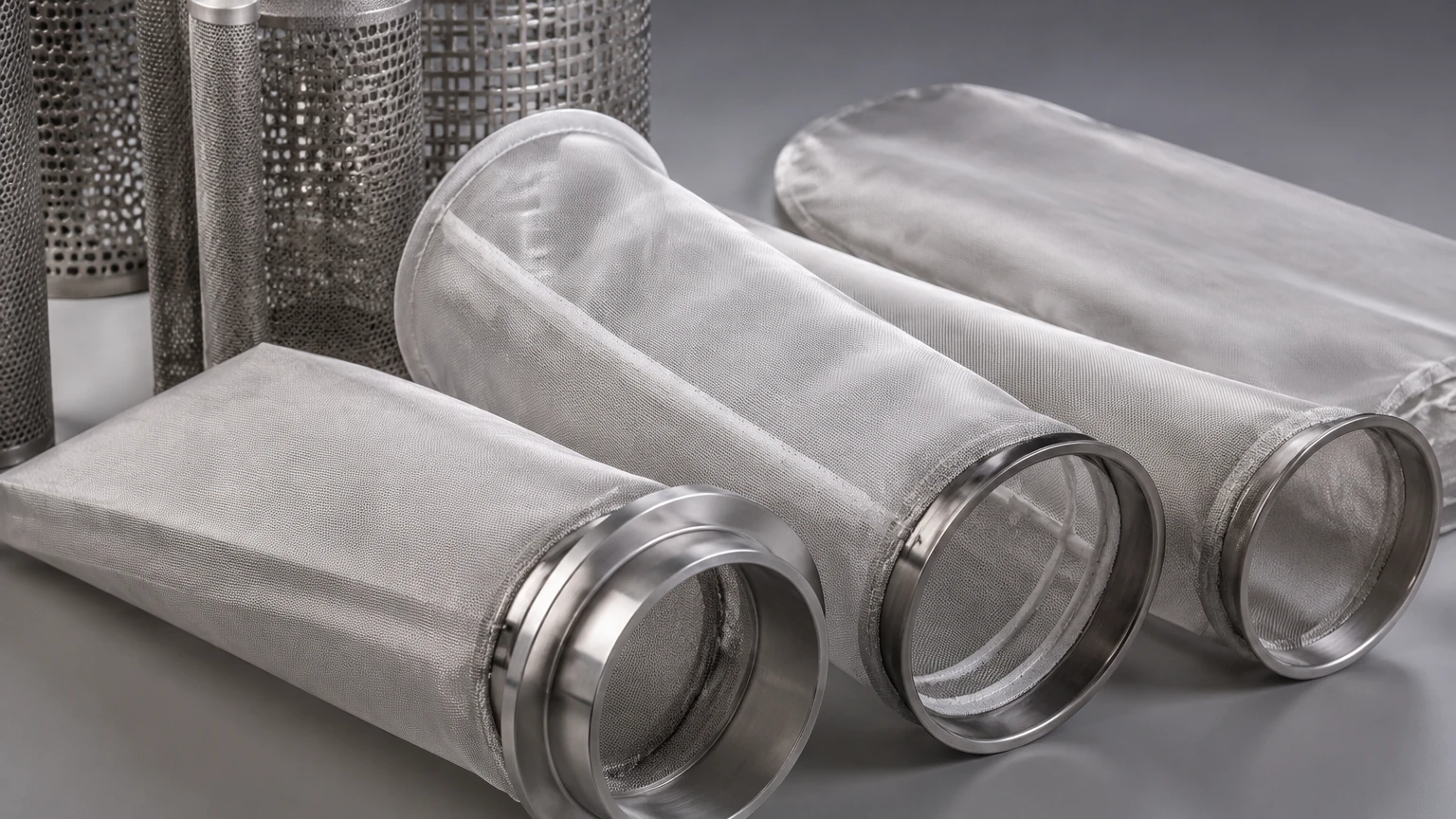
A filter bag is only as effective as its seal within the housing. Bypass—where unfiltered liquid escapes around the top of the bag—is a common failure point in industrial filtration. Customization of the bag’s structural components is necessary to ensure a leak-proof fit.
Ring and Flange Types
* Steel/Stainless Steel Rings: These are sewn into the top of the bag and rely on the pressure of the housing lid to create a seal. They are robust and suitable for high-temperature applications.
* Plastic Flanges (Polypropylene or Polyester): These often feature a "V" shape or a specialized profile that snaps into the housing seat. Plastic flanges provide a more positive seal and are often easier to install and remove.
* Drawstring Closures: Used in open-system filtration where the bag is tied over a pipe or outlet. These are not suitable for pressurized housings.
Seam Construction
For synthetic mesh filter bags, seams can be sewn or thermally welded. Welded seams eliminate the needle holes found in sewn bags, which can be a source of bypass for fine particles. For stainless steel mesh filter bags, seams are typically welded using advanced resistance welding or plasma welding techniques to ensure the joint is as strong as the parent mesh and free from contaminants.
Evaluating Performance and Operational Efficiency
When integrating mesh filter bags into a process, engineers must evaluate three primary performance metrics: Initial Pressure Drop, Dirt-Holding Capacity, and Flow Velocity.
Initial Pressure Drop (ΔP)
The initial ΔP is the resistance to flow caused by the clean filter bag and the housing. A high initial ΔP reduces the available operating range before the bag must be changed. Mesh bags, due to their high open area, generally offer a lower initial ΔP than felt bags. Factors influencing this include fluid viscosity, flow rate, and the percentage of open area in the mesh.
Dirt-Holding Capacity
Because mesh filter bags are surface filters, their dirt-holding capacity is lower than that of depth filters. Once the surface of the mesh is covered with a "filter cake" of solids, the differential pressure will rise rapidly. However, in many applications, the filter cake itself acts as a secondary filtration layer, often improving the clarity of the effluent until the terminal pressure drop is reached.
Flow Velocity
Exceeding the recommended flow velocity can cause particle breakthrough or structural damage to the mesh. For most standard #2 size bags, a flow rate of 80-120 GPM (gallons per minute) for water-like viscosities is a standard baseline, but this must be derated for higher viscosities or finer micron ratings.
Maintenance, Cleaning, and Replacement Protocols
The decision to clean or replace mesh filter bags depends on the material and the nature of the contaminants.
Monitoring Differential Pressure
All filtration systems should be equipped with upstream and downstream pressure gauges. A common industry standard is to change or clean the bag when the differential pressure reaches 15-20 PSI (1.0-1.4 bar). Operating beyond this point risks bag rupture or the forcing of contaminants through the mesh pores.
Cleaning Procedures for Stainless Steel Mesh
One of the primary benefits of stainless steel mesh filter bags is their reusability. Cleaning methods include:
* Backwashing: Reversing the flow of clean fluid through the mesh to dislodge particles.
* Ultrasonic Cleaning: Using high-frequency sound waves in a solvent bath to remove fine particles trapped in the weave.
* Chemical Cleaning: Using compatible acids or bases to dissolve organic or mineral scale.
It is vital to inspect the mesh for signs of "blinding" (permanent clogging) or mechanical fatigue after each cleaning cycle. If the initial pressure drop after cleaning is significantly higher than that of a new bag, the media has reached the end of its functional life.
Total Cost of Ownership and Procurement Strategy
When purchasing mesh filter bags, focusing solely on the unit price can be misleading. The Total Cost of Ownership (TCO) includes the purchase price, shipping, installation labor, downtime for changes, disposal costs, and—in the case of reusable bags—the cost of cleaning.
For high-volume processes or those involving expensive fluids, stainless steel mesh filter bags often provide a lower TCO over time despite a higher initial investment. Their durability reduces the frequency of procurement cycles and minimizes the waste stream associated with disposable synthetic bags.
Engineers should work closely with manufacturers to confirm the following before procurement:
* Dimensional Accuracy: Ensure the bag length and ring diameter match the specific housing model (e.g., Size #1, #2, #3, or #4).
* Certification Requirements: For food, beverage, or pharmaceutical applications, ensure the materials are FDA-compliant or meet specific industry standards.
* Customization Options: If standard sizes do not meet the flow requirements, custom-engineered bag geometries may be necessary to increase surface area.
Kaifil specializes in providing these technical solutions, ensuring that each filtration component is engineered for the specific rigors of its intended environment. By selecting the appropriate mesh material, weave, and structural design, industrial operators can achieve a balance of high-precision filtration and cost-effective performance. For further technical specifications and to explore custom filtration options, visit the Main Page to connect with our engineering team.
