


Mesh Sizes for Strainers
In industrial fluid handling, the selection of appropriate mesh sizes for strainers is a critical engineering decision that directly impacts the efficiency, safety, and longevity of downstream equipment. A strainer serves as the first line of defense, removing unwanted solids from liquids or gases to protect sensitive components such as pumps, valves, meters, and spray nozzles. However, selecting a mesh that is too coarse may allow damaging particles to pass through, while a mesh that is too fine can lead to excessive pressure drops and frequent maintenance shutdowns.
Understanding the technical nuances of mesh measurement, the relationship between wire diameter and open area, and the specific requirements of various industrial applications is essential for any engineering or procurement team. This guide provides a technical overview of how to evaluate and specify mesh sizes for industrial strainers.
Fundamentals of Mesh and Micron Ratings
The terms "mesh" and "micron" are the primary units used to describe the filtration capability of a strainer. While they are related, they represent different ways of measuring the openings in a wire cloth or screen.
Defining Mesh Count
Mesh count refers to the number of openings per linear inch of the wire cloth, measured from the center of one wire to the center of the next. For example, a 20-mesh screen has 20 openings per inch in both the horizontal and vertical directions. As the mesh number increases, the number of openings increases, which generally means the size of the openings decreases.
Defining Micron Ratings
A micron (micrometer) is a unit of length equal to one-thousandth of a millimeter (0.001 mm). In filtration, the micron rating indicates the size of the smallest particle that the mesh is designed to retain. Unlike mesh count, which describes the physical construction of the screen, the micron rating describes the performance outcome.
The Relationship Between Mesh and Micron
Because mesh count depends on the number of wires per inch, the actual size of the opening (the micron rating) is also influenced by the diameter of the wire used. Two different 100-mesh screens can have different micron ratings if they use different wire gauges. Engineers must consult technical charts that correlate mesh count, wire diameter, and opening size to ensure the specified strainer meets the required filtration threshold.
Engineering Factors Influencing Mesh Selection
Selecting the correct mesh sizes for strainers requires a balance between filtration efficiency and system hydraulics. Engineers must consider several variables beyond simple particle size.
Particle Size and Distribution
The primary goal of a strainer is to remove particles of a specific size. As a general rule of engineering, the strainer opening should be approximately one-half to one-third the size of the smallest particle that needs to be removed. If the goal is to protect a nozzle with a 1/8-inch orifice, a strainer with openings significantly smaller than 1/8-inch is required to prevent clogging.
Nature of the Contaminant
The shape and consistency of the debris play a role in mesh selection. Rigid, spherical particles are easily trapped by standard square-weave mesh. However, fibrous materials or elongated particles may "needle" through mesh openings that are technically smaller than the particle's length. In such cases, multi-layered sintered mesh or specialized weave patterns may be necessary to provide more effective entrapment.
Flow Rate and Velocity
High flow rates increase the velocity of the fluid passing through the mesh. High-velocity fluids can force soft or deformable particles through the mesh openings, a phenomenon known as "extrusion." Additionally, high velocity increases the mechanical stress on the wire cloth, necessitating a heavier wire diameter or reinforced support structures within the strainer basket.
The Relationship Between Mesh Size and Pressure Drop
One of the most critical considerations in strainer design is the clean pressure drop ($ΔP$). Every strainer introduces some resistance to flow. As the mesh size becomes finer, the resistance increases.
Calculating Allowable Pressure Drop
In many industrial systems, the maximum allowable pressure drop for a clean strainer is typically between 2 psi and 5 psi. If the mesh is too fine for the application, the system may reach its maximum allowable pressure drop almost immediately after startup, leading to cavitation in pumps or insufficient flow to downstream processes.
The Impact of Fluid Viscosity
Viscosity significantly affects pressure drop. Highly viscous fluids, such as heavy oils or resins, struggle to pass through fine mesh. For these applications, engineers often specify coarser mesh sizes or increase the total surface area of the strainer (using pleated designs or larger housings) to compensate for the flow resistance. For more information on how different designs accommodate these variables, engineers can Review product options and application support on the Kaifil site.
Material Selection for Industrial Strainer Mesh
The durability of the mesh is as important as its size. In industrial environments, the mesh must withstand chemical corrosion, thermal cycling, and mechanical wear.
Stainless Steel 304 and 316
Stainless steel is the standard material for industrial filtration due to its strength and resistance to oxidation.
* Type 304: Suitable for general-purpose applications, providing good corrosion resistance at a lower cost.
* Type 316: Contains molybdenum, which provides superior resistance to chlorides and acids. This is the preferred choice for chemical processing, pharmaceutical, and marine environments.
Specialized Alloys
For extreme environments, such as high-temperature petrochemical processing or highly acidic chemical lines, specialized alloys like Monel, Hastelloy, or Inconel may be used. These materials ensure that the mesh maintains its structural integrity and precise opening size even under aggressive conditions.
Calculating Percentage of Open Area
The "Open Area" of a mesh is the ratio of the area of the openings to the total area of the screen, expressed as a percentage. This is a vital metric for determining the capacity of the strainer.
The Formula for Open Area
The percentage of open area ($OA$) can be calculated using the following formula:
$OA = (O / (O + W))^2 \times 100$
Where:
* $O$ = Size of the opening
* $W$ = Diameter of the wire
Why Open Area Matters
A higher percentage of open area generally results in a lower pressure drop and a longer service life between cleanings. However, increasing the open area usually requires using thinner wires, which reduces the mechanical strength of the mesh. Engineers must find the "sweet spot" where the mesh is fine enough to filter, open enough to allow flow, and thick enough to withstand the system's operating pressure.
Industry-Specific Mesh Requirements
Different sectors have established standards for mesh sizes based on common contaminants and equipment protection needs.
Water Treatment and Cooling Towers
In these applications, strainers are used to remove sand, scale, and organic debris. Typical mesh sizes range from 20 to 100 mesh. If the water is used for fine spray nozzles in cooling towers, a finer 80 or 100 mesh is often specified.
Chemical and Petrochemical Processing
These industries often deal with corrosive fluids and high temperatures. Precision is paramount here, with mesh sizes often ranging from 40 to 400 mesh. Sintered wire mesh is frequently used in these sectors because the sintering process bonds the wires together, ensuring the mesh size does not shift under high pressure.
Food and Beverage
Sanitary strainers in the food industry must remove pulp, seeds, or foreign objects while remaining easy to clean. Stainless steel 316L is standard, and mesh sizes are selected based on the specific product viscosity. Common sizes range from 10 mesh for bulk solids to 200 mesh for fine clarification.
Maintenance, Cleaning, and Replacement Cycles
The operational cost of a strainer is largely determined by its maintenance requirements. The mesh size directly influences how quickly the strainer will "blind" or clog.
Monitoring Differential Pressure
Industrial systems should be equipped with pressure gauges upstream and downstream of the strainer. A significant increase in differential pressure indicates that the mesh is becoming clogged and requires cleaning. Standard practice is to clean or replace the strainer element when the pressure drop reaches 10-15 psi above the clean pressure drop.
Cleaning Methods
* Backwashing: Some automated systems use a reverse flow of fluid to dislodge particles from the mesh.
* Manual Cleaning: Baskets or cartridges are removed and cleaned using ultrasonic baths, high-pressure air, or chemical solvents, depending on the contaminant.
* Replacement: In applications with extremely fine mesh or delicate contaminants, the mesh may be considered a consumable item and replaced entirely to ensure system integrity.
Customization and OEM Filtration Solutions
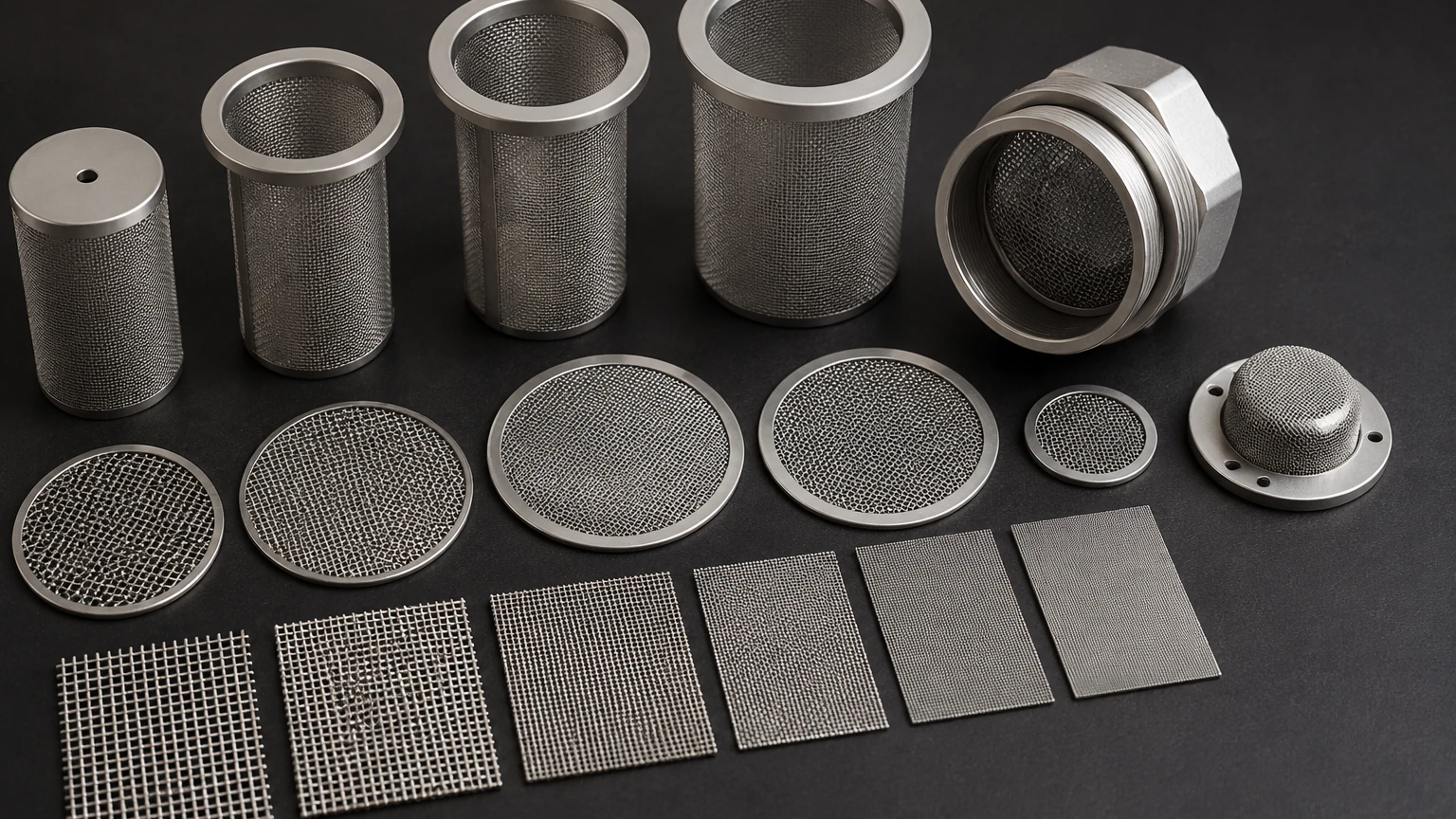
Standard off-the-shelf mesh sizes for strainers do not always meet the rigorous demands of specialized industrial processes. Customization allows engineers to specify the exact combination of mesh count, wire diameter, and weave type to optimize performance.
Custom Weave Patterns
While plain square weave is common, other patterns like Dutch weave or Twilled weave offer different benefits. Dutch weaves, for instance, provide a much finer filtration grade and higher mechanical strength, making them ideal for high-pressure hydraulic applications.
Multi-Layer Sintered Mesh
For applications requiring both high filtration accuracy and extreme durability, multiple layers of wire mesh can be sintered together. This creates a composite material that combines a fine filtration layer with thicker, supportive drainage layers. This construction prevents the fine mesh from deforming under pressure and significantly extends the service life of the strainer element.
When evaluating filtration requirements, it is essential to work with a manufacturer that understands the technical boundaries of metal filtration. For detailed specifications on custom stainless steel cartridges and wire mesh components, technical teams should visit the Main Page to explore engineering resources and manufacturing capabilities.
Conclusion
Selecting the right mesh sizes for strainers is a multifaceted process that involves more than just picking a hole size. It requires a deep understanding of fluid dynamics, material science, and the specific mechanical requirements of the industrial system. By carefully considering the mesh count, micron rating, open area, and material grade, engineers can ensure their filtration systems provide optimal protection with minimal operational overhead. Whether for protecting a high-pressure pump in a chemical plant or ensuring the purity of a pharmaceutical batch, the precision of the strainer mesh is fundamental to industrial success.
