


Metal Filters
In industrial processing, the selection of filtration media is a critical engineering decision that directly impacts operational efficiency, product purity, and long-term maintenance costs. Metal filters represent a specialized category of filtration solutions designed to withstand extreme environments where polymer, paper, or glass fiber media would fail. From high-pressure hydraulic systems to corrosive chemical reactors, metal filters provide the structural integrity and thermal stability required for demanding B2B applications.
As a professional manufacturer, Kaifil specializes in custom stainless steel filtration solutions, emphasizing precision engineering and material durability. Understanding the technical nuances of metal filters—ranging from material science to pore structure geometry—is essential for engineers and purchasing teams tasked with optimizing industrial fluid and gas systems.
Material Science: Selecting the Right Alloy for Metal Filters
The performance of metal filters begins with the alloy. Unlike disposable media, metal filters are chosen for their specific resistance to chemical attack and thermal degradation. The most common materials utilized in industrial filtration include various grades of stainless steel and high-performance alloys.
304 and 316L Stainless Steel
Stainless steel is the industry standard for most metal filters. Grade 304 offers excellent mechanical properties and basic corrosion resistance, suitable for food and beverage or general water treatment. However, for more aggressive environments, 316L stainless steel is preferred. The addition of molybdenum and a lower carbon content enhances resistance to pitting and crevice corrosion, particularly in chloride-rich environments or high-temperature steam applications.
Specialty Alloys
In extreme cases, such as highly acidic chemical processing or aerospace applications, specialty alloys like Hastelloy, Monel, or Inconel may be required. These materials maintain their structural integrity at temperatures exceeding 600°C and offer superior resistance to oxidative and reductive chemicals. Selecting the correct material ensures that the filter does not contribute to downstream contamination through media migration or corrosion byproducts.
Structural Variations in Metal Filter Media
Metal filters are not a monolithic product category; they are engineered in various structures to meet specific flow and retention requirements. The geometry of the filter media determines its permeability, dirt-holding capacity, and cleanability.
Woven Wire Mesh
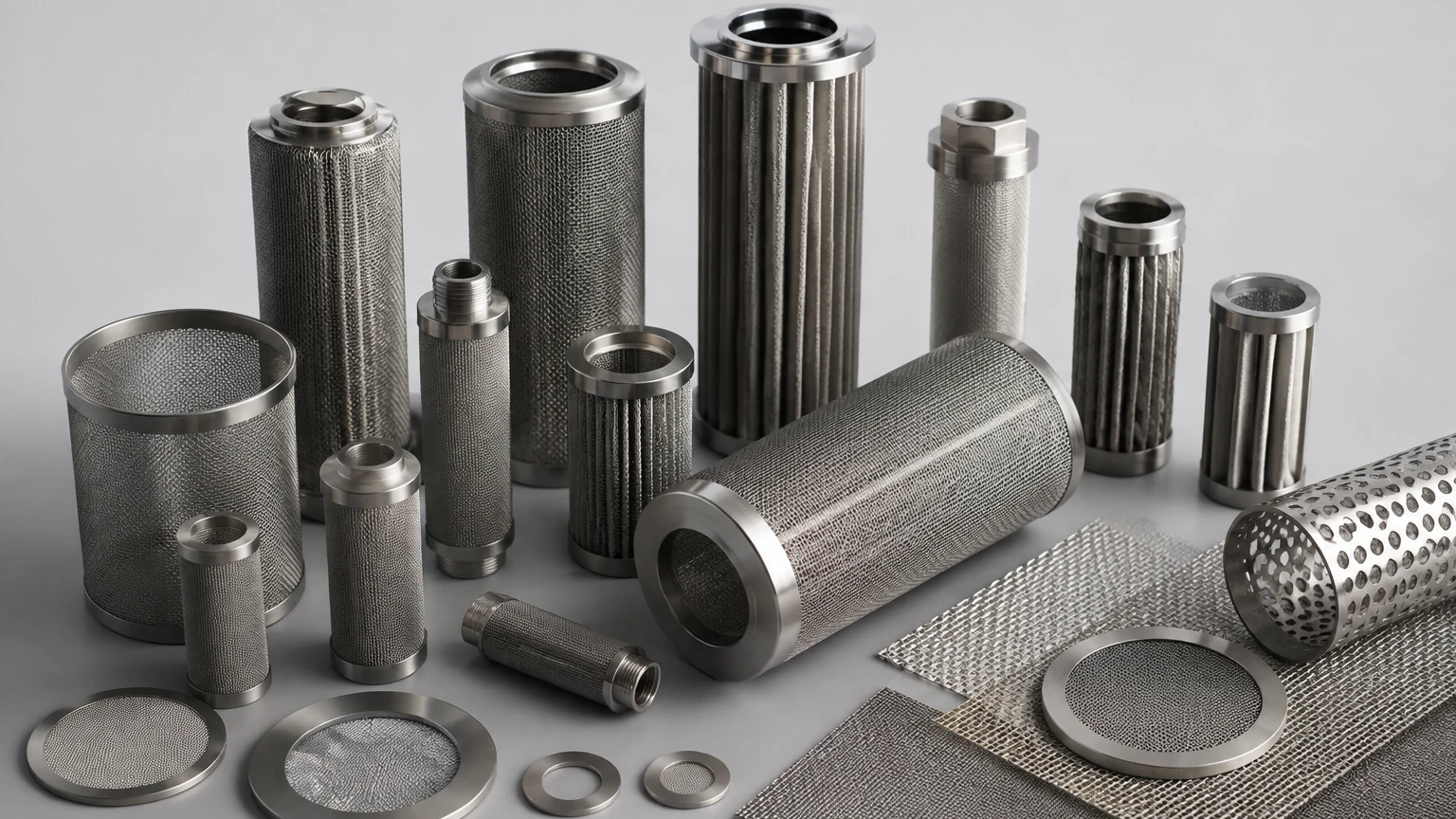
Woven wire mesh is the most versatile form of metal filter media. It is produced by weaving individual metal wires into precise patterns, such as plain weave, twilled weave, or Dutch weave. Dutch weaves, in particular, provide a dense, multi-layered structure that offers high mechanical strength and fine filtration ratings. Wire mesh filters are highly valued for their surface filtration characteristics, making them easy to clean via backwashing.
Sintered Metal Media
Sintering is a process where metal powder or multiple layers of wire mesh are bonded together using heat and pressure without melting the base material. This creates a rigid, porous structure with high mechanical strength. Sintered metal filters are ideal for high-pressure applications where the media must resist deformation under heavy differential pressure. They provide "depth filtration," allowing particles to be trapped within the tortuous path of the porous matrix.
Wedge Wire and Perforated Metal
For heavy-duty applications involving high solids loading, wedge wire (V-wire) and perforated metal plates are used. These structures are characterized by their extreme robustness. Wedge wire filters are particularly effective in self-cleaning systems because the V-shaped profile reduces the risk of particles becoming wedged in the openings.
Performance Metrics: Micron Ratings and Pressure Drop
When evaluating metal filters, engineers must balance filtration efficiency with system throughput. Two primary metrics define this balance: the micron rating and the pressure drop (ΔP).
Absolute vs. Nominal Micron Ratings
It is vital to distinguish between absolute and nominal ratings. A nominal rating indicates the filter's ability to retain a majority of particles of a certain size, but it does not guarantee 100% retention. An absolute rating, often verified through a Bubble Point Test, indicates the diameter of the largest spherical particle that can pass through the filter. For critical applications in the pharmaceutical or semiconductor industries, absolute-rated metal filters are mandatory to ensure process consistency.
Differential Pressure and Flow Resistance
Every filter introduces a degree of resistance to the flow. The initial pressure drop across a clean metal filter depends on the media's permeability, the fluid's viscosity, and the flow velocity. As the filter accumulates contaminants, the differential pressure increases. Engineers must design systems with sufficient headroom to allow the filter to operate effectively until it reaches its terminal pressure drop, at which point cleaning or replacement is required.
Customization and OEM Engineering Support
Standard off-the-shelf filtration components often fail to meet the unique spatial or performance constraints of specialized industrial machinery. This is where customized manufacturing becomes essential. Kaifil works closely with global customers to develop tailored filtration components that integrate seamlessly into existing hardware.
Customization options include:
* Dimensional Adjustments: Tailoring the length, diameter, and wall thickness of filter cartridges to fit specific housings.
* End Fitting Integration: Providing various connection types, such as NPT threads, flanges, or sanitary tri-clamp fittings, to ensure leak-proof installation.
* Multi-Layer Composites: Combining different types of mesh or sintered layers to achieve a specific balance of strength and fine filtration.
For technical teams looking to explore these specialized configurations, the Main Page provides a comprehensive overview of the manufacturing capabilities and product categories available for custom development.
Cleaning Protocols and Lifecycle Management
One of the primary economic advantages of metal filters is their reusability. While the initial capital expenditure (CapEx) for a stainless steel filter is higher than that of a disposable polymer cartridge, the total cost of ownership (TCO) is often significantly lower due to the extended service life.
Cleaning Methods
To maintain optimal performance, metal filters must be cleaned periodically. Common industrial cleaning methods include:
* Ultrasonic Cleaning: Using high-frequency sound waves in a liquid bath to dislodge fine particles from deep within the pore structure.
* Backpulsing/Backwashing: Reversing the flow of fluid through the filter to push contaminants off the surface.
* Chemical Cleaning: Using acids, alkalis, or solvents to dissolve organic or inorganic scaling, provided the chemicals are compatible with the filter alloy.
* Burn-off/Pyrolysis: Heating the filter in a controlled atmosphere to carbonize organic contaminants, which are then removed through ultrasonic cleaning.
Replacement Cycles
Despite their durability, metal filters are not infinite. Over time, repeated cleaning and mechanical stress can lead to work hardening or fatigue. Engineers should monitor the "clean pressure drop" after each cleaning cycle; if the baseline pressure drop remains significantly higher than the original specification, it indicates that the media is permanently fouled or blinded, and a replacement is necessary.
Application-Specific Selection Criteria
The optimal metal filter configuration depends heavily on the specific industry application. Each sector presents unique challenges that dictate material and structure choices.
Chemical and Petrochemical Processing
In these environments, filters must resist aggressive solvents and high temperatures. Sintered metal cartridges are often used for catalyst recovery, where the filter must withstand high differential pressures and provide absolute retention of expensive catalyst particles.
Food and Beverage Industry
Filtration in this sector requires compliance with hygiene standards. Stainless steel 316L is the material of choice due to its smooth surface finish and resistance to Clean-in-Place (CIP) chemicals. Metal filters are commonly used for steam filtration, carbonation, and the removal of particulates from edible oils.
Hydraulic and Lubrication Systems
Metal filters protect sensitive valves and pumps from wear-inducing particles. Wire mesh elements are frequently used in suction strainers and high-pressure return line filters to ensure the longevity of hydraulic components in construction and manufacturing equipment.
Conclusion: Technical Validation Before Procurement
Before finalizing a purchase order for metal filters, technical professionals should confirm several key parameters with their manufacturer. These include the maximum operating temperature, the required flow rate at a specific viscosity, and the chemical composition of the process fluid. Furthermore, confirming the manufacturing standards—such as ISO or specific industry certifications—ensures that the filters will perform reliably in demanding environments.
By focusing on high-quality materials and precision manufacturing, Kaifil provides the dependable filtration components necessary for modern industrial success. Whether the goal is to protect downstream equipment, ensure product purity, or reduce waste through reusable media, metal filters offer a robust and cost-effective solution for complex filtration challenges.
