


Nitrogen Gas Filter
Nitrogen gas is a fundamental utility in modern industrial processes, serving critical roles in inerting, blanketing, purging, and pressure-testing. However, the efficacy of nitrogen is entirely dependent on its purity at the point of use. Contaminants such as pipe scale, moisture, oil aerosols, and fine particulates can compromise sensitive equipment, contaminate chemical batches, or spoil food products. A high-performance nitrogen gas filter is the primary line of defense in maintaining system integrity and operational safety.
For engineers and procurement professionals, selecting the correct filtration solution requires a deep understanding of gas dynamics, material compatibility, and the specific demands of the application environment. As a specialist in custom stainless steel filtration, Kaifil provides the technical expertise necessary to navigate these complexities, ensuring that every filtration component meets rigorous industrial standards. To explore our full range of capabilities, you may visit our Main Page for detailed product specifications.
The Importance of Nitrogen Purity in Industrial Applications
Nitrogen is often produced on-site via Pressure Swing Adsorption (PSA) or membrane systems, or delivered in liquid form and vaporized. Regardless of the source, contaminants are frequently introduced during generation or transport through distribution piping.
Protecting Downstream Equipment
In pneumatic systems and analytical instrumentation, even microscopic particles can cause mechanical wear or blockages in precision orifices. High-velocity particles in nitrogen streams can act like sandblasting media, eroding valve seats and seals over time. A robust nitrogen gas filter prevents this mechanical degradation, extending the mean time between failures (MTBF) for expensive downstream assets.
Ensuring Product Quality
In the food and beverage industry, nitrogen is used for Modified Atmosphere Packaging (MAP) to displace oxygen and prevent oxidation. If the nitrogen contains microbial contaminants or oil carryover from compressors, the shelf life of the product is significantly reduced. Similarly, in pharmaceutical manufacturing, nitrogen used for tank blanketing must be sterile and free of pyrogens to maintain the purity of active pharmaceutical ingredients (APIs).
Technical Engineering Considerations for Nitrogen Filtration
Selecting a nitrogen gas filter is not a matter of simply matching pipe sizes. Several engineering parameters must be evaluated to ensure the filter performs reliably under varying load conditions.
Micron Rating and Filtration Efficiency
The micron rating defines the size of particles the filter is capable of capturing. For nitrogen gas, filtration typically falls into three categories:
1. Coarse/Pre-filtration: Capturing particles 10 microns and larger, often used to protect dryers or secondary filters.
2. Fine Particulate Filtration: Capturing particles down to 1 micron, suitable for general industrial use.
3. Ultra-fine/Sterile Filtration: Capturing sub-micron particles (0.01 to 0.1 microns) and aerosols, essential for high-purity electronics and pharmaceutical applications.
Engineers must distinguish between nominal and absolute ratings. An absolute rating implies a 99.9% efficiency at the specified micron size, which is critical for high-stakes nitrogen applications.
Pressure Drop ($ΔP$) and Flow Rate
Every filter introduces a restriction in the flow path, resulting in a pressure drop. An excessive $ΔP$ can lead to insufficient pressure at the point of use and increased energy consumption by the nitrogen generator or compressor. When designing a nitrogen gas filter system, it is vital to calculate the clean pressure drop and account for the terminal pressure drop—the point at which the filter element is considered fouled and requires cleaning or replacement.
Material Compatibility and Durability
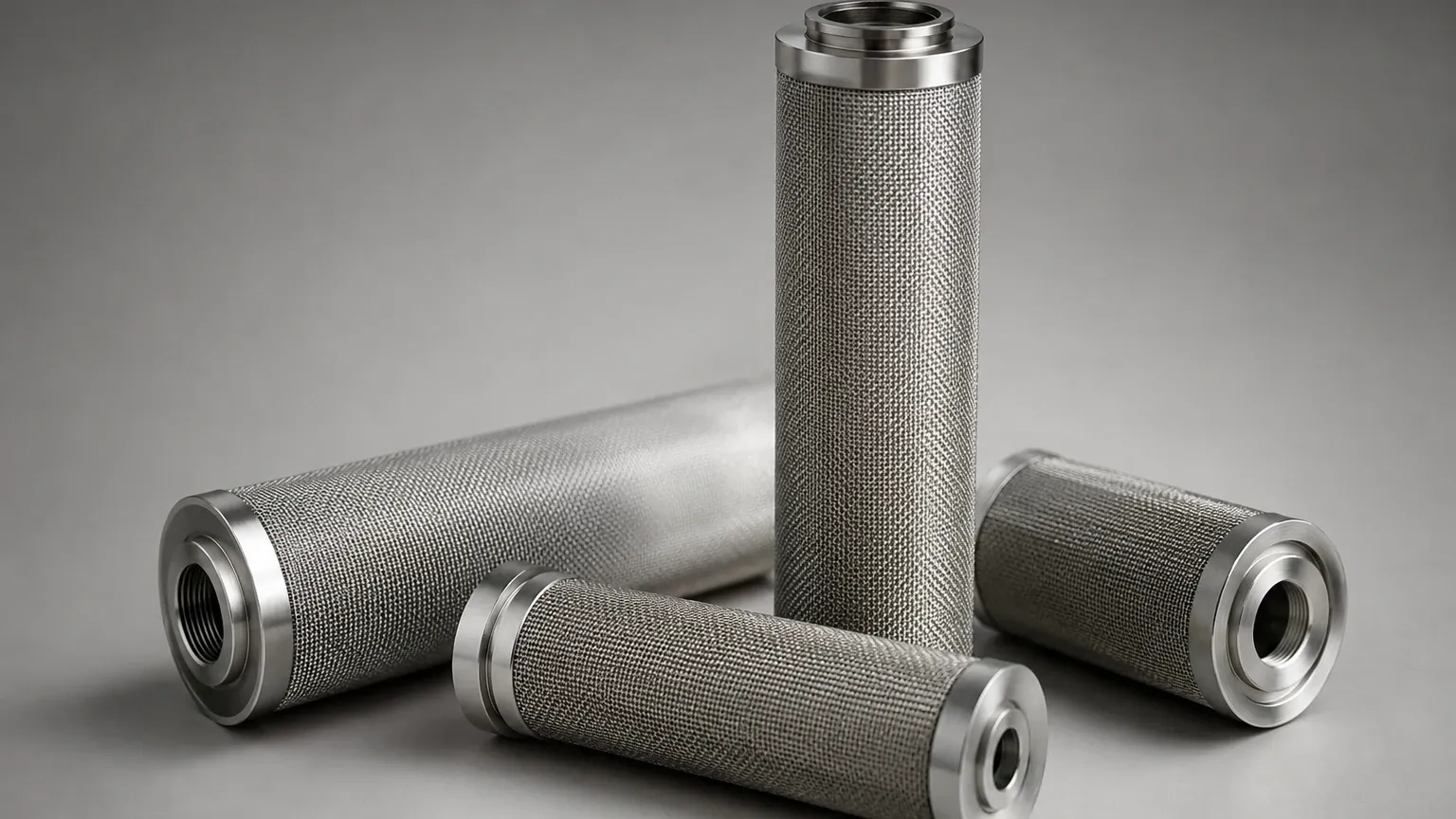
While polymer-based filters are common in low-pressure, ambient-temperature applications, industrial nitrogen systems often demand the durability of metal. Stainless steel (specifically 304 or 316L) is the preferred material for nitrogen gas filter elements due to its resistance to corrosion, ability to withstand high temperatures, and structural integrity under high-pressure differentials. Sintered wire mesh and porous metal structures provide a rigid filtration medium that does not shed fibers, a common failure mode in lower-quality synthetic filters.
Types of Nitrogen Gas Filter Media
The construction of the filter element determines its capacity for dirt holding and its suitability for specific contaminants.
Sintered Wire Mesh Filters
Sintered wire mesh is created by bonding multiple layers of woven wire cloth through a heat-treatment process. This creates a stable, high-strength porous material. In nitrogen filtration, sintered mesh is valued for its precise pore size and the ability to be cleaned and reused. It is particularly effective for high-temperature nitrogen streams where synthetic media would melt or degrade.
Pleated Metal Filters
To increase the effective filtration area within a compact housing, stainless steel mesh can be pleated. This design significantly lowers the initial pressure drop and increases the dirt-holding capacity, allowing for longer service intervals. Pleated nitrogen gas filters are ideal for high-flow systems where space is at a premium.
Coalescing Filters
In systems where nitrogen is compressed using oil-lubricated compressors, oil aerosols are a major concern. Coalescing filters use a multi-stage process to merge small liquid droplets into larger ones, which then drain away from the gas stream. While often using borosilicate microfibers, these can be supported by stainless steel inner and outer cores to provide the necessary mechanical strength for industrial nitrogen lines.
Application-Specific Requirements
Different industries impose unique constraints on nitrogen gas filter design. Understanding these nuances is essential for effective selection.
Chemical and Petrochemical Processing
In these environments, nitrogen is used for blanketing flammable liquids. The filters must be able to withstand potentially corrosive atmospheres and high pressures. Stainless steel 316L is often the standard here due to its superior resistance to chemical attack. Furthermore, filters in these sectors must often comply with pressure vessel codes such as ASME Section VIII.
Electronics and Semiconductor Manufacturing
Nitrogen is used in wafer fabrication to prevent oxidation. This requires "Ultrapure Nitrogen" (UPN), where particulate counts must be near zero. Filters for this application must be manufactured in cleanroom environments and often utilize electro-polished stainless steel housings to prevent any particulate generation from the filter's own surfaces.
Aerospace and Defense
Nitrogen is used for high-pressure pneumatic actuation and fuel tank inerting in aircraft. Filters must be lightweight yet capable of handling extreme vibration and pressure shocks. Custom-engineered metal filter elements are frequently used to meet these stringent safety and performance standards.
Customization and OEM Solutions
Standard off-the-shelf filters often fail to meet the specific geometric or performance requirements of specialized industrial equipment. This is where custom manufacturing becomes essential. When sourcing a nitrogen gas filter, engineers should consider the following customization options:
* End Cap Configurations: Customizing the interface (e.g., NPT, BSP, Flanged, or specialized O-ring seals) ensures a leak-free fit into existing housings.
* Layering Strategies: Combining different mesh counts in a single sintered element can provide integrated pre-filtration and final filtration in one component.
* Structural Reinforcement: For high-differential pressure applications, internal support cores or external shrouds can be added to prevent element collapse.
Kaifil specializes in these tailored solutions, working closely with engineering teams to develop filtration components that align with specific system parameters. Our expertise in wire mesh and stainless steel fabrication allows us to produce filters that outperform generic alternatives in demanding environments.
Maintenance, Cleaning, and Total Cost of Ownership
A critical factor in the selection of a nitrogen gas filter is the Total Cost of Ownership (TCO). While disposable synthetic filters have a lower initial purchase price, the ongoing costs of replacement, disposal, and system downtime can be substantial.
The Reusability Advantage
Stainless steel nitrogen gas filters are an investment in sustainability and long-term cost reduction. Unlike disposable cartridges, sintered metal elements can be cleaned using various methods:
* Ultrasonic Cleaning: High-frequency sound waves create cavitation bubbles that dislodge deeply embedded particles from the mesh.
* Backwashing: Reversing the flow of clean gas or liquid through the filter to blow out accumulated contaminants.
* Chemical Cleaning: Using compatible solvents or acids to dissolve specific types of fouling without damaging the stainless steel structure.
Monitoring Performance
To optimize maintenance schedules, nitrogen systems should be equipped with differential pressure gauges. By monitoring the $ΔP$ across the nitrogen gas filter, operators can perform cleanings based on actual condition rather than arbitrary time intervals, preventing both premature maintenance and the risk of element failure due to excessive loading.
Conclusion
The selection of a nitrogen gas filter is a technical decision that impacts the safety, efficiency, and quality of industrial operations. By prioritizing material integrity, precise engineering of micron ratings, and the long-term benefits of cleanable stainless steel media, organizations can ensure their nitrogen systems remain reliable under the most demanding conditions.
Whether you are designing a new nitrogen distribution system or looking to optimize an existing process, technical consultation is key to identifying the most cost-effective and high-performance solution. For more information on our custom manufacturing capabilities and to view our complete product line, please visit our Main Page. Our team is dedicated to providing the engineering support and high-quality filtration components required to achieve superior industrial performance.
