


Oil Coalescers
In industrial fluid management, the separation of immiscible liquids—specifically oil and water—is a critical process that impacts equipment longevity, product purity, and environmental compliance. Oil coalescers are specialized filtration and separation devices designed to merge small, dispersed oil droplets into larger masses, allowing for easier removal from a process stream. For engineers and technical procurement teams, understanding the mechanics, material science, and operational parameters of these systems is essential for optimizing industrial performance.
Effective oil separation is not merely a matter of gravity; it requires an engineered approach to overcome the physical forces that keep oil droplets suspended in a secondary fluid. Whether the application involves removing tramp oil from coolant, treating wastewater, or protecting downstream hydraulic components, the selection of the right coalescing technology determines the overall efficiency of the system.
Fundamentals of Industrial Oil Coalescence
Coalescence is a physical process where two or more droplets of a discontinuous phase (such as oil) merge to form a single, larger droplet. In an industrial oil coalescer, this process is typically facilitated by a media that provides a surface for the droplets to collect. As the fluid passes through the coalescing media, the oil droplets are intercepted and held by the fibers or mesh. As more droplets are captured, they join together, eventually reaching a size where the buoyant force of the oil exceeds the drag force of the fluid flow, causing the oil to rise to the surface for collection.
This process is governed largely by Stokes' Law, which describes the settling or rising velocity of a particle in a fluid. The velocity is proportional to the square of the particle's diameter. By increasing the diameter of the oil droplets through coalescence, the separation speed increases exponentially. Industrial coalescers are designed to maximize this effect by optimizing the contact time and surface area available for droplet interaction.
The Mechanics of Droplet Capture
There are three primary mechanisms by which oil coalescers capture droplets:
1. Direct Interception: Occurs when an oil droplet follows a fluid streamline and comes into contact with the media surface.
2. Inertial Impaction: Happens when a droplet’s momentum causes it to deviate from the streamline and strike the media fiber.
3. Diffusional Deposition: Relevant for extremely small droplets (sub-micron), where Brownian motion causes the droplet to collide with the media.
Once captured, the droplets must wet the surface of the media to promote merging. This is why material selection—specifically the oleophilic or hydrophobic nature of the filter media—is a critical engineering decision.
The Role of Media Selection in Coalescer Performance
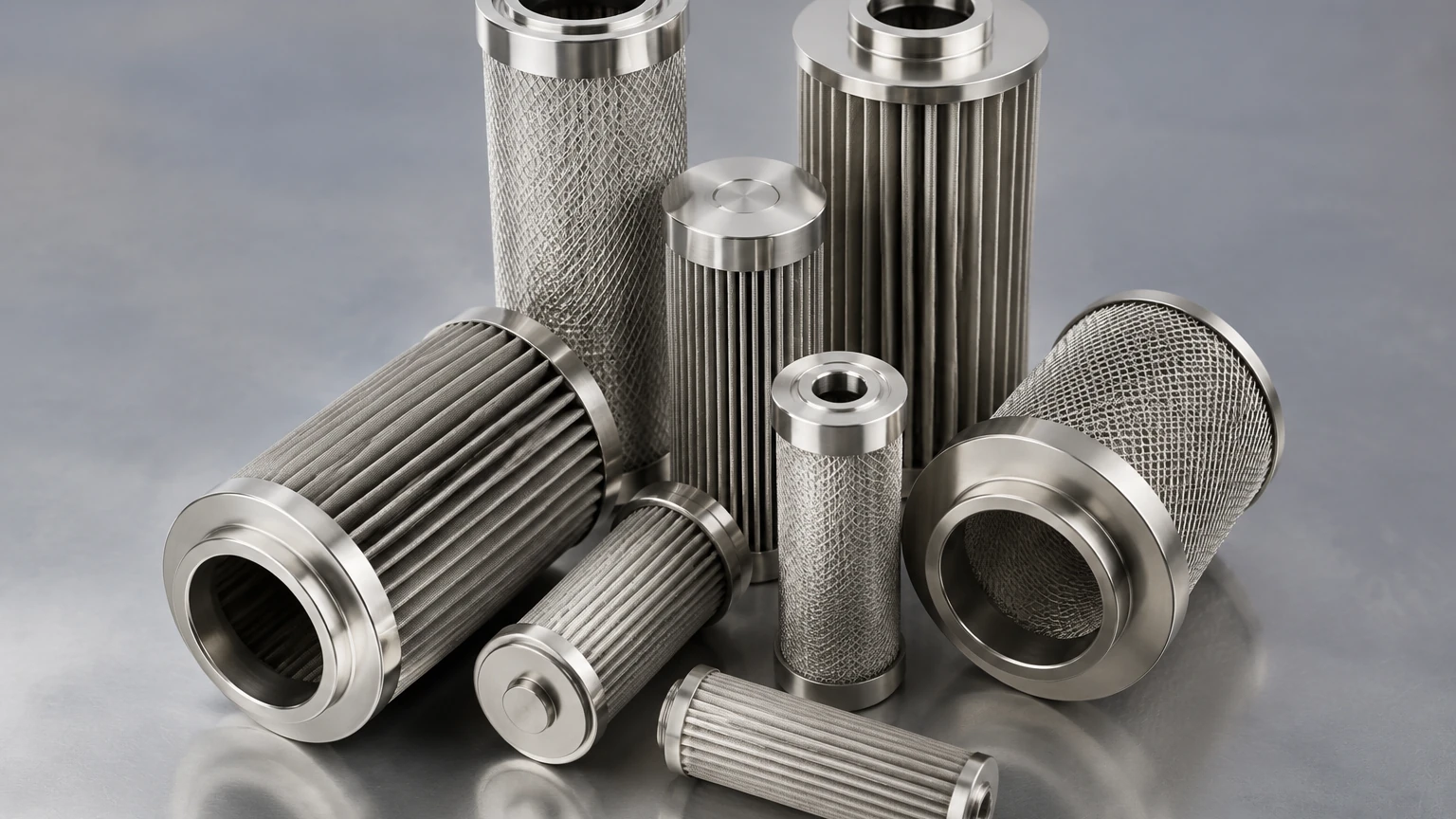
The performance of oil coalescers is heavily dependent on the physical and chemical properties of the coalescing media. In demanding industrial environments, stainless steel wire mesh and sintered metal components are often preferred over synthetic alternatives due to their structural integrity and resistance to harsh conditions.
Stainless Steel Wire Mesh
Stainless steel wire mesh is a primary material for high-performance coalescers. It offers precise pore sizes and a high surface-area-to-volume ratio, which is essential for capturing fine oil droplets. Because stainless steel is naturally durable, it can withstand high pressure differentials and turbulent flow without deforming. This stability ensures that the pore structure remains consistent throughout the service life of the filter, providing predictable separation efficiency.
Sintered Metal Media
For applications requiring extremely fine filtration and high structural strength, sintered metal media is utilized. This material consists of multiple layers of wire mesh or metal fibers that are bonded together through a high-temperature sintering process. The result is a rigid, porous structure that can handle extreme temperatures and corrosive chemical environments, making it ideal for chemical processing and steam filtration where oil removal is necessary.
Engineering Considerations for Efficient Separation
When specifying oil coalescers, engineers must account for several variables that influence the efficiency of the separation process. A failure to address these factors can lead to premature media saturation, bypass, or inadequate separation levels.
Fluid Viscosity and Temperature
Viscosity is a measure of a fluid's resistance to flow. High-viscosity oils are more difficult to coalesce because the resistance to droplet merging is higher. Temperature plays a significant role here; as temperature increases, viscosity typically decreases, which can improve the efficiency of the coalescing process. However, the coalescer materials must be rated for the operating temperature to prevent thermal degradation or expansion that might alter filtration accuracy.
Flow Rate and Velocity
Coalescence requires a specific residence time within the media to be effective. If the fluid velocity is too high, the drag forces may strip captured droplets from the media before they have grown large enough to separate effectively. Conversely, if the flow is too slow, the system may not process the required volume of fluid. Engineers must balance the flux rate (flow per unit area) with the media's capacity to ensure laminar flow conditions, which are most conducive to coalescence.
Interfacial Tension (IFT)
Interfacial tension is the force that exists at the boundary between the oil and the water. If the IFT is low (often due to the presence of surfactants or detergents), the oil droplets will be very small and stable, making them difficult to coalesce. In such cases, specialized media treatments or multi-stage filtration systems may be required to break the emulsion before coalescence can occur.
Comparative Analysis: Stainless Steel vs. Synthetic Media
While synthetic media like polypropylene or fiberglass are common in light-duty applications, industrial-grade oil coalescers often require the robustness of metal. The choice between these materials impacts the total cost of ownership and the reliability of the process.
* Durability: Stainless steel media can be cleaned and reused multiple times, whereas synthetic media is typically disposable. In high-volume industrial settings, the ability to backwash or ultrasonically clean a stainless steel filter cartridge significantly reduces waste and long-term replacement costs.
* Chemical Compatibility: Stainless steel (particularly 316L grade) is resistant to a wide array of solvents, acids, and bases found in chemical processing. Synthetics may swell, soften, or dissolve when exposed to certain hydrocarbons or process chemicals.
* Pressure Resistance: Metal media can withstand significantly higher differential pressures. In systems where pressure spikes are common, such as hydraulic circuits, a stainless steel coalescer provides a necessary safety margin against structural failure.
Integration within Industrial Systems: Applications and Use Cases
Oil coalescers are integrated into various stages of industrial production to protect equipment and ensure product quality. Their versatility allows them to be used in both liquid-liquid and gas-liquid separation.
Chemical and Petrochemical Processing
In the chemical industry, removing oil from process water or separating hydrocarbons from aqueous solutions is vital for maintaining reaction kinetics and preventing catalyst poisoning. High-precision metal filters are used to ensure that even trace amounts of oil are removed before the fluid reaches sensitive downstream equipment.
Hydraulic and Lube Oil Systems
Water contamination in hydraulic fluid or lubricating oil can lead to corrosion, increased wear, and fluid breakdown. Coalescers are used in kidney-loop filtration systems to continuously remove water from the oil, extending the life of the fluid and the mechanical components it protects.
Food and Beverage Production
In food processing, compressed air systems must be free of oil to prevent contamination of the final product. Oil coalescers are used in the compressed air line to remove oil aerosols generated by the compressor, ensuring compliance with stringent safety standards.
For organizations looking to optimize their filtration infrastructure, reviewing technical specifications and manufacturer capabilities is a necessary step. Engineering teams can Review product options and application support to determine the most effective configuration for their specific industrial requirements.
Maintenance, Longevity, and Total Cost of Ownership (TCO)
The TCO of an oil coalescer is not defined by the initial purchase price alone, but by the maintenance requirements, energy consumption, and replacement frequency. Metal-based coalescers, while often requiring a higher initial investment, offer a lower TCO in demanding applications due to their longevity.
Monitoring Performance
The most common method for monitoring the health of a coalescer is measuring the differential pressure (ΔP) across the media. An increase in ΔP typically indicates particulate loading. However, in a coalescer, it is also important to monitor the clarity of the effluent. If the oil content in the discharge begins to rise despite a stable ΔP, it may indicate that the media has become "blinded" by surfactants or that the flow rate has exceeded the design parameters.
Cleaning Protocols
One of the primary advantages of stainless steel oil coalescers is their cleanability. Depending on the nature of the contaminants, media can be cleaned using:
* Backwashing: Reversing the flow of clean fluid to dislodge particulates.
* Chemical Cleaning: Using solvents or detergents to dissolve accumulated resins or oils.
* Ultrasonic Cleaning: Using high-frequency sound waves in a cleaning bath to remove fine particles from deep within the pore structure.
Customization and OEM Solutions for Specialized Requirements
Every industrial process has unique constraints, from space limitations to specific chemical exposures. Standard off-the-shelf coalescers may not always provide the necessary efficiency or fit. Customization is often required to meet exact filtration goals.
Custom Dimensions and Housing
In many retrofit scenarios, a coalescer must fit into an existing footprint. Custom manufacturing allows for the production of filter cartridges and coalescing elements in non-standard lengths, diameters, and end-cap configurations. This ensures a seamless fit without the need for expensive piping modifications.
Material Engineering
Beyond standard 304 or 316 stainless steel, specialized alloys like Monel or Hastelloy can be used for coalescers operating in extremely corrosive environments, such as offshore oil rigs or specialized chemical plants. The ability to customize the wire diameter and weave pattern also allows for fine-tuning the coalescing efficiency to target specific oil droplet sizes.
Conclusion
Oil coalescers are fundamental components in the modern industrial landscape, providing a reliable means of separating immiscible fluids to protect equipment and improve process efficiency. By focusing on the physical principles of coalescence and the material advantages of stainless steel and precision metal media, engineers can implement solutions that offer long-term durability and high performance. When selecting a coalescing system, it is vital to consider the specific operational variables—viscosity, flow rate, and chemical environment—to ensure the chosen technology meets the rigorous demands of the application. For further technical guidance and to explore customized filtration components, visiting the Main Page of an experienced manufacturer can provide the necessary resources for informed decision-making.
