


Oil & Gas Filtration
In the demanding environment of the energy sector, filtration is not merely a peripheral process but a critical component of operational integrity. The efficiency of oil & gas filtration systems directly impacts the longevity of downstream equipment, the purity of final products, and the overall safety of the extraction and refining processes. For engineers and procurement professionals, selecting the correct filtration solution requires a deep understanding of fluid dynamics, material science, and the specific rigors of industrial environments.
As a specialized manufacturer, Kaifil provides precision-engineered stainless steel filtration components designed to withstand the high pressures and corrosive elements inherent in this industry. This guide examines the technical requirements, material considerations, and selection criteria essential for optimizing filtration performance in oil and gas applications.
The Critical Role of Filtration in the Energy Sector
Filtration in the oil and gas industry spans the entire value chain, from upstream extraction to downstream refining. Each stage presents unique contaminants that must be managed to prevent equipment failure and process inefficiencies.
Upstream: Protecting Subsurface and Surface Assets
In upstream operations, filtration is primarily concerned with the removal of solids from produced water, completion fluids, and injection water. Sand, scale, and silt can cause severe erosion in pumps and valves. Furthermore, in secondary recovery phases, water injected into the reservoir must be filtered to a high degree of precision to prevent the plugging of the rock formation, which would otherwise decrease the permeability and productivity of the well.
Midstream: Ensuring Pipeline Integrity
Midstream operations involve the transport and storage of hydrocarbons. Here, filtration systems protect compressors and turbines from particulates and liquids that may have entered the pipeline. Gas filtration is particularly critical; removing compressor oil carryover and solid debris prevents fouling in heat exchangers and protects sensitive instrumentation.
Downstream: Refining and Petrochemical Processing
Refineries utilize filtration to protect catalysts and ensure the quality of the final fuel or chemical product. High-temperature processes require filters that maintain structural integrity under thermal stress. Stainless steel filter cartridges are often the preferred choice here due to their ability to be cleaned and reused, offering a sustainable alternative to disposable media in high-volume applications.
Material Engineering: Why Stainless Steel Dominates Oil & Gas Applications
The choice of material is perhaps the most significant factor in the success of a filtration system. In oil and gas environments, materials are subjected to hydrogen sulfide (H2S), carbon dioxide (CO2), high chlorides, and extreme temperatures.
Corrosion Resistance
Stainless steel, particularly grades 316 and 316L, is the industry standard for its resistance to pitting and crevice corrosion. For more aggressive environments involving high concentrations of sour gas or brine, specialized alloys or Duplex stainless steels may be required. These materials form a passive oxide layer that protects the underlying metal from chemical attack, ensuring a long service life even in continuous contact with corrosive fluids.
Mechanical Strength and Durability
Unlike polymer-based filters, stainless steel wire mesh and sintered metal components possess high mechanical strength. This allows them to withstand high differential pressures without collapsing or deforming. In high-pressure hydraulic systems or deep-sea extraction, the structural integrity of the filter element is paramount to preventing bypass—where unfiltered fluid bypasses the media due to structural failure.
Thermal Stability
Oil and gas processes often operate at temperatures exceeding the limits of synthetic fibers. Stainless steel components remain stable at temperatures ranging from cryogenic levels to over 500°C (depending on the alloy and atmosphere). This thermal stability ensures that the pore size and filtration accuracy remain consistent throughout the operating cycle.
Technical Evaluation Criteria for Industrial Filter Selection
When evaluating filtration solutions on the Main Page, engineers must look beyond simple dimensions. Several technical parameters define the performance and suitability of a filter for a specific application.
Micron Rating: Absolute vs. Nominal
Understanding the distinction between absolute and nominal micron ratings is vital for process safety.
* Nominal Rating: Refers to an approximate filtration level, often indicating that the filter can trap a certain percentage (e.g., 60-90%) of particles at that size.
* Absolute Rating: Refers to the diameter of the largest hard spherical particle that will pass through the filter under specified test conditions. In critical oil and gas applications—such as protecting fuel injectors or sensitive valves—an absolute rating is usually required to ensure no damaging particles pass through.
Pressure Drop (ΔP)
Pressure drop is the difference in pressure between the upstream and downstream sides of the filter. A high initial pressure drop indicates that the filter may be undersized or the media is too restrictive for the required flow rate. Engineers must calculate the clean pressure drop and define the maximum allowable pressure drop before the filter element requires cleaning or replacement. Minimizing ΔP is essential for reducing the energy consumption of pumps and compressors.
Dirt Holding Capacity
This refers to the total amount of contaminant a filter can retain before reaching its maximum allowable pressure drop. A higher dirt holding capacity extends the service interval, reducing downtime and maintenance costs. This is often achieved through pleated designs, which increase the effective surface area of the wire mesh within the same footprint.
Common Challenges and Risks in High-Pressure Filtration
Operating filtration systems in the oil and gas sector involves managing several inherent risks. Failure to account for these can lead to costly unscheduled shutdowns.
Media Migration and Fiber Shedding
In high-vibration or high-flow environments, some filtration media can shed fibers into the downstream fluid, becoming a source of contamination themselves. Stainless steel wire mesh filters are preferred in these scenarios because they are constructed of woven or sintered metallic strands that do not migrate, ensuring the purity of the effluent.
Chemical Incompatibility
While stainless steel is robust, certain chemicals used in well stimulation or cleaning can attack specific alloys. It is essential to confirm the compatibility of the filter media, support structures, and seals (O-rings/gaskets) with the entire range of chemicals they will encounter.
Fatigue and Pulsation
Fluctuations in flow and pressure can cause mechanical fatigue in filter elements. Over time, these pulsations can lead to stress cracks in the mesh or at the weld points. Selecting filters with reinforced internal cores and robust end-cap welding is necessary for systems prone to hydraulic shock or reciprocating pump pulsations.
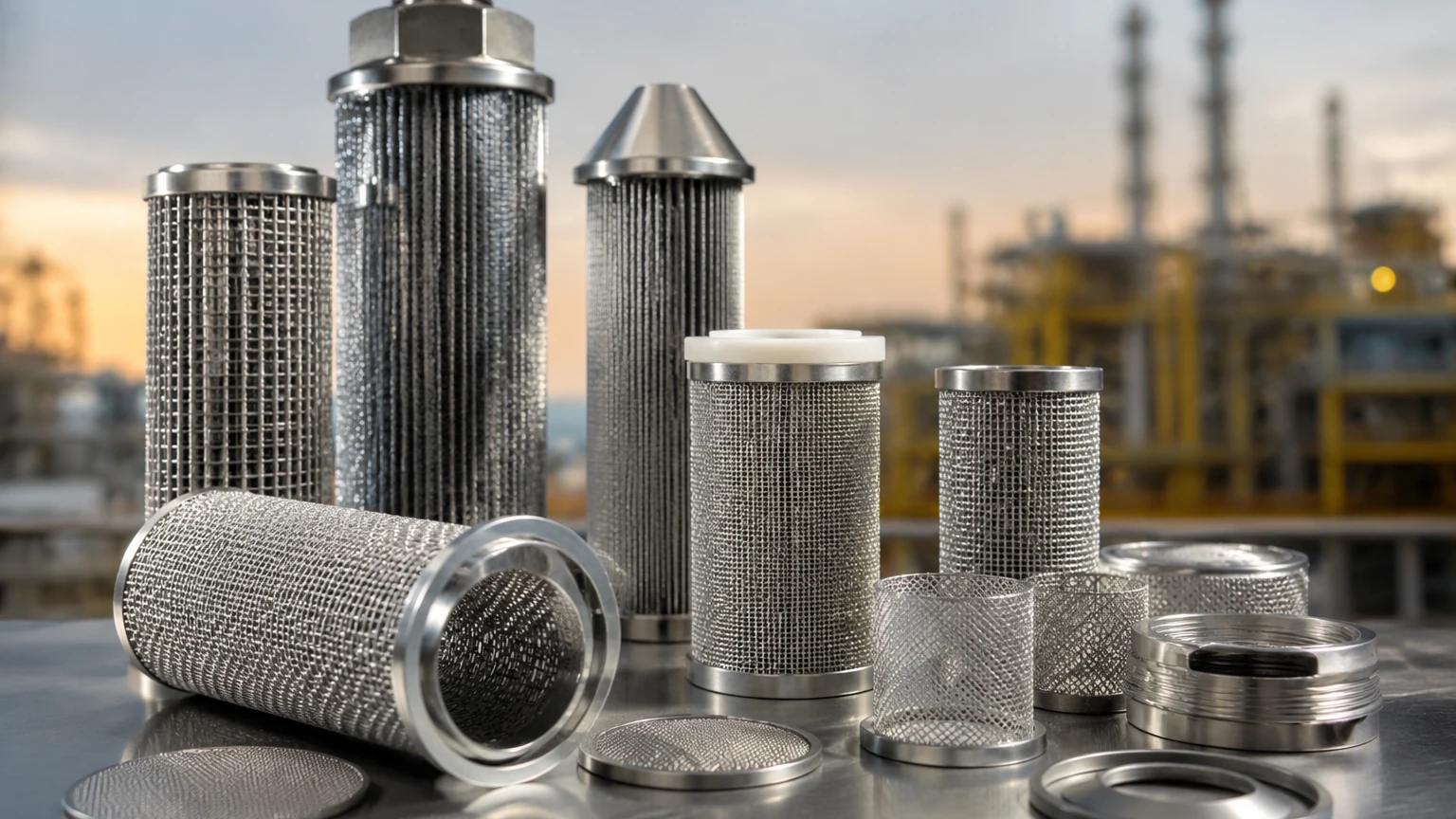
Customization and OEM Solutions for Specialized Requirements
Standard off-the-shelf filters rarely meet the precise needs of specialized oil and gas equipment. Customization is often necessary to balance filtration efficiency with spatial constraints and flow requirements.
Kaifil specializes in OEM and customized filtration solutions, allowing engineers to specify:
* Custom Dimensions: Tailoring the length, diameter, and fitting types (e.g., NPT, flange, or threaded) to fit existing housings.
* Layered Configurations: Combining different mesh counts to create a multi-stage filtration effect within a single cartridge, optimizing both fine filtration and dirt-holding capacity.
* Reinforced Structures: Adding outer guards or inner support tubes to handle extreme collapse pressure requirements.
By working closely with a manufacturer during the design phase, purchasing teams can ensure that the filtration component is optimized for the specific fluid viscosity and contaminant profile of their application.
Optimizing Total Cost of Ownership and Maintenance Cycles
While the initial purchase price of a stainless steel filter may be higher than that of a disposable plastic or paper filter, the Total Cost of Ownership (TCO) is often significantly lower in industrial settings.
Cleanability and Reuse
One of the primary advantages of stainless steel wire mesh filters is their ability to be cleaned. Depending on the contaminant, filters can be cleaned via backwashing, ultrasonic cleaning, or chemical baths. This eliminates the recurring cost of purchasing new filters and the environmental and logistical burden of disposing of contaminated spent cartridges.
Reduced Downtime
High-quality metal filters are designed for durability. By selecting a filter with a higher dirt-holding capacity and robust construction, operators can extend the time between maintenance cycles. In offshore environments, where labor and logistics costs are exceptionally high, extending the service interval by even a small percentage can result in substantial annual savings.
Engineering Checklist for Filter Procurement
Before finalizing a purchase or initiating a custom design for oil & gas filtration, technical teams should confirm the following data points:
1. Fluid Characteristics: What is the fluid type, viscosity at operating temperature, and chemical composition (including H2S or chloride content)?
2. Operating Conditions: What are the normal and maximum operating pressures and temperatures? Are there significant pressure spikes?
3. Contaminant Profile: What is the nature of the solids (hard, soft, fibrous)? What is the typical particle size distribution?
4. Target Cleanliness Level: What is the required ISO cleanliness code or absolute micron rating needed for downstream protection?
5. Flow Rate: What is the minimum, normal, and maximum flow rate the filter must handle?
6. Housing Compatibility: Does the filter element need to interface with existing hardware, and what are the sealing requirements?
By addressing these factors, engineers can ensure they select a filtration solution that provides reliable performance, protects critical assets, and contributes to the overall efficiency of the oil and gas operation. For further technical specifications and to explore custom engineering capabilities, professionals are encouraged to review product options and application support on the Main Page.
