


Oil Water Coalescer
In industrial fluid management, the separation of immiscible liquids—specifically oil and water—is a critical process for environmental compliance, equipment longevity, and product purity. An oil water coalescer is a specialized filtration and separation device designed to merge small, dispersed droplets of one liquid into larger globules, which can then be easily separated from the continuous phase based on density differences. This technology is indispensable in sectors ranging from petrochemical processing and marine operations to hydraulic systems and industrial wastewater treatment.
Effective oil-water separation relies on understanding the physical properties of the fluids involved, including viscosity, density, and surface tension. For engineers and procurement teams, selecting the right oil water coalescer involves evaluating the specific emulsion characteristics and the operational environment to ensure the chosen system meets required discharge or purity standards.
The Physics of Coalescence in Industrial Filtration
The fundamental principle behind an oil water coalescer is the promotion of droplet growth. In many industrial processes, oil and water exist as an emulsion. These emulsions can be "loose" (mechanically dispersed) or "tight" (chemically stabilized). A coalescer works by forcing the fluid through a medium—often composed of specialized layers of wire mesh or fiber—that provides a surface for the dispersed droplets to attach to.
Mechanisms of Particle Capture
As the fluid passes through the coalescing media, three primary physical mechanisms occur:
1. Direct Interception: Large droplets that are physically larger than the pore size of the media are trapped on the surface.
2. Inertial Impaction: Heavier droplets, unable to follow the rapid changes in fluid direction through the tortuous path of the media, collide with the fibers or wires.
3. Brownian Diffusion: Extremely small droplets (sub-micron) move erratically due to molecular collisions, eventually making contact with the media surface.
Once a droplet makes contact with the coalescing media, it adheres to the surface. As more droplets are captured, they merge (coalesce) with existing ones. Eventually, the droplets grow large enough that the drag force of the flowing fluid or the force of gravity overcomes the adhesive force, causing the enlarged drop to detach and migrate toward the separation zone.
Engineering Components of an Oil Water Coalescer
A high-performance oil water coalescer is rarely a single-stage component. It is typically part of a multi-stage system designed to handle varying levels of contamination. For manufacturers like Kaifil, the focus is on the precision and durability of the internal components that facilitate this separation.
Pre-filtration Stage
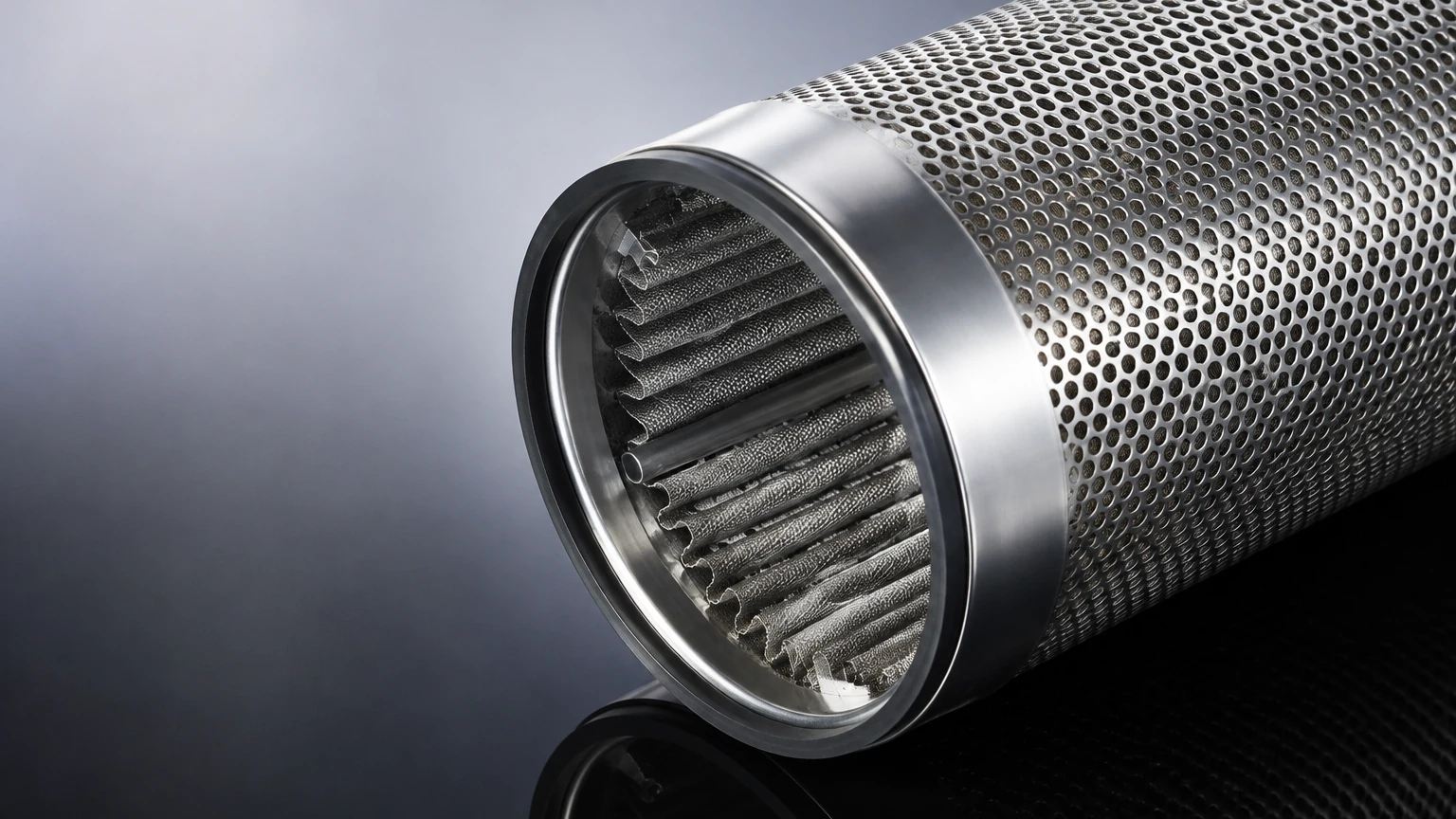
Before the fluid reaches the coalescing element, it often passes through a pre-filter. The purpose of this stage is to remove solid particulates. If solids are allowed to reach the coalescing media, they can coat the fibers or mesh, leading to premature fouling and reducing the surface area available for droplet attachment. Stainless steel wire mesh filters are frequently used here due to their ability to be cleaned and their resistance to high-pressure differentials.
The Coalescing Element
This is the core of the system. In many industrial applications, stainless steel filter cartridges are preferred for their chemical compatibility and structural integrity. The media within these cartridges is engineered with a specific gradient of pore sizes. The upstream side usually has a finer mesh to initiate the capture of small droplets, while the downstream side may have a more open structure to allow the enlarged droplets to exit without breaking apart.
The Separator Element
In some designs, particularly those used for removing water from fuel or oil, a secondary "separator" stage is used. This stage typically employs a hydrophobic material that allows the continuous phase (the oil) to pass through while repelling the newly enlarged water droplets, forcing them to settle into a collection sump.
Material Selection and Technical Specifications
For engineers, the choice of material for an oil water coalescer is governed by the chemical nature of the fluids and the operating temperature. Stainless steel remains the gold standard for demanding B2B applications.
Advantages of Stainless Steel Media
* Chemical Resistance: Stainless steel (304, 316L, or 904L) can withstand the corrosive nature of produced water in oil fields or the acidic environments found in chemical processing.
* Temperature Stability: Unlike polymer-based media, metal filters maintain their structural dimensions and coalescing efficiency at elevated temperatures.
* Durability: In high-pressure hydraulic systems, the media must resist collapse. Sintered metal and multi-layer wire mesh provide the necessary mechanical strength.
* Cleanability: Many stainless steel coalescing elements can be backwashed or ultrasonically cleaned, extending the service life and reducing the total cost of ownership compared to disposable fiberglass elements.
Evaluating Filtration Accuracy
Filtration accuracy in a coalescer is measured by its ability to reduce the concentration of the dispersed phase. For example, a system might be designed to take an inlet concentration of 1,000 ppm (parts per million) of oil in water and reduce it to less than 5 ppm at the outlet. Achieving this requires precise control over the wire diameter and weave patterns used in the mesh components.
Key Factors Influencing Coalescer Performance
When specifying an oil water coalescer, several variables must be confirmed to ensure the system performs as expected in the field.
Fluid Viscosity and Density
The rate at which a droplet rises or falls through a continuous phase is governed by Stokes' Law. If the density difference between the oil and water is very small, or if the continuous phase has a high viscosity, the coalesced droplets will move slowly. This may require a larger vessel design to allow for sufficient residence time.
Surface and Interfacial Tension
Surface tension determines how easily droplets can merge. The presence of surfactants (detergents or chemicals) can lower the interfacial tension, creating "tight" emulsions that are difficult to break. In such cases, specialized media coatings or finer mesh structures are required to overcome the stabilizing effect of the surfactants.
Flow Velocity
Coalescence is a velocity-sensitive process. If the flow rate is too high, the shear forces can break apart the droplets as they exit the media, re-emulsifying the mixture. Engineers must calculate the "face velocity" across the media to ensure it remains within the optimal range for the specific fluid pair.
Applications Across Industrial Sectors
The versatility of the oil water coalescer makes it a staple in various heavy industries. Each application presents unique challenges for filtration components.
* Petrochemical and Refining: Removing water from hydrocarbons is essential to prevent catalyst poisoning and corrosion in downstream equipment. Coalescers are used in the production of gasoline, diesel, and jet fuel.
* Marine and Offshore: Bilge water treatment is strictly regulated by international maritime law. Coalescers ensure that overboard discharge contains minimal oil, protecting marine ecosystems.
* Hydraulic and Lubrication Systems: Water is a major contaminant in hydraulic oils, leading to oxidation, loss of lubricity, and component wear. High-pressure coalescers integrated into the lubrication loop help maintain oil health.
* Wastewater Treatment: In manufacturing plants, wash water often becomes contaminated with tramp oils. A coalescer allows for the recovery of oil for recycling and ensures the water meets municipal discharge standards.
Maintenance and Operational Considerations
To maintain the efficiency of an oil water coalescer, regular monitoring of the differential pressure (ΔP) is required. An increase in ΔP typically indicates that the pre-filter or the coalescing media is becoming loaded with solids.
Replacement Cycles
While stainless steel elements are durable, they are not infinite. Over time, deep-seated particulates or chemical scaling can reduce the effective surface area. Manufacturers provide guidelines on the maximum allowable pressure drop before the elements should be removed for cleaning or replacement. For critical applications, redundant systems (duplex filters) are often installed to allow for maintenance without shutting down the process line.
Confirming Specifications Before Purchase
Before finalizing a purchase for industrial filtration components, engineers should confirm the following with the manufacturer:
1. Inlet Contamination Levels: What is the maximum ppm of the dispersed phase the system can handle?
2. Target Outlet Purity: What are the local regulatory or process requirements for the effluent?
3. Chemical Compatibility: Does the filter material (including gaskets and seals) resist the specific chemicals in the stream?
4. Pressure and Temperature Ratings: Will the housing and elements withstand the maximum surge pressures and operating temperatures?
Conclusion
The oil water coalescer is a vital tool for achieving high-efficiency liquid-liquid separation in industrial environments. By leveraging the physical properties of coalescence and utilizing robust materials like stainless steel, these systems provide a reliable means of protecting equipment and meeting environmental standards. For technical professionals looking to optimize their filtration processes, understanding the nuances of media selection and fluid dynamics is the first step toward a successful installation.
For more technical details on custom filtration components and engineering support, you can Review product options and application support to find solutions tailored to specific industrial requirements. As a professional manufacturer, Kaifil provides the expertise needed to navigate complex filtration challenges, ensuring that every oil water coalescer component is built for durability and precision performance.
