


Oil Water Filtration
In industrial processing, the separation of oil and water is a fundamental requirement across a wide spectrum of applications, ranging from wastewater treatment and environmental remediation to the protection of downstream machinery and the purification of process fluids. Effective oil water filtration relies on a combination of physical principles, material science, and precise engineering to ensure that fluids meet specific purity standards. For engineers and procurement teams, selecting the correct filtration media is not merely a matter of choosing a micron rating; it involves understanding the fluid dynamics, chemical interactions, and mechanical stresses present within a specific system.
As a manufacturer specializing in stainless steel filtration solutions, Kaifil provides the technical components necessary to facilitate high-performance separation. By utilizing advanced wire mesh and sintered metal technologies, industrial operators can achieve consistent results even in the most demanding environments. This guide explores the technical foundations of oil water filtration, the role of stainless steel components, and the critical factors that influence system design and component selection.
The Mechanics of Oil Water Filtration
Oil water filtration is the process of removing dispersed or emulsified oil from water, or conversely, removing water from oil. The difficulty of this separation depends largely on the state of the oil in the water. Oil typically exists in three forms within a water-based stream: free oil, dispersed oil, and emulsified oil.
Free oil consists of large droplets that rise to the surface quickly due to the difference in specific gravity. Dispersed oil consists of smaller droplets (typically 10 to 100 microns) that require mechanical intervention to separate efficiently. Emulsified oil involves droplets smaller than 10 microns, often stabilized by surfactants, which are the most challenging to remove.
Industrial filtration systems employ several mechanisms to address these states:
1. Mechanical Interception: Using a physical barrier, such as a stainless steel wire mesh, to trap oil droplets or solid particulates that may be stabilizing an emulsion.
2. Coalescence: This is a critical stage in oil water filtration where small droplets are encouraged to collide and merge into larger droplets on the surface of the filter media. Once the droplets reach a sufficient size, buoyancy forces allow them to separate from the continuous phase.
3. Adsorption and Surface Tension: The surface properties of the filter media, including its hydrophobicity or hydrophilicity, play a significant role in how oil droplets interact with the mesh. Stainless steel can be treated or manufactured with specific weave patterns to optimize these interactions.
The Role of Stainless Steel in Filtration Systems
While various materials can be used for filtration, stainless steel remains the preferred choice for industrial oil water filtration due to its mechanical and chemical properties. In applications involving high temperatures, high pressures, or corrosive chemicals, synthetic or paper-based filters often fail to provide the necessary durability.
Corrosion Resistance and Longevity
Stainless steel grades such as 304 and 316L offer exceptional resistance to oxidation and corrosion. In oil-water mixtures, which may contain salts, acidic components, or caustic cleaning agents, the integrity of the filter media is paramount. 316L stainless steel, in particular, contains molybdenum, which enhances resistance to pitting and crevice corrosion in chloride-rich environments.
Structural Integrity
Industrial filtration often involves high flow rates and significant differential pressures. Stainless steel wire mesh and sintered cartridges maintain their pore structure under mechanical stress. Unlike soft media, metal filters do not suffer from "media migration," where fibers from the filter itself break off and contaminate the downstream fluid.
Thermal Stability
Many oil-water separation processes occur at elevated temperatures to reduce fluid viscosity and improve separation efficiency. Stainless steel components can operate at temperatures exceeding 300°C without losing structural form or filtration accuracy, making them ideal for steam-assisted separation or high-temperature process loops.
Key Components for Effective Separation
To achieve optimal results in oil water filtration, engineers must select components that match the specific requirements of the application. Kaifil designs and manufactures several types of components used in these systems.
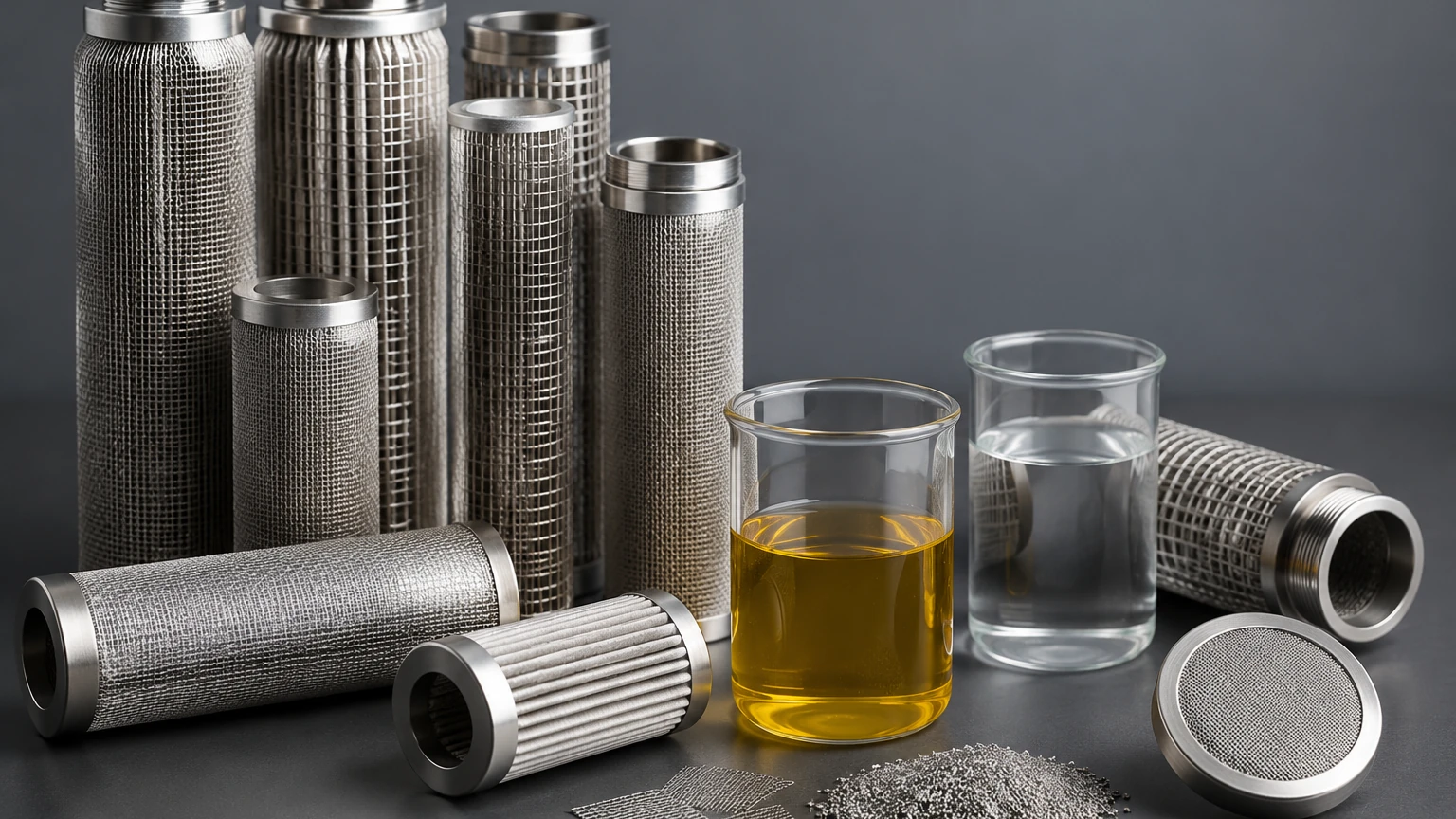
Stainless Steel Wire Mesh Filters
Wire mesh is the backbone of many separation systems. By varying the weave pattern—such as plain weave, twill weave, or Dutch weave—manufacturers can control the filtration accuracy and the flow characteristics. In coalescing applications, multi-layered mesh structures provide the high surface area necessary for droplet growth.
Sintered Metal Filter Cartridges
For applications requiring high precision and the ability to withstand extreme pressure, sintered metal cartridges are used. These are created by fusing multiple layers of wire mesh or metallic powder under heat and pressure. The result is a porous, rigid structure with a fixed pore size that provides absolute filtration ratings.
Custom Precision Components
Every industrial system has unique spatial and flow requirements. Custom-designed filter baskets, strainers, and internal components ensure that the filtration media is positioned correctly within the separator vessel to prevent bypassing and ensure uniform flow distribution.
Engineering Considerations for Selection
When specifying components for oil water filtration, several technical parameters must be evaluated to ensure the system performs as expected over its operational life.
Micron Rating and Efficiency
The micron rating defines the size of the particles or droplets the filter can intercept. It is important to distinguish between nominal and absolute ratings. An absolute rating indicates that 99.9% of particles above a certain size will be captured, which is critical for protecting sensitive downstream equipment like high-pressure pumps or fuel injectors.
Flow Rate and Pressure Drop
The "clean pressure drop" is the initial resistance the filter offers to the fluid flow. As the filter captures contaminants, the pressure drop increases. Engineers must size the filter surface area to ensure that the flow velocity does not exceed the point where oil droplets are sheared and broken back down into smaller, harder-to-separate emulsions.
Viscosity and Temperature
The viscosity of the oil significantly impacts the ease of filtration. Higher temperatures typically lower viscosity, which aids in separation but may require more robust filter materials. The selection of the stainless steel grade and the thickness of the wire must account for the maximum operating temperature and the potential for thermal expansion.
Chemical Compatibility
Beyond the oil and water themselves, process streams often contain additives, inhibitors, or contaminants like hydrogen sulfide (H2S). Confirming the compatibility of the filter media and the housing seals with these chemicals is essential to prevent premature failure.
Maintenance and Total Cost of Ownership
One of the primary advantages of stainless steel oil water filtration components is their cleanability. Unlike disposable cartridges, metal filters can often be cleaned and reused, which significantly impacts the total cost of ownership (TCO).
Cleaning Methods
Depending on the nature of the contaminants, stainless steel filters can be cleaned using:
* Backwashing: Reversing the flow of fluid to dislodge accumulated debris.
* Ultrasonic Cleaning: Using high-frequency sound waves in a solvent bath to remove fine particles from deep within the mesh.
* Chemical Cleaning: Using acids or alkalis to dissolve organic or inorganic scaling.
* Burn-off/Pyrolysis: Heating the filter to high temperatures to carbonize organic contaminants (applicable only to all-metal assemblies).
Replacement Cycles
While stainless steel filters are durable, they are not infinite. Factors such as erosion from high-velocity particles or fatigue from pressure cycling will eventually necessitate replacement. Establishing a regular inspection schedule and monitoring differential pressure are the best ways to determine the optimal replacement cycle.
Industrial Applications of Oil Water Separation
Oil water filtration is utilized across diverse sectors, each with its own set of challenges.
* Chemical and Petrochemical: Separating oil from process water or protecting catalysts from oil contamination. Here, the chemical resistance of 316L stainless steel is vital.
* Hydraulic Systems: Removing water from hydraulic oil is essential to prevent cavitation, corrosion, and the breakdown of lubrication properties. Precision sintered filters are often used in these high-pressure circuits.
* Food and Beverage: In edible oil processing, water must be removed to ensure product stability and shelf life. Filtration components must meet strict hygienic standards and be easy to sterilize.
* Marine and Environmental: Bilge water treatment and oil spill recovery require robust filtration systems that can handle large volumes of water while meeting strict environmental discharge limits (often 15 ppm or lower).
Conclusion
Selecting the right oil water filtration solution requires a deep understanding of the physical properties of the fluids involved and the mechanical demands of the industrial environment. By choosing high-quality stainless steel components, engineers can ensure their systems operate with high efficiency, minimal downtime, and a lower long-term cost.
Kaifil's expertise in manufacturing custom wire mesh and precision metal filters allows for the development of tailored solutions that meet the specific needs of demanding industrial applications. Whether you are designing a new separation system or looking to optimize an existing process, focusing on material durability and engineering precision is the key to successful filtration.
For more information on customized filtration components and technical specifications, visit the Main Page to explore our full range of industrial solutions and application support.
