


Paint Strainer Mesh Size Chart
In industrial coating and finishing processes, the precision of filtration directly dictates the quality of the final surface and the operational lifespan of application equipment. For engineers and procurement specialists, selecting the correct filtration media requires a technical understanding of how mesh counts translate to particle retention. A paint strainer mesh size chart serves as the foundational reference for matching coating viscosity and solids content with the appropriate filter density.
At Kaifil, we specialize in the engineering and manufacture of stainless steel wire mesh filters designed to withstand the rigorous demands of industrial chemical processing and high-volume coating lines. Understanding the relationship between mesh count, micron ratings, and flow dynamics is essential for optimizing production efficiency and reducing rework caused by particulate contamination.
Understanding the Technical Relationship: Mesh vs. Micron
Before consulting a paint strainer mesh size chart, it is critical to define the terminology used in industrial filtration. The term "Mesh" refers to the number of openings per linear inch of the filter screen. For instance, a 100-mesh screen has 100 openings per inch in both the warp and weft directions.
However, mesh count alone does not provide a complete picture of filtration capability because it does not account for the wire diameter. The actual size of the particles that can pass through the mesh is measured in microns (μm). As the mesh count increases, the size of the openings decreases, leading to a lower micron rating.
For industrial applications, engineers must also consider the "Percentage Open Area" (POA). This is the ratio of the total area of the openings to the total area of the mesh. A higher POA allows for greater flow rates and lower pressure drops, which is vital in high-viscosity coating applications. Stainless steel mesh, such as those produced by Kaifil, offers a superior POA compared to synthetic alternatives because the high tensile strength of stainless steel allows for thinner wires without sacrificing structural integrity.
The Comprehensive Paint Strainer Mesh Size Chart
The following chart provides a technical cross-reference between U.S. Mesh sizes and their corresponding micron ratings, along with typical industrial coating applications. This data is intended to assist in the initial selection phase of filter procurement.
| Mesh Count | Opening Size (Microns) | Opening Size (Inches) | Typical Industrial Application |
| :— | :— | :— | :— |
| 30 | 595 | 0.0234 | Heavy-duty primers, block fillers, and high-build coatings. |
| 40 | 400 | 0.0157 | Standard industrial primers and thick architectural coatings. |
| 60 | 250 | 0.0098 | General-purpose enamels and maintenance coatings. |
| 80 | 177 | 0.0070 | Industrial topcoats and medium-viscosity resins. |
| 100 | 149 | 0.0059 | Standard basecoats, solvent-based paints, and automotive primers. |
| 150 | 100 | 0.0039 | High-quality clearcoats and waterborne industrial finishes. |
| 200 | 74 | 0.0029 | Fine automotive clearcoats, specialty inks, and precision coatings. |
| 325 | 44 | 0.0017 | Ultra-fine pigments, laboratory-grade filtration, and electronics coatings. |
| 400 | 37 | 0.0015 | High-precision filtration for specialized chemical applications. |
When utilizing this paint strainer mesh size chart, it is important to note that these values represent the nominal filtration rating. In pressurized systems, such as airless sprayers, particle deformation can occur, potentially allowing particles slightly larger than the nominal rating to pass through the mesh. Therefore, selecting a mesh size slightly finer than the maximum allowable particle size is often a prudent engineering decision.
Engineering Considerations for Material Selection
While the paint strainer mesh size chart provides the dimensions, the material of the filter is equally important for performance and total cost of ownership. In the B2B industrial sector, the choice often lies between disposable synthetic (nylon/polyester) filters and reusable stainless steel wire mesh.
Chemical Compatibility
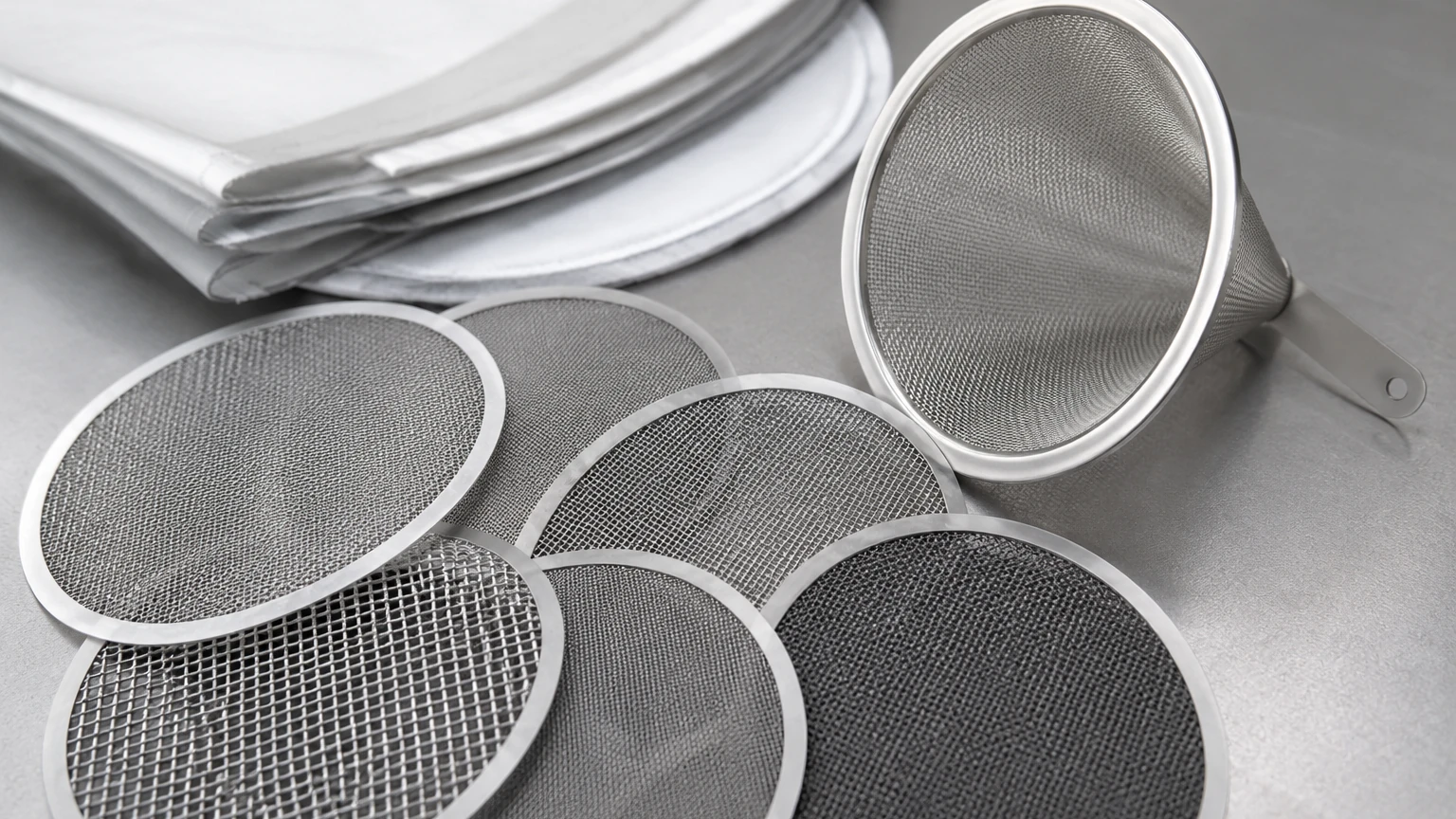
Industrial coatings often involve aggressive solvents, including MEK (Methyl Ethyl Ketone), toluene, and various alcohols. Synthetic filters may swell or degrade when exposed to these chemicals, leading to mesh distortion and inconsistent filtration. Stainless steel 304 and 316L, the primary materials used by Kaifil, offer exceptional resistance to a wide range of industrial solvents and corrosive additives, ensuring that the mesh geometry remains stable throughout the filtration cycle.
Structural Integrity and Pressure Resistance
In high-pressure filtration systems, the filter media is subjected to significant mechanical stress. Stainless steel wire mesh provides the rigidity necessary to prevent "media migration"—a phenomenon where the filter fibers break off and contaminate the filtrate. For applications involving high-viscosity fluids or high flow rates, Kaifil provides reinforced stainless steel cartridges that maintain their shape and filtration accuracy under pressure, whereas paper or thin plastic strainers would collapse.
Thermal Stability
Certain industrial coating processes require the paint or resin to be heated to reduce viscosity. Stainless steel filters can operate at temperatures far exceeding the melting points of synthetic fibers, making them the only viable option for hot-melt coatings or high-temperature chemical processing.
Factors Influencing Mesh Selection in Industrial Environments
Selecting the right entry on the paint strainer mesh size chart involves more than just matching a number; it requires a holistic view of the fluid dynamics within the system. Engineers should evaluate the following factors:
1. Fluid Viscosity
Viscosity is the primary resistance to flow. High-viscosity fluids, such as heavy primers or bituminous coatings, require a coarser mesh (lower mesh count) to prevent excessive pressure drop across the filter. If a mesh is too fine for a viscous fluid, the filter will clog rapidly, leading to frequent downtime for cleaning or replacement. Conversely, low-viscosity fluids like stains or clearcoats require a finer mesh (higher mesh count) to remove minute contaminants that would be visible on a smooth, reflective surface.
2. Solids Loading and Particle Distribution
The "solids loading" refers to the volume of particulate matter present in the coating. If a coating has a high concentration of pigments or fillers, a single-stage fine filter may clog too quickly. In these scenarios, a multi-stage filtration approach is recommended: a coarse pre-filter to remove large agglomerates followed by a fine finish filter. This strategy protects the precision mesh and extends the overall service life of the filtration system.
3. Application Method
The type of spray equipment used also dictates mesh requirements.
- Airless Sprayers: These systems use high pressure to atomize the paint. The mesh must be fine enough to prevent particles from clogging the small orifices of the spray tip. Typically, the filter mesh should be at least one size finer than the spray tip opening.
- HVLP (High Volume Low Pressure): These systems are used for fine finishes. They require very clean paint to ensure a consistent spray pattern, often necessitating mesh sizes in the 100 to 200 range.
- Gravity Feed/Pressure Pots: These rely on lower pressures and are often used with medium to fine mesh strainers depending on the desired finish quality.
Maintenance and Cleaning of Stainless Steel Filters
One of the primary advantages of using stainless steel filters in industrial painting is their reusability. Unlike disposable strainers, stainless steel mesh can be cleaned and returned to service, significantly reducing waste and long-term costs. However, improper cleaning can damage the mesh and alter its filtration characteristics.
For effective maintenance, filters should be cleaned immediately after use before the coating begins to cure. Ultrasonic cleaning is the preferred method for fine mesh (150 mesh and higher), as it removes trapped particles from the wire intersections without mechanical abrasion. For coarser mesh, solvent soaking followed by back-flushing with high-pressure air or liquid is usually sufficient.
Regular inspection is mandatory. Engineers should look for "blinding" (permanent clogging of the mesh) or physical damage like tears or wire displacement. If the mesh is compromised, it will no longer adhere to the specifications found in the paint strainer mesh size chart, and the filter must be replaced to ensure process consistency.
Customization and OEM Solutions from Kaifil
At Kaifil, we understand that standard sizes do not always meet the unique requirements of specialized industrial processes. Beyond providing a standard paint strainer mesh size chart, we offer comprehensive customization services. This includes the development of custom-sized filter cartridges, pleated wire mesh for increased surface area, and specialized alloy selections for extreme environments.
Our engineering team works closely with OEMs to design filtration components that integrate seamlessly into existing machinery, ensuring optimal flow paths and ease of maintenance. Whether you are filtering architectural coatings, automotive finishes, or pharmaceutical-grade liquids, our focus is on delivering durable, high-precision stainless steel solutions that enhance your production quality.
For technical consultation on selecting the right filtration media for your specific application, or to explore our full range of stainless steel wire mesh products, please visit our Main Page. Our team is ready to assist you in navigating the complexities of industrial filtration to find the most cost-effective and high-performance solution for your needs.
