


Pipette Filtration
In the realm of precision liquid handling, the integrity of the process is often determined by the smallest components. Pipette filtration serves as a critical safeguard in laboratory and industrial environments, ensuring that both the equipment and the samples remain free from contamination. For engineers and procurement specialists, understanding the technical nuances of filtration media, pore structures, and material compatibility is essential for maintaining high-throughput accuracy and reducing the total cost of ownership in liquid handling systems.
Industrial pipette filtration is not merely about blocking large particles; it is a complex engineering challenge involving aerosol management, chemical resistance, and airflow dynamics. Whether in automated liquid handling workstations or manual pipetting systems, the filter acts as a barrier between the liquid sample and the internal mechanism of the pipette. This article explores the engineering considerations, material sciences, and selection criteria necessary for optimizing filtration performance in demanding professional applications.
Understanding the Fundamentals of Pipette Filtration
The primary function of pipette filtration is to prevent the passage of aerosols, liquids, and particulates into the pipette shaft. In many industrial applications, such as pharmaceutical manufacturing or chemical analysis, cross-contamination can lead to catastrophic failures in data integrity or product quality. The filtration component must be designed to allow air to pass freely while providing a robust barrier against contaminants.
There are two main types of filtration mechanisms employed in this context: physical barriers and hydrophobic barriers. Physical barriers rely on the tortuous path of the filter media to trap particles through interception and impaction. Hydrophobic barriers, often used in high-precision pipette filtration, utilize materials that repel aqueous solutions, preventing liquid from entering the pipette even if the user over-aspirates. For those seeking a comprehensive overview of specialized filtration components, our Main Page provides detailed insights into our manufacturing capabilities and product range.
From an engineering perspective, the efficiency of the filter is measured by its ability to capture sub-micron particles. Aerosols, which are tiny droplets suspended in the air, are particularly difficult to manage because they can bypass standard coarse filters. High-performance pipette filtration utilizes depth filtration media or sintered structures to ensure that even the finest mists are contained within the disposable tip or the internal filter housing.
Aerosol Barriers and Contamination Control
Contamination control is the cornerstone of modern laboratory workflows. In molecular biology, clinical diagnostics, and forensic science, the presence of even a single foreign molecule can compromise results. Pipette filtration is the first line of defense against "carry-over" contamination, where residues from a previous sample are transferred to a subsequent one via the pipette’s internal air column.
Aerosols are generated during the aspiration and dispensing cycles of liquid handling. When a liquid is drawn into a tip, the rapid movement of the plunger creates a pressure differential that can cause microscopic droplets to become airborne. Without effective pipette filtration, these droplets can coat the internal piston and seals of the pipette. Over time, these residues can degrade the instrument's accuracy and lead to cross-contamination between different samples.
To mitigate these risks, engineers specify filters with high Bacterial Filtration Efficiency (BFE) and Viral Filtration Efficiency (VFE) ratings. While these ratings are common in medical contexts, they are equally relevant in industrial liquid handling where biological or sensitive chemical reagents are used. The filter must maintain a balance between high capture efficiency and low airflow resistance. If the resistance is too high, it can lead to inaccurate volume delivery, as the pipette's vacuum system struggles to pull the liquid against the backpressure of the filter.
Engineering Specifications for Precision Filter Components
When designing or selecting filters for industrial pipetting systems, several technical specifications must be evaluated. These include pore size distribution, thickness, diameter, and the specific filtration mechanism (surface vs. depth filtration).
1. Pore Size and Porosity: The pore size determines the maximum diameter of a particle that can pass through the filter. For pipette filtration, pore sizes typically range from 1 to 30 microns, depending on the sensitivity of the application. However, the "nominal" pore size is often less important than the pore size distribution. A narrow distribution ensures consistent performance across thousands of pipetting cycles.
2. Airflow Resistance (Differential Pressure): This is a critical metric for automated systems. High differential pressure can slow down the aspiration rate, impacting the throughput of high-speed liquid handling robots. Engineers must calculate the pressure drop across the filter media to ensure it falls within the operational parameters of the pipette's motor or plunger system.
3. Mechanical Stability: In industrial environments, filters may be subjected to rapid pressure changes and mechanical vibrations. The filter media must be structurally sound to prevent "shedding," where the filter itself releases fibers or particles into the sample. Sintered metal or high-density polymers are often preferred for their structural integrity.
4. Hydrophobicity: In many chemical and biological applications, the filter must be naturally hydrophobic or treated with a coating to ensure that aqueous samples do not wet the media. If a filter becomes wet, it effectively seals off the air path, rendering the pipette inoperable until the filter is replaced.
Material Science in Industrial Filtration Solutions
The choice of material for pipette filtration depends heavily on the chemical nature of the samples being handled. While many laboratory pipette tips use polyethylene (PE) or polypropylene (PP) filters, industrial-grade liquid handling often requires more robust materials.
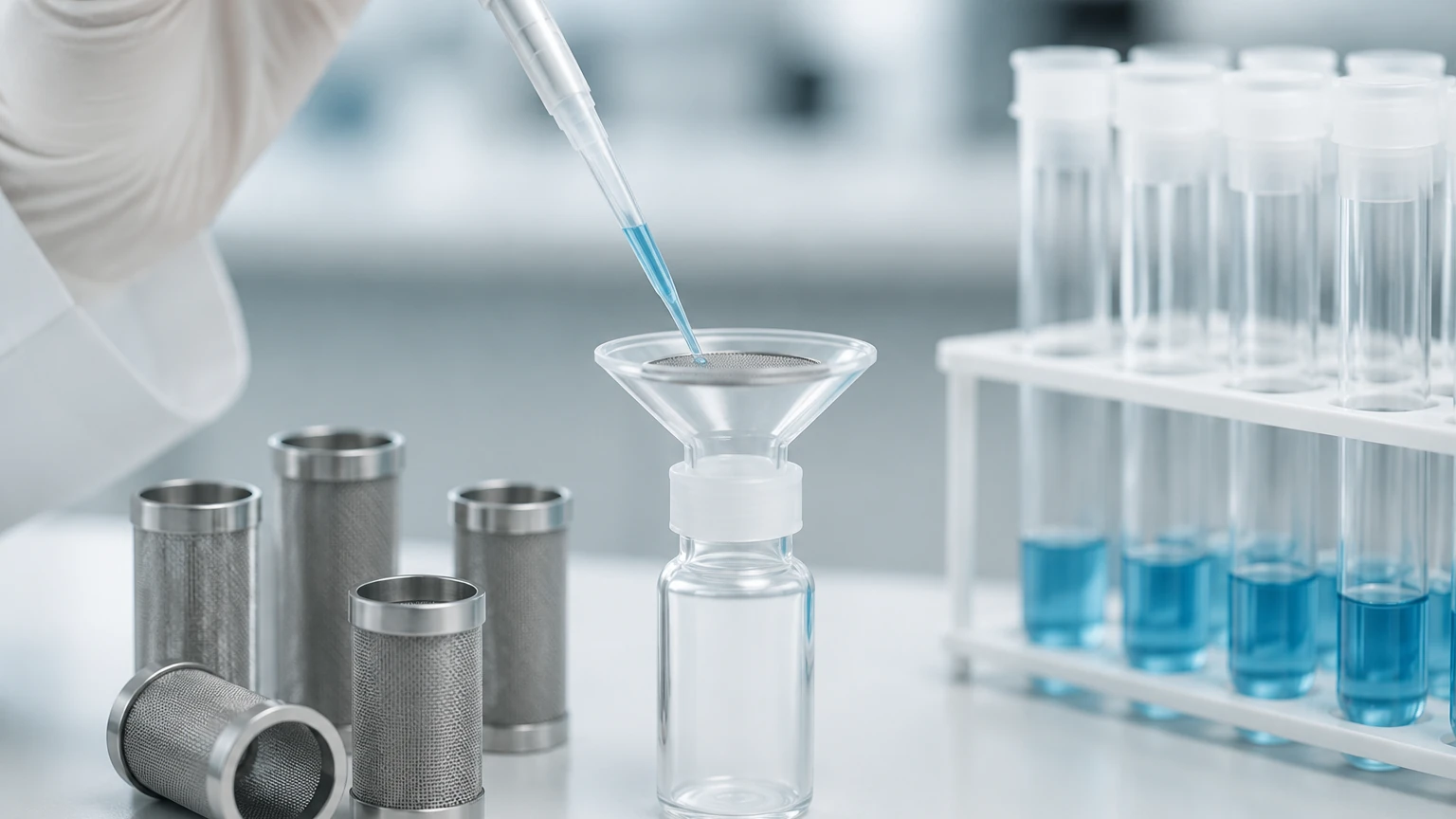
Stainless Steel and Porous Metals: For applications involving aggressive solvents, high temperatures, or extreme pressures, stainless steel filtration components are superior. Sintered stainless steel wire mesh or porous metal powders provide exceptional chemical compatibility and can be cleaned and reused in certain industrial configurations. At Kaifil, we specialize in custom stainless steel filtration solutions that meet the rigorous demands of chemical processing and pharmaceutical manufacturing. These metal filters offer a level of durability and precision that polymer-based filters cannot match, particularly in automated systems where the filter is a permanent or semi-permanent part of the hardware.
Polymer-Based Media: High-density polyethylene (HDPE) and ultra-high-molecular-weight polyethylene (UHMWPE) are the standards for disposable pipette tips. These materials are chosen for their purity and low extractable profile, ensuring that no chemicals leach from the filter into the sample. However, for engineers designing heavy-duty industrial equipment, the transition to metal-based filtration is often necessary to ensure long-term reliability and resistance to mechanical wear.
When evaluating materials, engineers must also consider the "leachable" profile. In sensitive analytical chemistry, such as LC-MS (Liquid Chromatography-Mass Spectrometry), any contaminants from the filter material can interfere with the detection of trace compounds. Therefore, the manufacturing process—whether it involves sintering, weaving, or molding—must be strictly controlled to maintain the highest levels of cleanliness.
Customization and OEM Integration for Liquid Handling
Many industrial liquid handling projects require bespoke filtration solutions that cannot be met by off-the-shelf products. Customization in pipette filtration involves tailoring the dimensions, pore structures, and material properties to fit a specific instrument design or a unique application.
OEM (Original Equipment Manufacturer) partnerships are vital for developing these specialized components. For instance, a manufacturer of automated diagnostic equipment may require a filter with a specific outer diameter and a non-standard thickness to fit into a proprietary nozzle design. Furthermore, the filtration efficiency may need to be tuned to handle high-viscosity fluids or volatile organic compounds (VOCs).
Custom stainless steel wire mesh filters can be engineered to provide specific flow rates while maintaining a compact footprint. By adjusting the weave pattern or the sintering parameters, manufacturers can create a filter that offers the exact balance of protection and performance required by the end-user. This level of customization ensures that the filtration component is not an afterthought but an integrated part of the system's engineering excellence.
For engineers looking to integrate high-performance metal filtration into their liquid handling designs, it is essential to work with a manufacturer that understands the complexities of fluid dynamics and material science. You can review our product options and application support on our Main Page to see how we support OEM projects across various industrial sectors.
Operational Longevity and Maintenance Protocols
The total cost of ownership for any filtration system is influenced by the replacement cycle and the ease of maintenance. In manual pipetting, filters are typically disposed of with the tip, making the cost-per-unit a primary concern. However, in industrial and automated systems, the filter may be a fixed component that requires regular inspection and periodic replacement.
Replacement Indicators: Engineers should establish clear protocols for when a filter needs to be replaced. Common indicators include:
* Increased Aspiration Time: A clogged or partially obstructed filter will increase the time required to draw a specific volume of liquid.
* Volume Inaccuracy: If the filter's resistance changes, it can lead to under-aspiration or over-dispensing.
* Visible Contamination: Any sign of liquid penetration or discoloration on the filter surface necessitates an immediate change.
Maintenance of Fixed Filters: In systems utilizing stainless steel or permanent metal filters, cleaning protocols must be strictly followed. Ultrasonic cleaning or back-flushing with compatible solvents can extend the life of the filter, but eventually, the accumulation of sub-micron particles within the depth of the media will require the component to be replaced to maintain system integrity.
By selecting high-quality materials and adhering to a rigorous maintenance schedule, industrial facilities can minimize downtime and ensure the continued accuracy of their liquid handling processes. The reliability of pipette filtration is a direct reflection of the engineering rigor applied during the selection and implementation phases.
Conclusion: Selecting the Right Filtration Partner
Pipette filtration is a critical technical requirement for any precision liquid handling application. From protecting sensitive samples against cross-contamination to ensuring the mechanical longevity of expensive automated equipment, the role of the filter cannot be overstated. For engineers and technical professionals, the challenge lies in balancing filtration efficiency, airflow dynamics, and chemical compatibility.
As a professional manufacturer of custom stainless steel filtration solutions, Kaifil provides the technical expertise and manufacturing capabilities needed to address the most demanding industrial filtration challenges. Whether you require precision wire mesh components or sintered metal filters for specialized liquid handling, our team works closely with you to develop solutions that meet your exact specifications. For more information on our capabilities and to discuss your specific project needs, please visit our Main Page.
