


Polyurethane Foam Filter
In industrial filtration, the polyurethane foam filter serves as a versatile and essential component for air and liquid management. Often referred to as reticulated foam, these filters are characterized by a unique open-cell structure that allows for high flow rates while capturing particulate matter. For engineers and procurement specialists, understanding the technical nuances of polyurethane foam—from its chemical composition to its pore density—is critical for optimizing system performance and protecting downstream precision equipment.
While high-precision applications often require the durability of stainless steel mesh, polyurethane foam filters frequently act as the first line of defense in multi-stage filtration systems. This guide examines the engineering principles, material specifications, and industrial applications of polyurethane foam filters to assist in informed technical decision-making.
The Science of Reticulation in Polyurethane Foam
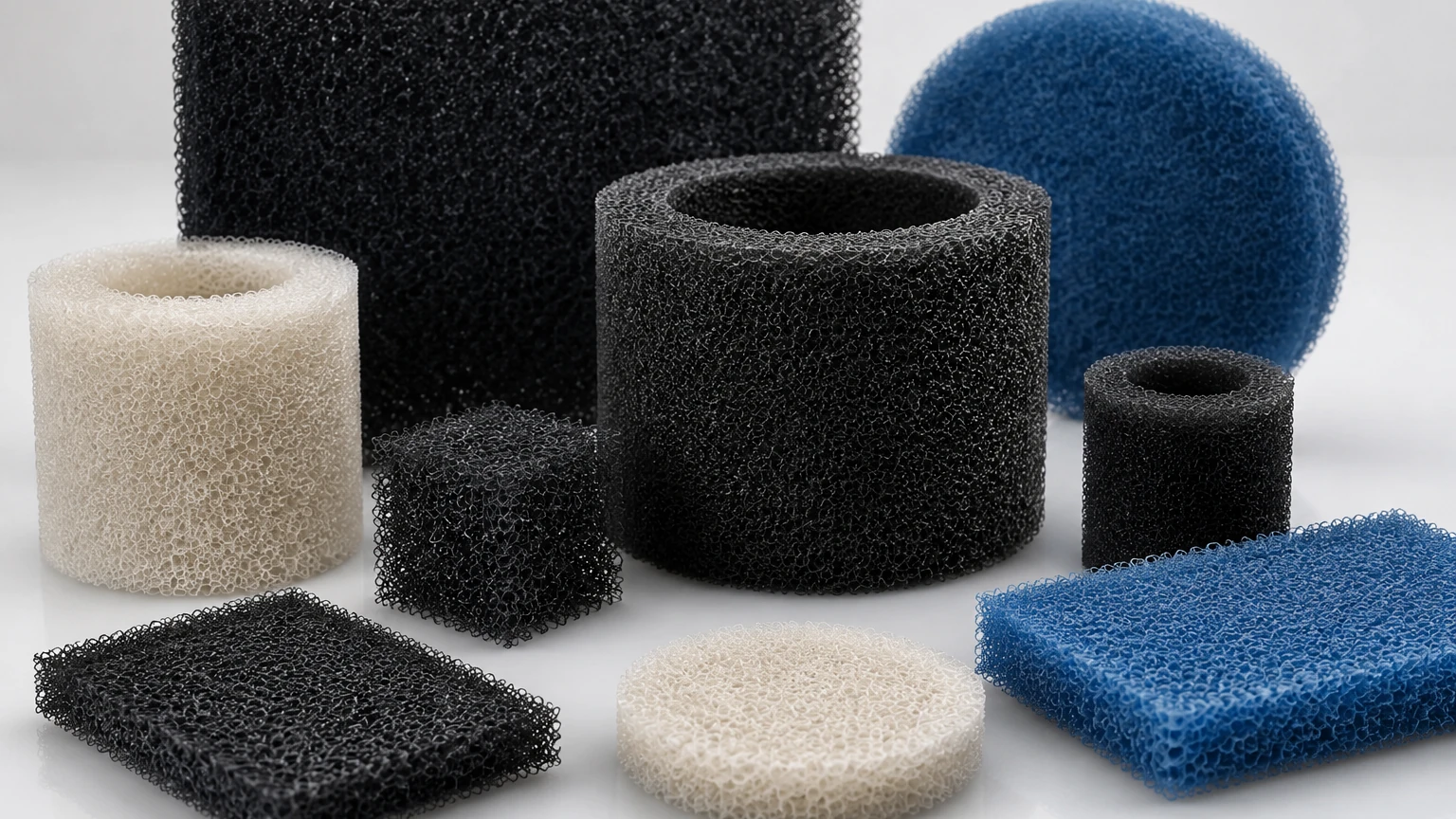
The effectiveness of a polyurethane foam filter stems from a manufacturing process known as reticulation. Standard polyurethane foam typically contains "windows" or membranes between the cell strands. Reticulation involves a controlled combustion or chemical process that removes these membranes, leaving only a skeletal dodecahedral structure.
This open-cell architecture is what distinguishes a filter-grade foam from common cushioning foam. By removing the membranes, manufacturers create a material with a high void volume—often exceeding 95%. This high porosity ensures that fluids or gases can pass through the media with minimal resistance, which is a primary requirement for HVAC systems, air compressors, and small engine intakes. From an engineering perspective, the reticulation process ensures that the internal surface area is maximized for particle impingement without significantly compromising the structural integrity of the polymer strands.
Technical Classification: Understanding PPI (Pores Per Inch)
The most critical specification for any polyurethane foam filter is its pore density, measured in Pores Per Inch (PPI). This metric dictates both the filtration efficiency and the pressure drop across the media. Industrial foam filters typically range from 10 PPI to 100 PPI.
* 10 to 30 PPI (Coarse): These foams have large, visible pores. They are primarily used for large particle capture, such as lint, hair, and heavy dust. They offer the lowest pressure drop and are frequently used as pre-filters for more sensitive components.
* 45 to 60 PPI (Medium): This range strikes a balance between efficiency and flow. It is commonly found in industrial power equipment and general-purpose air filtration where moderate particulate removal is required.
* 80 to 100 PPI (Fine): These filters have very small pores and provide the highest efficiency for fine dust. However, they also exhibit the highest initial pressure drop and can clog more quickly if the particulate load is high.
When selecting a PPI rating, engineers must calculate the face velocity of the system. If the velocity is too high for a fine PPI foam, the material may deform or the pressure drop may exceed the system's operational limits. Conversely, choosing a PPI that is too coarse may allow contaminants to pass through, potentially damaging precision components like those found on the Main Page of high-performance filtration catalogs.
Chemical Compatibility: Polyester vs. Polyether Formulations
Polyurethane foam filters are generally categorized into two chemical families: polyester-based and polyether-based. Selecting the correct base material is vital for ensuring the filter survives the operating environment.
Polyester Polyurethane Foam
Polyester-based foams are known for their superior mechanical strength and resistance to hydrocarbons. They are the preferred choice for applications involving oils, greases, and many solvents. In automotive and industrial lubricant filtration, polyester foam maintains its structural integrity even when saturated with petroleum-based products. However, polyester foam is susceptible to hydrolytic degradation; it can break down when exposed to high humidity and high temperatures over long periods.
Polyether Polyurethane Foam
Polyether-based foams are engineered for environments where moisture and heat are prevalent. They offer excellent resistance to hydrolysis and are less likely to support microbial growth (fungal or bacterial). This makes them the standard for water filtration, outdoor equipment, and humid HVAC environments. While they may have slightly lower tensile strength and tear resistance compared to polyester foams, their longevity in aqueous or humid conditions makes them indispensable for specific industrial sectors.
Performance Characteristics: Pressure Drop and Dust Holding Capacity
The primary performance metrics for a polyurethane foam filter are its initial pressure drop and its dust holding capacity (DHC). Because the foam is a depth-loading medium, it can trap particles throughout its entire thickness, not just on the surface.
1. Pressure Drop: This is the resistance to flow. As the PPI increases, the resistance increases. Engineers must ensure the fan or pump in the system can overcome the resistance of the filter even as it becomes loaded with contaminants.
2. Dust Holding Capacity: This refers to the amount of particulate the filter can retain before reaching a terminal pressure drop. Polyurethane foam's high void volume allows it to hold significant amounts of dust. This depth-loading characteristic is why foam is often preferred over thin paper or fabric filters in heavy-duty industrial environments.
To optimize these metrics, manufacturers often use "gradient density" configurations, where layers of different PPI foams are bonded together. A coarse outer layer captures large debris, while a finer inner layer captures smaller particles, effectively extending the service life of the entire filter assembly.
Industrial Applications and Pre-filtration Strategies
Polyurethane foam filters are utilized across a broad spectrum of industries due to their versatility and low cost.
* HVAC and Air Handling: Used as permanent, washable filters in air conditioning units and industrial ventilation to protect coils from dust buildup.
* Small Engine Protection: Found in lawnmowers, chainsaws, and portable generators, where they protect the carburetor from environmental debris.
* Electronic Enclosures: Used to filter cooling air for servers and control panels, preventing dust from accumulating on sensitive circuit boards.
* Medical Devices: Employed in CPAP machines and oxygen concentrators as both a filter and a noise dampener.
* Acoustic Management: Beyond filtration, the open-cell structure of polyurethane foam is excellent at dissipating sound energy, making it a dual-purpose component in noisy industrial machinery.
In many high-end industrial processes, a polyurethane foam filter is used as a pre-filter for stainless steel cartridges or precision wire mesh. By removing the bulk of the particulate load, the foam filter prevents the more expensive metal filters from clogging prematurely, thereby reducing the total cost of ownership for the filtration system.
Selection Criteria for Engineering and Procurement
When specifying a polyurethane foam filter for a new project, technical teams should confirm the following parameters with their supplier:
* Operating Temperature: Most polyurethane foams are rated for continuous use up to 180°F (82°C) or 200°F (93°C). Beyond this, the polymer may soften or lose structural integrity.
* Face Velocity: The speed of the air or liquid passing through the filter face. High velocities may require reinforced foam or a more rigid support structure to prevent "blow-through."
* Environmental Exposure: Will the filter be exposed to UV light, ozone, or specific chemicals? UV stabilizers can be added to the foam to prevent yellowing and embrittlement in outdoor applications.
* Flame Retardancy: Many industrial applications require foams that meet specific fire safety standards, such as UL 94 HF-1. Specialized additives can be incorporated to provide self-extinguishing properties.
Maintenance Protocols and Total Cost of Ownership
One of the most significant advantages of the polyurethane foam filter is its washability. Unlike disposable paper filters, many foam filters can be cleaned and reused multiple times.
Maintenance typically involves vacuuming the loose dust or washing the foam in a mild detergent solution. After washing, it is crucial that the foam is completely dry before re-installation to prevent the growth of mold or restricted airflow. However, engineers should note that foam filters do have a finite lifespan. Over time, the polymer strands can become brittle due to chemical exposure or thermal cycling. A regular replacement schedule—based on pressure drop monitoring—is essential to ensure the filter does not fail and release captured contaminants downstream.
From a cost perspective, foam filters are highly economical. While their initial efficiency may be lower than HEPA or specialized membrane filters, their ability to be cleaned and their high dust-holding capacity make them a cost-effective solution for primary and secondary filtration stages.
Synergistic Filtration: Foam Pre-filters and Stainless Steel Components
In demanding industrial environments, such as chemical processing or hydraulic systems, a single-stage filter is rarely sufficient. Engineers often design systems that utilize the depth-loading capabilities of polyurethane foam filters in conjunction with the precision and durability of stainless steel filtration components.
For instance, in a hydraulic reservoir breather, a coarse polyurethane foam filter might capture ambient dust, while a stainless steel mesh filter handles the finer internal contaminants. This combination ensures that the high-precision metal components—which can be reviewed for specific technical grades on the Main Page—operate under optimal conditions for longer durations.
By leveraging the strengths of different materials, industrial facilities can achieve a balance between filtration efficiency, system longevity, and operational economy. Whether used as a standalone solution or as part of a complex filtration train, the polyurethane foam filter remains a foundational technology in modern industrial engineering.
