


Pond Filter Foam
In the realm of industrial water treatment, aquaculture, and large-scale commercial water features, the selection of filtration media is a critical engineering decision. Among the various options available, pond filter foam remains a staple for both mechanical and biological filtration. However, for engineers and facility managers, understanding the technical nuances of foam media—including its material composition, pore structure, and performance limitations—is essential to ensuring system longevity and water quality.
While pond filter foam is often associated with residential applications, its industrial-grade counterparts are designed to meet rigorous standards for flow rate, durability, and chemical resistance. This article examines the technical specifications of pond filter foam and explores how it integrates into broader industrial filtration strategies, including the use of high-performance metal components found on our Main Page.
Understanding the Engineering of Pond Filter Foam
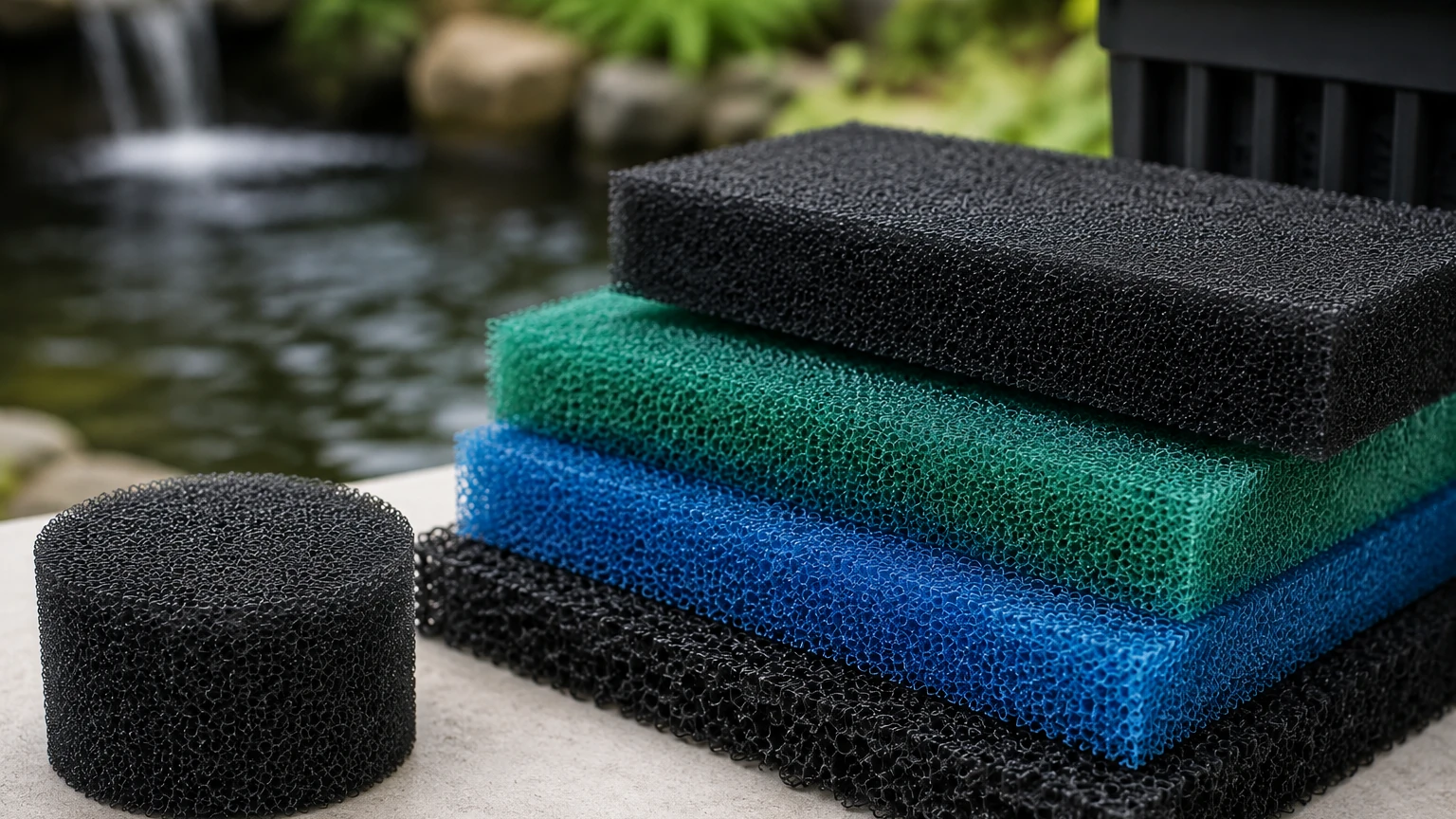
Pond filter foam is a reticulated, open-cell polyurethane material specifically engineered to allow water passage while trapping suspended solids and providing a substrate for microbial growth. Unlike closed-cell foams used for insulation, reticulated foam undergoes a process called "zapping" or thermal reticulation, where the cell membranes are removed, leaving only a skeletal dodecahedron structure.
Pore Density and PPI Ratings
The performance of pond filter foam is primarily categorized by its Pores Per Inch (PPI) rating. This metric defines the coarseness or fineness of the media:
* 10 PPI (Coarse): Large pore sizes designed for primary mechanical filtration. These are used to capture large debris such as leaves, twigs, and heavy sludge without immediate clogging. They offer the lowest pressure drop and highest flow rates.
* 20 to 30 PPI (Medium): The standard for general-purpose filtration. This density balances mechanical trapping of smaller particulates with a significant surface area for biological colonization.
* 45 PPI and Higher (Fine): Used for polishing water. These foams trap fine silt and organic matter but are prone to rapid clogging (blinding) if not preceded by coarser stages.
In professional systems, these densities are often used in a graduated stack. This "staged filtration" ensures that the coarse layers protect the fine layers, extending the maintenance interval of the entire assembly.
Material Science: Polyether vs. Polyester Foam
Not all pond filter foam is created equal. From a chemical engineering perspective, the choice between polyether-based and polyester-based polyurethane is vital for long-term submerged performance.
Polyether-Based Polyurethane
For water treatment and pond applications, polyether foam is the industry standard. It exhibits superior hydrolytic stability, meaning it does not break down or crumble when permanently submerged in water. It is also more resistant to microbial attack and the various chemical additives often found in industrial water circuits.
Polyester-Based Polyurethane
While polyester foams often have higher tensile strength and tear resistance, they are susceptible to hydrolysis. Over time, exposure to water causes the polymer chains to break, leading to a loss of structural integrity. In a B2B or industrial context, using polyester foam in a continuous-flow water system is a common failure point that leads to media migration and downstream equipment damage.
Mechanical vs. Biological Filtration Performance
Industrial filtration systems utilizing pond filter foam must account for two distinct functional roles: mechanical capture and biological conversion.
Mechanical Capture and Tortuosity
Foam acts as a depth filtration medium. As water travels through the open-cell structure, it follows a tortuous path. Particulates are captured through inertial impaction and sedimenting into the "pockets" of the foam skeleton. Unlike surface filtration (like a fine wire mesh), foam can hold a significant volume of solids before the pressure drop becomes critical. However, as the foam loads with solids, the effective pore size decreases, which can actually improve filtration efficiency at the cost of flow velocity.
Biological Surface Area (BSA)
The skeletal structure of pond filter foam provides a massive protected surface area for nitrifying bacteria (such as *Nitrosomonas* and *Nitrobacter*). These bacteria convert toxic ammonia into nitrite and then into nitrate. For large-scale aquaculture or bio-remediation projects, the Total Surface Area (TSA) per cubic meter of foam is a key design parameter. High-quality reticulated foam can offer between 500 and 1,000 square meters of surface area per cubic meter of volume, making it one of the most efficient bio-media options available.
Limitations and Industrial Alternatives
Despite its versatility, pond filter foam has inherent limitations that may necessitate the transition to more robust filtration technologies, such as the stainless steel solutions provided by Kaifil.
1. Structural Integrity Under High Pressure
Foam is a compressible medium. In high-pressure hydraulic or industrial pumping systems, foam can compress, leading to a drastic reduction in pore size and eventual bypass or system failure. In these scenarios, rigid metal filters, such as stainless steel wire mesh or sintered metal cartridges, are preferred. These components maintain their geometry regardless of flow fluctuations.
2. Cleaning and Sterilization
In pharmaceutical or food-grade water treatment, the ability to sterilize equipment is paramount. Pond filter foam is difficult to sterilize effectively without damaging the polymer. Stainless steel filters, conversely, support Clean-in-Place (CIP) and Steam-in-Place (SIP) protocols, offering a level of hygiene that foam cannot match.
3. Replacement Cycles and Waste
Foam is a consumable. Even high-quality polyether foam eventually loses its elasticity and must be replaced. For facilities aiming for zero-waste or reduced O&M (Operations and Maintenance) costs, permanent stainless steel filtration components offer a significantly lower total cost of ownership over a 5-to-10-year horizon.
For technical professionals evaluating these trade-offs, reviewing the range of durable alternatives on our Main Page can provide insights into more permanent filtration architectures.
Engineering Considerations for Selection and Customization
When specifying pond filter foam for a commercial or industrial project, engineers should confirm several factors with their suppliers to ensure the media meets the application's demands.
Flow Rate and Velocity
The face velocity of water entering the foam should be calculated to prevent "channeling," where water finds a path of least resistance and bypasses the majority of the media. Lower velocities generally lead to better mechanical capture and more stable biological activity.
UV Resistance
If the filtration system is exposed to direct sunlight (as in many outdoor pond or water feature designs), the foam must be UV-stabilized. Standard polyurethane degrades rapidly under ultraviolet radiation, turning yellow and eventually becoming brittle. UV-stable additives are essential for any foam media used in open-top gravity filters.
Chemical Compatibility
In industrial settings, the water may contain ozone, chlorine, or various scale inhibitors. It is necessary to verify that the foam's polymer base and any colorants used are chemically inert to these substances to prevent leaching or premature degradation.
Integration with Stainless Steel Components
In many advanced filtration systems, pond filter foam is used as a secondary or tertiary stage. For example, a system may utilize a stainless steel coarse screen to remove large debris, followed by a foam stage for biological treatment, and finally a precision stainless steel cartridge for fine particulate removal.
This hybrid approach leverages the strengths of both materials:
* Stainless Steel: Provides the structural backbone, high-pressure resistance, and precision micron ratings for critical stages.
* Foam: Provides cost-effective, high-surface-area biological filtration and depth loading for non-critical solids.
By integrating custom-manufactured metal components, engineers can protect the foam media from excessive loading, thereby extending its service life and improving the overall reliability of the filtration circuit.
Maintenance and Lifecycle Management
Maintenance of pond filter foam in an industrial context requires a standardized protocol to prevent anaerobic conditions and system clogs.
1. Pressure Monitoring: Differential pressure gauges should be installed before and after the foam chamber. A rise in pressure indicates the need for cleaning.
2. Cleaning Protocols: Foam should be cleaned using de-chlorinated water (if biological activity is to be preserved) or high-pressure air/water (if strictly mechanical). Over-cleaning can strip the beneficial biofilm, leading to ammonia spikes in the system.
3. Inspection for Degradation: During cleaning, the foam should be inspected for "compression set"—a condition where the foam fails to return to its original shape. This indicates that the polymer is reaching the end of its functional life.
Conclusion
Pond filter foam is a sophisticated engineering material that, when correctly specified, provides exceptional mechanical and biological filtration. By understanding PPI ratings, material chemistry, and the physical principles of depth filtration, technical professionals can design more efficient water treatment systems. However, for applications requiring high precision, extreme durability, or sterile conditions, foam should be supplemented or replaced with professional-grade stainless steel filtration components.
For more information on custom metal filtration solutions and how they can enhance your industrial water treatment processes, please visit our Main Page.
