


Reticulated Polyurethane Foam Low Pressure Drop
In industrial filtration and fluid handling, the efficiency of a system is often dictated by the resistance to flow encountered by the medium. Reticulated polyurethane foam (RPF) has emerged as a critical material in applications requiring high permeability and minimal resistance. The primary engineering advantage of this material is the reticulated polyurethane foam low pressure drop, which allows for high flow rates in air, gas, and liquid filtration systems without necessitating excessive energy consumption from blowers or pumps.
Understanding the technical nuances of reticulated foam—from its cellular structure to its performance under varying face velocities—is essential for engineers and procurement teams tasked with optimizing filtration efficiency. This article examines the mechanics of pressure drop in reticulated foam, its selection criteria, and how it compares to high-performance alternatives like stainless steel wire mesh.
The Engineering Behind Reticulated Polyurethane Foam
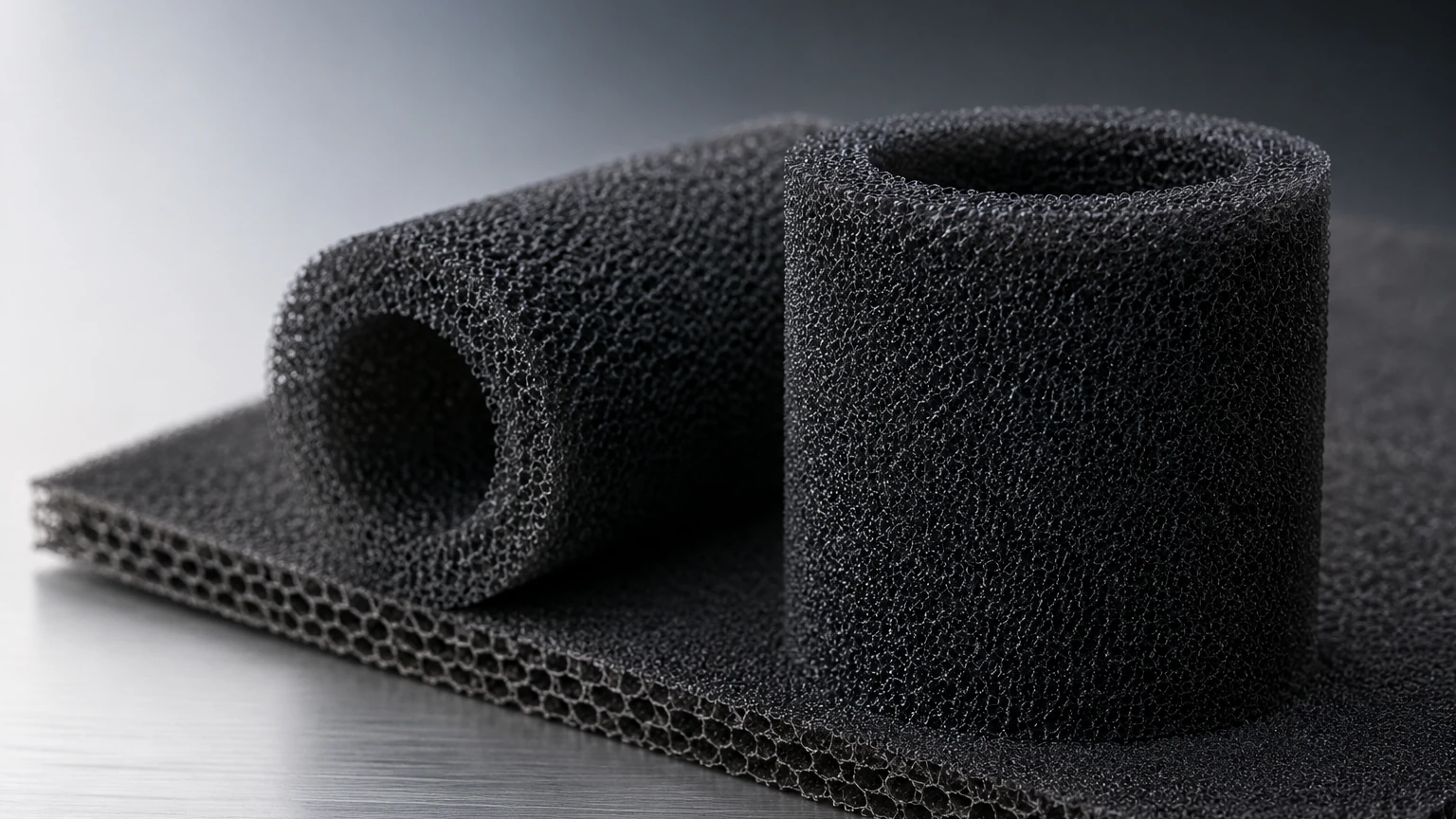
Reticulated polyurethane foam is a specialized open-cell material characterized by a three-dimensional skeletal structure. Unlike standard flexible polyurethane foam, which contains intact membranes (or "windows") between the cell strands, reticulated foam undergoes a secondary manufacturing process—typically thermal or chemical—to remove these membranes.
This process, known as reticulation, leaves only the dodecahedron-like skeletal framework. The resulting structure is approximately 95% to 98% void space. From a fluid dynamics perspective, this high porosity is the fundamental reason for the reticulated polyurethane foam low pressure drop. Because there are no membranes to block the path of the fluid, the air or liquid can pass through the medium with significantly less impingement and friction than would be encountered in non-reticulated or closed-cell materials.
Analyzing the Mechanics of Low Pressure Drop
Pressure drop ($ΔP$) is the difference in total pressure between two points of a fluid carrying network. In filtration, it represents the energy lost as the fluid overcomes the resistance of the filter media. For engineers, minimizing $ΔP$ is vital for reducing the Total Cost of Ownership (TCO) of a system, as every Pascal of resistance requires additional power from the prime mover.
Several factors contribute to the low pressure drop profile of reticulated polyurethane foam:
1. High Porosity: The nearly complete absence of cell membranes ensures that the effective open area is maximized. This reduces the "constriction" effect that occurs when fluid is forced through small apertures.
2. Skeletal Geometry: The thin, aerodynamic strands of the polyurethane skeleton offer minimal surface area for drag to develop.
3. Uniformity: High-quality reticulated foam features a consistent pore size distribution, which prevents the formation of localized high-velocity zones that could lead to turbulent flow and disproportionate pressure increases.
In most industrial air filtration applications, the flow remains laminar or in the transitional regime. In these states, the pressure drop is typically linear relative to the face velocity. However, as velocities increase, the reticulated polyurethane foam low pressure drop remains competitive due to the material’s ability to maintain structural integrity without collapsing under the force of the flow.
Key Performance Factors: PPI and Porosity
The most common metric for specifying reticulated foam is Pores Per Inch (PPI). This measurement defines the number of pores across a linear inch and directly correlates with the filtration efficiency and the resulting pressure drop.
* Low PPI (10–30 PPI): These foams have large, coarse pores. They offer the lowest possible pressure drop and are typically used for high-volume air intake, pre-filtration, or as a substrate for ceramic coatings. In these ranges, the reticulated polyurethane foam low pressure drop is negligible even at high velocities.
* Medium PPI (45–75 PPI): These provide a balance between particle capture and flow resistance. They are commonly found in HVAC systems and small engine air cleaners.
* High PPI (80–100+ PPI): These foams are used for fine filtration. While the pressure drop increases as the PPI increases, the reticulated nature of the foam still ensures that the $ΔP$ is significantly lower than that of felted or non-woven media of comparable efficiency.
When selecting a PPI rating, engineers must calculate the required face velocity. A common error is over-specifying the filtration fineness (higher PPI), which can lead to premature clogging and a rapid spike in pressure drop, necessitating more frequent maintenance cycles.
Industrial Applications and Performance Expectations
The reticulated polyurethane foam low pressure drop makes it an ideal candidate for a wide array of industrial sectors where air or liquid movement is critical.
HVAC and Air Handling
In large-scale HVAC systems, reticulated foam is often used as a permanent, washable pre-filter. Its ability to capture large particulates while maintaining low resistance ensures that the primary, more expensive HEPA or ULPA filters are protected without straining the system's fans.
Compressor and Blower Intake
Industrial compressors require massive volumes of air. Any resistance at the intake can lead to a significant drop in volumetric efficiency. Reticulated foam provides the necessary protection against environmental debris with minimal impact on the compressor's performance curve.
Medical and Laboratory Equipment
In medical devices, such as oxygen concentrators or diagnostic equipment, low noise and low energy consumption are paramount. The low pressure drop of RPF allows for smaller, quieter motors to be used, improving the overall design of the device.
Comparing Reticulated Foam with Stainless Steel Filtration
While reticulated polyurethane foam is excellent for many applications, engineers must recognize its limitations in demanding industrial environments. Polyurethane is a polymer and is subject to degradation from high temperatures (typically above 90°C), UV exposure, and certain aggressive chemicals.
In environments involving high-pressure hydraulics, steam, corrosive chemicals, or extreme temperatures, the industry often transitions from foam to metal-based solutions. As a professional manufacturer, Kaifil provides advanced alternatives such as stainless steel wire mesh and sintered metal cartridges. You can Review product options and application support on our Main Page to see how metal filtration components compare in terms of durability and precision.
Unlike foam, stainless steel filters offer:
* Mechanical Strength: Ability to withstand high differential pressures without deformation.
* Chemical Compatibility: Resistance to solvents and acids that would dissolve polyurethane.
* Cleanability: Metal filters can be ultrasonically cleaned or back-flushed, whereas foam may eventually degrade after multiple wash cycles.
However, for low-pressure air applications where cost-effectiveness and weight are the primary drivers, the reticulated polyurethane foam low pressure drop remains an industry standard.
Selection Criteria for Engineering and Procurement
When specifying reticulated foam for a project, several technical parameters must be confirmed to ensure the low pressure drop is maintained throughout the filter's service life:
1. Face Velocity (FPM or m/s): Determine the speed at which the fluid will hit the filter face. Higher velocities require lower PPI foams to keep $ΔP$ within acceptable limits.
2. Dust Holding Capacity: A filter with a low initial pressure drop is useless if it clogs instantly. Reticulated foam’s depth-loading characteristics allow it to hold a significant amount of contaminant before the pressure drop begins to rise exponentially.
3. Environmental Stability: Confirm if the foam is polyester-based (better for oils/hydrocarbons) or polyether-based (better for high-humidity/water applications). Hydrolytic stability is crucial for maintaining the skeletal structure.
4. Thickness: The depth of the foam contributes to the pressure drop. Doubling the thickness does not always double the $ΔP$ in laminar flow, but it does significantly increase the tortuous path for particles.
Maintenance, Durability, and Total Cost of Ownership
The lifecycle of a filtration system is heavily influenced by how the pressure drop evolves over time. Reticulated foam is often marketed as a "permanent" filter because it can be cleaned. However, in industrial B2B contexts, "cleanability" must be weighed against the labor costs of maintenance.
Because of the reticulated polyurethane foam low pressure drop, these filters can often run longer between cleanings than surface-loading paper filters. When the pressure drop reaches a pre-defined limit (often 2 to 3 times the initial $ΔP$), the foam can be washed with mild detergents or vacuumed.
For procurement teams, the initial low cost of foam is attractive, but for mission-critical systems where downtime is expensive, transitioning to a custom stainless steel solution from Kaifil may offer a lower TCO due to the extended service life and superior structural integrity of metal components. We encourage technical professionals to evaluate the specific demands of their application—considering temperature, pressure, and chemical exposure—before finalizing their filter media selection.
Conclusion
Reticulated polyurethane foam remains a cornerstone of low-resistance filtration. Its unique skeletal structure provides a reticulated polyurethane foam low pressure drop that is difficult to match with other lightweight materials. By understanding the relationship between PPI, velocity, and fluid dynamics, engineers can effectively integrate this material into their designs to optimize energy efficiency and performance.
For applications that exceed the physical limits of polyurethane, such as high-temperature processing or high-pressure hydraulic systems, specialized metal filtration components are required. Kaifil remains committed to providing high-performance, customized stainless steel filtration solutions for global industrial leaders. For more information on precision metal filters and custom engineering support, please visit our Main Page.
Download Reticulated Polyurethane Foam Low Pressure Drop as a PDF
