


Rotary Drum Screen
In the landscape of industrial liquid-solid separation, the rotary drum screen stands as a fundamental component for primary filtration and wastewater pretreatment. These mechanical self-cleaning filters are engineered to remove suspended solids from fluid streams, protecting downstream equipment and ensuring process efficiency. For engineers and procurement teams, selecting the appropriate rotary drum screen involves a deep understanding of hydraulic loads, particle characteristics, and material durability. As a specialized manufacturer of stainless steel filtration solutions, Kaifil emphasizes the technical precision required to optimize these systems for demanding industrial environments.
Introduction to Rotary Drum Screen Technology
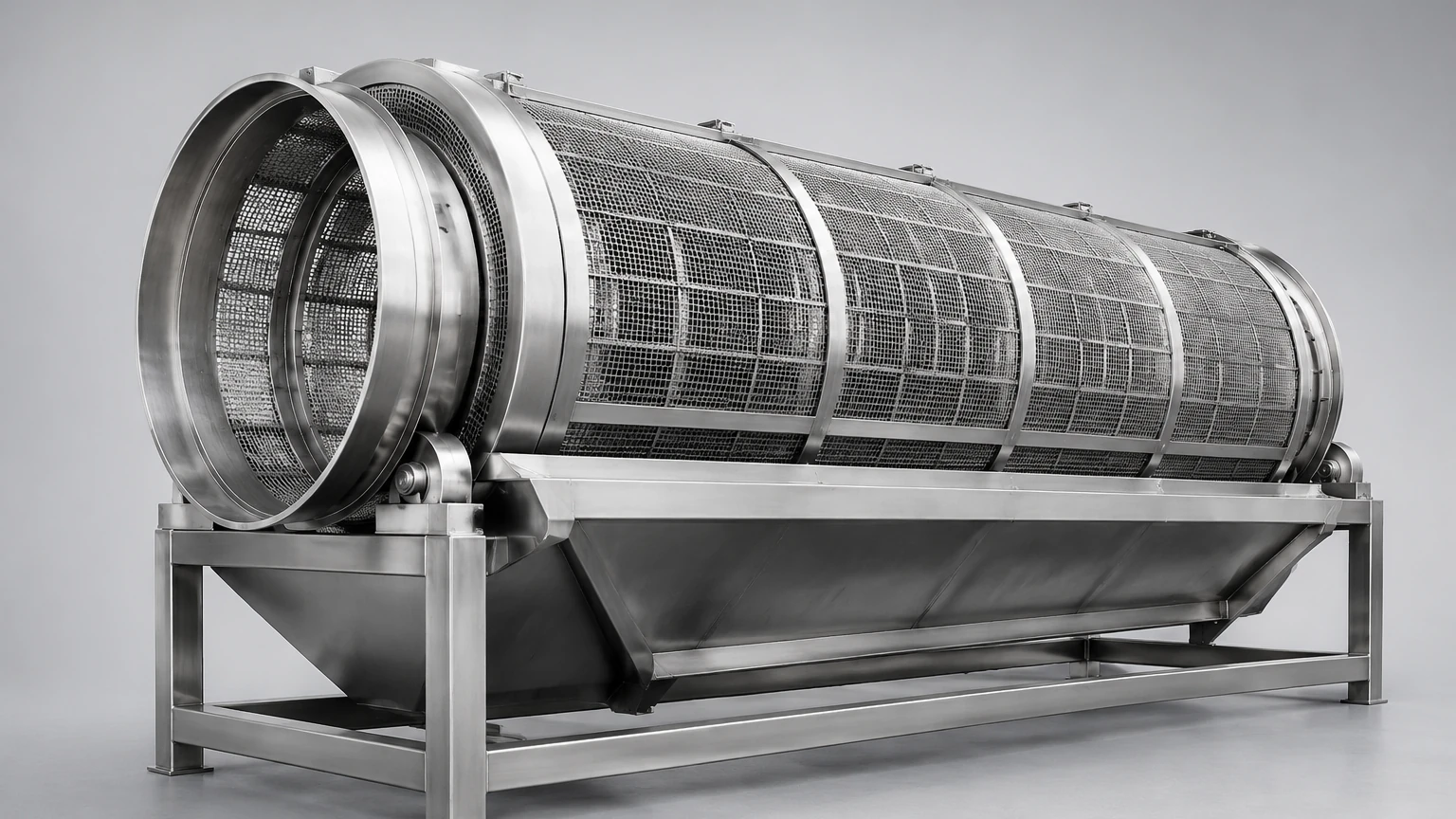
A rotary drum screen is a mechanical filtration device consisting of a rotating cylindrical drum covered with a filter medium—typically stainless steel wedge wire, perforated plate, or woven wire mesh. As the drum rotates, the influent enters either the interior or exterior of the cylinder, where solids are captured on the screen surface while the clarified liquid passes through.
The primary objective of this technology is to provide continuous, automated separation without the frequent downtime associated with static screens. In industrial B2B applications, these units are valued for their high throughput-to-footprint ratio and their ability to handle varying solids concentrations. Whether utilized in municipal wastewater treatment or specialized chemical processing, the performance of the screen is dictated by the quality of the filter media and the precision of the drum’s mechanical assembly.
Operational Mechanics: Internal vs. External Feed Systems
Rotary drum screens are generally categorized by their flow direction: internal feed and external feed. Each configuration offers distinct advantages based on the nature of the waste stream and the required filtration fineness.
Internal Feed Rotary Drum Screens
In an internal feed system, the influent enters the center of the rotating drum through a distribution header. The liquid passes through the screen media from the inside out. Solids are retained on the inner surface and are transported axially by internal flights or the drum's inclination toward a discharge chute. This design is particularly effective for high-grease applications or where very fine screening is required, as it prevents solids from bypassing the media.
External Feed Rotary Drum Screens
In external feed systems, the influent is directed onto the exterior surface of the drum. The liquid penetrates the screen into the center of the drum and is discharged through one end, while the solids remain on the outer surface. A scraper blade (doctor blade) or a spray bar typically removes the captured solids as the drum rotates. External feed screens are often preferred for high-flow applications with larger inorganic solids, such as those found in primary municipal screening or industrial flume water recovery.
Critical Component Design: The Role of Stainless Steel Filter Media
The heart of any rotary drum screen is the filter medium. The choice of material and structure directly impacts the filtration efficiency, pressure drop, and service life of the equipment. At Kaifil, the focus remains on high-performance stainless steel components that withstand the rigors of continuous industrial rotation.
1. Wedge Wire (V-Wire): This is the most common media for rotary drum screens. The V-shaped profile provides a non-clogging surface; the narrowest part of the slot is at the face, widening inward. This ensures that any particle passing the initial gap will continue through without getting wedged. Wedge wire offers superior structural strength and high open area.
2. Perforated Plates: For applications requiring the removal of specific shapes (like hair or fibers), perforated plates with circular or square holes are utilized. While they offer lower open area than wedge wire, they provide excellent dimensional stability.
3. Woven Wire Mesh: When fine filtration (below 100 microns) is necessary, multi-layered or reinforced woven wire mesh is employed. This requires a robust support structure to prevent the mesh from deforming under hydraulic pressure.
For technical professionals evaluating these options, the Main Page of the Kaifil site offers comprehensive data on material grades and customization options for these critical filtration components.
Engineering Considerations for Sizing and Capacity
Sizing a rotary drum screen is not merely a matter of matching pipe diameters. Engineers must calculate the "Hydraulic Capacity" and the "Solids Loading Rate" to prevent overflow and ensure effective separation. Several variables influence these calculations:
* Drum Diameter and Length: The total surface area available for filtration is the primary driver of capacity. Larger diameters allow for higher head pressure, which can increase throughput, while longer drums provide more residence time for dewatering solids.
* Rotational Speed: The peripheral speed of the drum must be optimized. If the drum rotates too slowly, the screen may become blinded by solids; if it rotates too quickly, the liquid may be carried over the top of the drum rather than passing through the media.
* Slot Opening (Aperture): The slot size must be selected based on the smallest particle that needs to be removed. However, smaller slots increase the resistance to flow, requiring a larger drum to maintain the same capacity.
* Submergence Level: In many designs, a portion of the drum is submerged. The level of submergence affects the effective filtration area and the hydraulic head driving the fluid through the screen.
Application-Specific Requirements in Industrial Processing
Rotary drum screens are versatile, but their configuration must be tailored to the specific industry.
Food and Beverage Industry
In food processing (such as poultry, meat, or vegetable canning), the screen must handle high organic loads and often fats, oils, and greases (FOG). Stainless steel 304 or 316L is mandatory for hygiene and corrosion resistance. The screen design must facilitate easy "Clean-in-Place" (CIP) to prevent bacterial growth.
Pulp and Paper
Here, the rotary drum screen is used for fiber recovery and white water filtration. The challenge lies in the fibrous nature of the solids, which can easily mat and blind a screen. High-pressure spray bars are essential in this sector to continuously clear the mesh.
Chemical and Pharmaceutical
In these sectors, chemical compatibility is the priority. The use of specialized stainless steel alloys ensures that the screen does not degrade when exposed to aggressive solvents or acidic process streams. Precision in the slot width is also critical to ensure product consistency during solid-catalyst recovery or intermediate filtration steps.
Maintenance Strategies and Operational Longevity
To ensure the total cost of ownership (TCO) remains low, a proactive maintenance schedule is required. The rotary drum screen is a dynamic machine with moving parts subject to wear.
* Cleaning Systems: Most screens utilize a spray bar. The water pressure and nozzle angle must be checked regularly to ensure the entire width of the drum is being cleaned. In applications with sticky solids, mechanical brushes or scrapers may also be used.
* Bearing and Drive Lubrication: The drum is supported by trunnion wheels or a central shaft with bearings. Regular lubrication is vital to prevent mechanical failure, especially in wet and corrosive environments.
* Seal Integrity: For internal feed screens, the seals between the stationary inlet and the rotating drum are wear items. If these seals fail, unfiltered liquid can bypass the screen, contaminating the effluent.
* Media Inspection: Periodically, the stainless steel surface should be inspected for signs of "pinning" (particles stuck in the slots) or physical damage from heavy debris. Early detection of wear on the wedge wire or mesh can prevent a catastrophic failure of the filtration process.
Custom OEM Solutions for Complex Filtration Challenges
Standard off-the-shelf rotary drum screens may not meet the specific constraints of every industrial facility. Customization often involves modifying the drum's metallurgy, the screen's aperture geometry, or the overall structural footprint to fit into existing infrastructure.
When specifying a custom rotary drum screen or replacement components, engineers should confirm the following data points with their manufacturer:
1. Fluid Chemistry: pH levels, temperature, and presence of corrosive agents.
2. Solids Characteristics: Particle size distribution, shape (fibrous vs. granular), and friability.
3. Flow Dynamics: Average flow, peak flow, and expected surge frequencies.
4. Discharge Requirements: The desired dryness of the captured solids.
By focusing on these technical boundaries, Kaifil provides reliable filtration components that integrate seamlessly into larger industrial systems. High-quality manufacturing ensures that the rotary drum screen remains a dependable asset rather than a bottleneck in the production line.
In conclusion, the rotary drum screen is an indispensable tool for modern industrial filtration. Through the careful selection of stainless steel media, precise engineering of drum mechanics, and a robust maintenance strategy, facilities can achieve superior separation performance and long-term operational stability. For those looking to explore specific filter configurations or custom metal components, visiting the Main Page offers a gateway to expert consultation and high-performance filtration technology.
