


Rotary Screen
In the landscape of industrial liquid-solid separation, the rotary screen—often referred to as a drum screen or trommel—stands as a cornerstone technology for continuous, high-volume filtration. Unlike static screens that may suffer from rapid blinding or vibrating screens that require significant energy for mechanical oscillation, the rotary screen utilizes rotational motion to facilitate particle separation. For engineers and procurement specialists, selecting the correct rotary screen configuration is a critical decision that impacts operational efficiency, maintenance cycles, and the purity of the final product.
As a specialized manufacturer of stainless steel filtration solutions, Kaifil provides the technical foundation required to optimize these systems. Understanding the engineering nuances of rotary screens is essential for applications ranging from municipal wastewater treatment to precision chemical processing.
Fundamental Mechanics of Rotary Screens
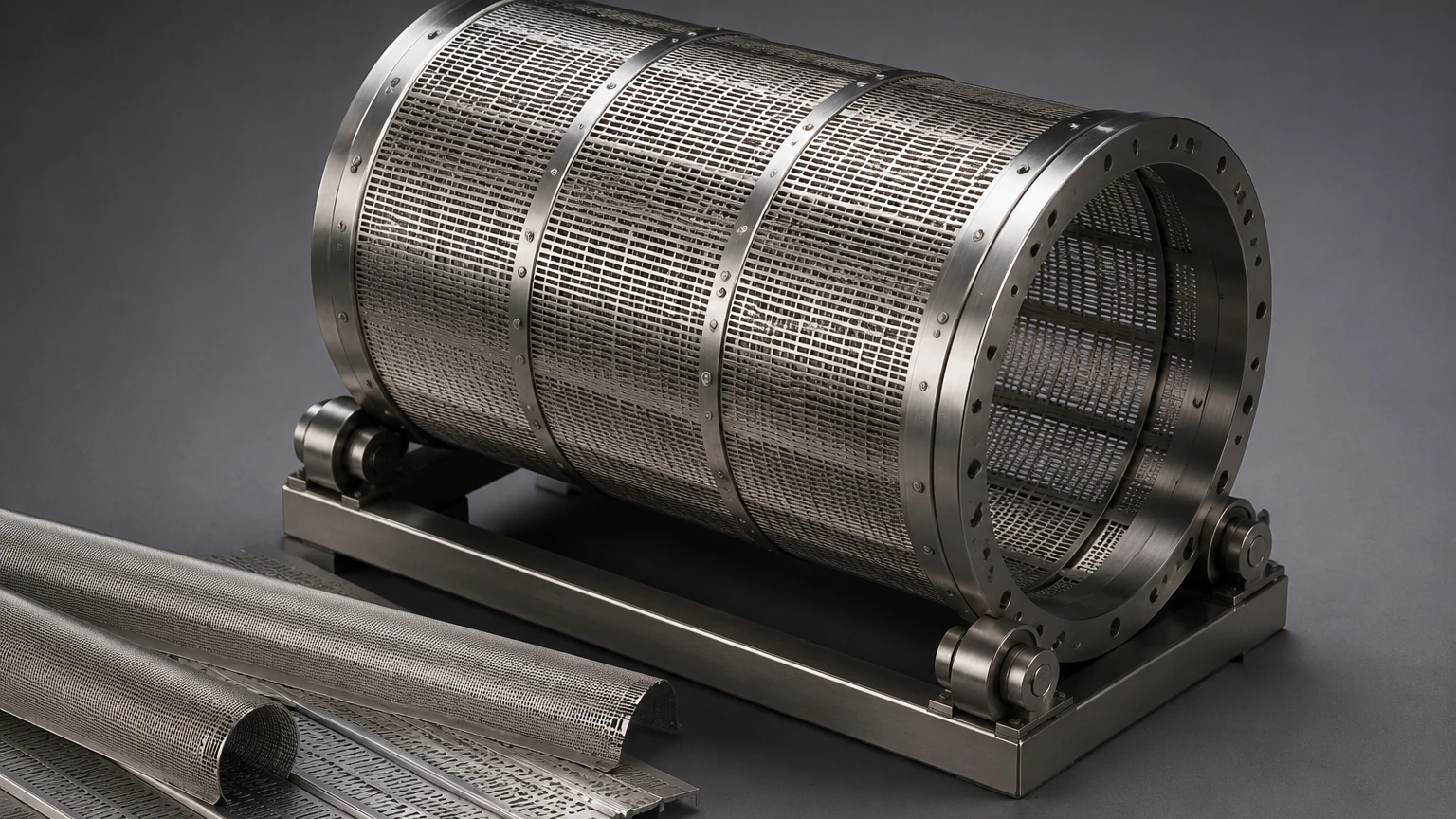
The primary function of a rotary screen is to separate solids from a liquid stream or to grade dry materials by size. The system typically consists of a cylindrical drum constructed from a filtration medium—such as wedge wire, woven wire mesh, or perforated metal—mounted on a horizontal or slightly inclined axis.
Internal-Fed vs. External-Fed Systems
There are two primary flow configurations in industrial rotary screening:
1. Internal-Fed (Inward Flow): The influent enters the interior of the rotating drum. As the drum rotates, the liquid passes through the screen media while the solids are retained on the inner surface. Internal flights or the natural incline of the drum then transport the solids toward the discharge end. This configuration is often preferred for high-flow applications where large debris must be captured.
2. External-Fed (Outward Flow): The influent is distributed across the exterior surface of the rotating drum. The liquid penetrates the screen to the interior, while the solids remain on the outside, typically removed by a scraper blade or "doctor blade." This design is highly effective for removing fine particles and fibers that might otherwise clog internal mechanisms.
The Role of Centrifugal Force and Gravity
In many high-speed rotary screens, centrifugal force plays a vital role in pushing the liquid through the mesh, effectively increasing the throughput beyond what gravity alone could achieve. In slower trommel-style screens, gravity is the primary driver, with the tumbling action of the material ensuring that all surfaces are exposed to the screen media, reducing the likelihood of "masking" where smaller particles are trapped by larger ones.
Material Engineering and Structural Integrity
For industrial filtration, the choice of material is non-negotiable. Stainless steel is the industry standard due to its mechanical strength and resistance to environmental degradation. At Kaifil, the focus remains on high-grade alloys that can withstand the rigors of continuous rotation and chemical exposure.
Stainless Steel Grades
* Grade 304/304L: The most common choice for general industrial applications. It provides excellent corrosion resistance and structural stability for water treatment and standard food processing.
* Grade 316/316L: Enhanced with molybdenum, this grade is essential for environments involving chlorides or acidic solutions, such as marine applications or chemical manufacturing.
* Duplex Steels: For extreme environments involving high pressure and highly corrosive chemicals, duplex stainless steels offer superior yield strength and pitting resistance.
Structural Reinforcement
A rotary screen is subject to constant torque and the weight of the processed media. Engineering the drum requires a balance between "open area" (for flow efficiency) and structural rigidity. Reinforcement rings, longitudinal ribs, and precision-welded end flanges are integrated into the design to prevent drum deformation over time. A sagging or warped drum leads to uneven wear on seals and bearings, eventually causing catastrophic mechanical failure.
Customization of Filtration Media
The heart of the rotary screen is the media itself. Depending on the particle size, shape, and the nature of the fluid, different types of stainless steel media are utilized.
Wedge Wire (Profile Wire)
Wedge wire is often the preferred choice for rotary screens in heavy-duty industrial applications. The V-shaped profile of the wire creates a slot that widens inwardly. This unique geometry ensures that any particle capable of passing through the surface opening will continue through the screen without getting stuck, making wedge wire inherently resistant to blinding. Furthermore, the continuous slots provide a high percentage of open area, facilitating high flow rates.
Woven Wire Mesh
For applications requiring fine filtration (down to the micron level), multi-layer woven wire mesh is utilized. To survive the mechanical stresses of a rotary screen, the fine mesh is often sintered to a coarser support mesh. This creates a composite structure that offers the precision of fine weaving with the durability of a rigid plate. You can explore various mesh configurations on our Main Page to understand how different weaves affect flow dynamics.
Perforated Plate
When the primary goal is the removal of large, heavy, or abrasive solids, perforated stainless steel plates offer the highest level of physical durability. While they generally offer less open area than wedge wire or woven mesh, their resistance to impact and abrasion is unmatched, making them ideal for primary screening in mining or heavy industrial waste.
Key Performance Indicators for Selection
When engineers evaluate a rotary screen for a new installation or a system upgrade, several technical parameters must be quantified to ensure the equipment meets the process requirements.
1. Filtration Accuracy and Particle Cut-off
The "cut-off" point refers to the size of the particle that the screen is guaranteed to retain. It is vital to distinguish between nominal and absolute filtration ratings. In a rotary screen, the effective filtration can sometimes be finer than the physical opening due to the formation of a "filter cake"—a layer of solids that builds up on the screen and acts as a secondary filter medium.
2. Hydraulic Capacity and Open Area
The hydraulic capacity is the volume of liquid the screen can process per unit of time. This is directly proportional to the "open area" percentage of the screen media. Engineers must calculate the maximum anticipated flow, including surge events, to prevent the screen from overflowing. Over-sizing a rotary screen is generally safer than under-sizing, though it increases the initial capital expenditure.
3. Solid-to-Liquid Ratio
The concentration of solids in the influent affects the rotational speed required. High solids concentrations require faster rotation or larger drum diameters to ensure that the screen surface is cleared quickly enough to maintain flow. If the solids load is too high for the screen's discharge capacity, the drum can become "blinded" or bogged down by weight.
Industry-Specific Applications
The versatility of the rotary screen allows it to be adapted for diverse sectors, each with unique engineering challenges.
Wastewater and Water Treatment
In municipal and industrial wastewater plants, rotary screens are used for "pre-treatment" to remove plastics, rags, and organic solids. This protects downstream equipment like pumps and membranes from damage. In these settings, self-cleaning mechanisms are mandatory due to the presence of fats, oils, and greases (FOG).
Food and Beverage Processing
From juice extraction to poultry processing, rotary screens must meet stringent sanitary standards. This involves using 316L stainless steel and ensuring that the screen design eliminates "dead zones" where bacteria can grow. The ability to withstand Clean-in-Place (CIP) procedures with caustic chemicals is a primary requirement.
Chemical and Pharmaceutical Manufacturing
In these sectors, the rotary screen is often used for catalyst recovery or the separation of active pharmaceutical ingredients (APIs). The filtration must be precise, and the equipment must often be explosion-proof or sealed to prevent the escape of volatile organic compounds (VOCs).
Maintenance and Operational Longevity
A rotary screen is a long-term investment, and its total cost of ownership is heavily influenced by its maintenance requirements.
Self-Cleaning Mechanisms
To maintain continuous operation, most industrial rotary screens incorporate a cleaning system. This may include:
* Spray Bars: High-pressure water nozzles that blast particles off the screen media.
* Internal/External Brushes: Rotating brushes that physically dislodge stubborn debris.
* Doctor Blades: Scrapers used in external-fed systems to peel away the accumulated solids.
Monitoring Wear and Tear
Engineers should implement a regular inspection schedule for the following components:
* Trunnion Wheels and Bearings: These support the weight of the drum and are the most common points of mechanical wear.
* Seals: Flexible seals prevent bypass (unfiltered liquid escaping into the clean stream). Over time, these can harden or abrade.
* Media Integrity: Even stainless steel can suffer from erosion if the processed fluid contains abrasive silts or sands. Checking for thinning of the wire or mesh is essential to prevent breakthrough.
Technical Consultation and Customization
Selecting a rotary screen is not a "one-size-fits-all" process. It requires a deep dive into the rheology of the fluid, the morphology of the particles, and the specific constraints of the installation site. Kaifil works closely with engineering teams to provide customized filtration components that integrate seamlessly into existing rotary screen frameworks or new equipment builds.
Before finalizing a specification, engineers should confirm:
* The chemical compatibility of the seals and metal alloys with the process fluid.
* The expected replacement cycle of the screen media based on abrasive load.
* The availability of custom mesh sizes to hit specific micron targets.
For more information on material specifications, custom OEM capabilities, and technical support for your filtration projects, please visit our Main Page. Our team is dedicated to providing the durable, high-performance stainless steel components that modern industrial filtration demands.
