


Sand Screen Mesh
In industrial filtration, sand control is a critical requirement for protecting equipment, ensuring fluid purity, and maintaining the structural integrity of wells and processing systems. Sand screen mesh serves as the primary barrier against particulate ingress, specifically designed to filter out sand and other fine solids while allowing the desired fluids—whether water, oil, or chemical solvents—to pass through with minimal pressure drop. Selecting the appropriate sand screen mesh requires a deep understanding of material science, mechanical engineering, and the specific geological or industrial conditions of the application.
As a professional manufacturer of custom stainless steel filtration solutions, Kaifil provides high-performance components designed to meet these rigorous demands. For more information on our full range of industrial filters, visit our Main Page.
Understanding Sand Screen Mesh in Industrial Filtration
Sand screen mesh is not a single product but a category of filtration media engineered to manage solids in fluid streams. Its primary function is to prevent "sand production," a phenomenon where solid particles are entrained in the fluid flow, leading to erosion of downstream components, clogging of valves, and potential system failure.
In industrial contexts, sand screen mesh is utilized in water well completion, oil and gas extraction, and various chemical processing stages. The effectiveness of the mesh is determined by its ability to retain specific particle sizes based on a Particle Size Distribution (PSD) analysis of the formation or the process fluid. Engineers must balance the need for fine filtration with the requirement for high flow rates, as a mesh that is too restrictive will cause excessive pressure buildup, while a mesh that is too coarse will fail to protect the system.
Material Science: Selecting Alloys for Corrosive Environments
The longevity of a sand screen mesh is heavily dependent on its material composition. Because these filters are often deployed in subterranean environments or chemical reactors, they are exposed to corrosive agents such as hydrogen sulfide (H2S), carbon dioxide (CO2), and high concentrations of chlorides.
1. Stainless Steel 304/304L: Suitable for general industrial applications where corrosion risk is moderate. It offers good mechanical strength and cost-effectiveness for water treatment and food-grade applications.
2. Stainless Steel 316L: The industry standard for sand screen mesh in more demanding environments. The addition of molybdenum enhances resistance to pitting and crevice corrosion, particularly in chloride-rich fluids.
3. Duplex and Super Duplex Stainless Steels: Used in high-pressure, high-temperature (HPHT) environments or highly saline conditions. These alloys provide superior yield strength and exceptional resistance to stress corrosion cracking.
4. Nickel-Based Alloys (e.g., Monel, Inconel): Reserved for extreme chemical processing environments where standard stainless steels would undergo rapid degradation.
Kaifil specializes in the precision fabrication of these materials, ensuring that the chemical integrity of the alloy is maintained throughout the welding and forming processes.
Structural Designs: Woven vs. Wedge Wire vs. Sintered Mesh
The structural configuration of the sand screen mesh dictates its mechanical strength and filtration characteristics. There are three primary types used in industrial settings:
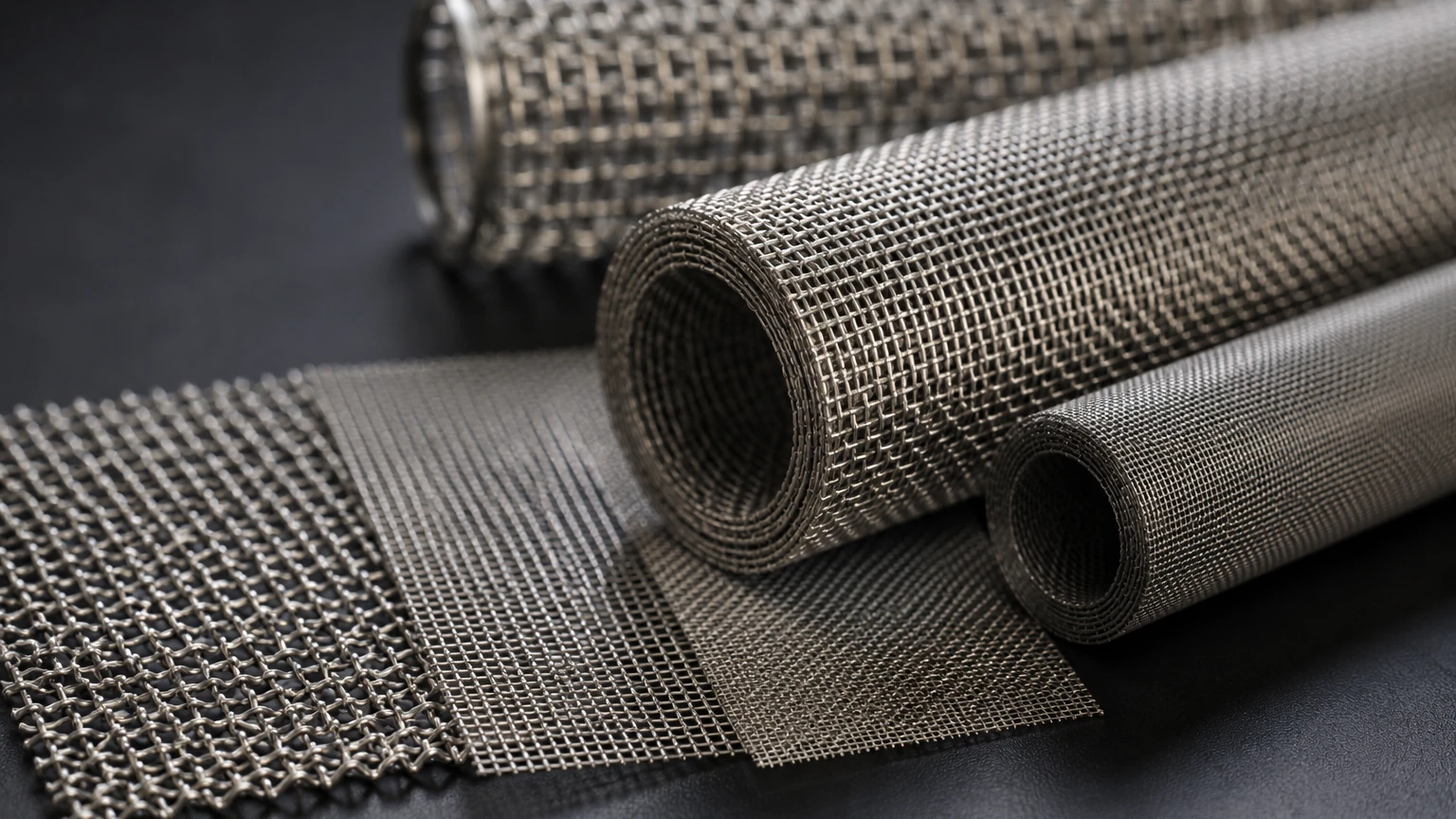
Woven Wire Mesh
Woven mesh is created by interlacing wires in various patterns, such as plain weave, twill weave, or Dutch weave.
* Plain Weave: Offers a straightforward aperture and high open area.
* Dutch Weave: Provides a more complex, tortuous path for the fluid, allowing for much finer filtration (down to several microns) while maintaining a robust structure.
Woven mesh is often used as the filtration layer in multi-layer screen assemblies.
Wedge Wire (V-Wire) Screens
Wedge wire is constructed by welding V-shaped profile wires onto support rods. This design is highly resistant to plugging because the inward-opening slots provide only two points of contact for particles. If a particle passes the narrowest point of the V-opening, it will continue through the screen without getting stuck. This makes wedge wire an excellent choice for high-flow water wells and heavy-duty industrial intake screens.
Sintered Metal Mesh
Sintered mesh is produced by diffusion-bonding multiple layers of woven wire mesh under high temperature and pressure. This process creates a monolithic structure that combines the fine filtration capabilities of Dutch weave mesh with the mechanical strength of coarse support layers. Sintered sand screen mesh is ideal for high-pressure applications where the mesh must resist deformation under heavy loads.
Key Engineering Parameters for Sand Control
When specifying sand screen mesh, engineers must evaluate several technical parameters to ensure the component is fit for purpose:
* Micron Rating (Aperture Size): This is the size of the largest particle that can pass through the mesh. It must be calibrated against the D50 or D10 (median particle sizes) of the sand being filtered. Common engineering practices include the "2-to-1" or "3-to-1" rule, where the mesh opening is sized relative to the grain size of the formation solids.
* Open Area Percentage: This refers to the ratio of the total area of the openings to the total area of the screen. A higher open area reduces fluid velocity through the mesh, which in turn reduces the risk of erosion and minimizes pressure drop.
* Collapse and Burst Pressure: In downhole or high-pressure industrial applications, the mesh must withstand significant differential pressures. Sintered and reinforced mesh designs are typically required for these scenarios.
* Tensile Strength: Essential for screens that are part of a long string of components, such as in deep-well completions, where the mesh must support its own weight and the weight of attached hardware during installation.
Performance Evaluation: Erosion and Plugging Resistance
The two primary failure modes for sand screen mesh are erosion and plugging.
Erosion occurs when high-velocity fluid carrying abrasive sand particles strikes the mesh wires. Over time, this thins the wires, eventually leading to a breach in the filter. To mitigate this, engineers often select mesh with larger wire diameters or use protective shrouds (perforated metal outer layers) to dissipate the energy of the incoming fluid.
Plugging (or Clogging) happens when particles become lodged within the mesh openings or when a "filter cake" builds up on the surface, significantly reducing flow. The choice of mesh geometry is vital here. For example, the smooth surface of wedge wire is less prone to biological fouling and mineral scaling than complex woven patterns. In applications where plugging is inevitable, the mesh must be designed for backwashing or chemical cleaning to restore flow capacity.
Customization and OEM Integration for Specific Applications
Industrial filtration requirements are rarely "one size fits all." Customization is often necessary to integrate sand screen mesh into existing equipment or to meet unique environmental challenges.
At Kaifil, we provide OEM services that allow for the customization of:
* Layer Configuration: Combining different mesh counts to create a graduated filtration effect, which increases the dirt-holding capacity of the screen.
* End Fittings: Customizing the threaded or welded connections (e.g., NPT, BSP, or flange mounts) to ensure seamless integration into the customer’s piping or wellbore assembly.
* Reinforcement: Adding internal support cores or external protective jackets to enhance the structural integrity of the filter cartridge.
By working closely with engineering teams, we develop filtration components that are optimized for the specific flow rates and particulate loads of their operations. Our manufacturing process ensures high precision in mesh alignment and weld integrity, which are critical for maintaining the rated filtration accuracy.
Procurement Considerations: Technical Specification and Quality Assurance
For purchasing teams and engineers, the procurement of sand screen mesh should be guided by a comprehensive data sheet. Before initiating a project, the following information should be confirmed:
1. Fluid Characteristics: Temperature, pH level, viscosity, and chemical composition.
2. Solids Analysis: Sieve analysis or laser diffraction results of the sand/particulates.
3. Flow Requirements: Minimum and maximum flow rates and the allowable pressure drop across the filter.
4. Regulatory Compliance: Requirements for material certifications (e.g., MTRs) or industry-specific standards like ISO 10432 for downhole equipment.
Quality assurance is paramount. Professional manufacturers utilize bubble point testing to verify the pore size of the mesh and ultrasonic cleaning to ensure the finished product is free from manufacturing debris. This level of technical oversight prevents premature failure and ensures that the filtration system performs as designed from the first day of operation.
Conclusion
Sand screen mesh is a fundamental component in the protection and efficiency of modern industrial systems. Whether it is a simple woven wire filter or a complex sintered multi-layer assembly, the choice of mesh impacts the entire lifecycle of the equipment it protects. By focusing on material durability, precise aperture engineering, and robust structural design, operators can significantly reduce maintenance costs and prevent unscheduled downtime.
For engineers seeking reliable, custom-engineered filtration components, Kaifil offers the technical expertise and manufacturing capability to deliver high-performance solutions. To explore our capabilities and discuss your specific filtration requirements, please visit our Main Page.
