


Sanitary Filters
In the landscape of industrial processing, particularly within the pharmaceutical, food and beverage, and biotechnology sectors, the integrity of the filtration process is a critical determinant of product safety and system efficiency. Sanitary filters are specialized components engineered to meet stringent hygiene standards, ensuring that fluids are free from contaminants while preventing the growth of bacteria or the accumulation of residues within the filtration system itself. Unlike standard industrial filters, sanitary versions focus heavily on material purity, surface finish, and the elimination of "dead zones" where microorganisms could proliferate.
For engineers and procurement professionals, selecting the appropriate sanitary filtration solution requires a deep understanding of material science, fluid dynamics, and regulatory compliance. As a professional manufacturer specializing in custom stainless steel filtration solutions, Kaifil provides high-performance components designed to withstand the rigors of demanding industrial environments. To explore the full range of available solutions, professionals can visit the Main Page for detailed product specifications and application support.
Engineering Standards for Sanitary Filter Design
The primary distinction of a sanitary filter lies in its design architecture. In high-purity applications, the physical structure of the filter must facilitate complete sterilization and easy cleaning. This is achieved through several engineering considerations:
Surface Finish and Ra Values
Surface roughness, measured as Ra (Roughness Average), is a critical metric. For a filter to be considered truly sanitary, internal surfaces must be polished to a high degree—typically an Ra of 0.8 μm (32 micro-inches) or smoother. Electropolishing is often employed to achieve a mirror-like finish that minimizes the microscopic pits and valleys where bacteria can hide. This smooth surface not only prevents biofilm formation but also improves the efficiency of Clean-in-Place (CIP) cycles.
Elimination of Dead Legs
A "dead leg" is an area in a piping system or filter housing where fluid can become stagnant. Stagnant fluid is a primary risk factor for microbial growth. Sanitary filters are designed with streamlined flow paths and specialized connections, such as Tri-clamp or hygienic flange fittings, to ensure that every part of the filter is reached by the process fluid and cleaning agents.
Weld Integrity
In the manufacturing of stainless steel wire mesh filters and cartridges, welding techniques must be precise. TIG (Tungsten Inert Gas) welding is standard, ensuring that welds are smooth, continuous, and free from porosity. Any crevice or oxidation at a weld point can become a site for corrosion or contamination, compromising the entire sanitary process.
Material Selection: The Role of Stainless Steel
Material compatibility is the cornerstone of sanitary filtration. The choice of material affects not only the filter's longevity but also its resistance to the aggressive chemicals used during sterilization.
316L Stainless Steel
While 304 stainless steel is common in many industrial applications, 316L is the preferred grade for sanitary filters. The "L" denotes low carbon content, which improves weldability and resistance to intergranular corrosion. The addition of molybdenum in 316L provides superior resistance to chlorides and organic acids, making it ideal for food processing and pharmaceutical manufacturing where acidic or saline solutions are common.
Gasket and Seal Compatibility
A sanitary filter is only as effective as its seals. Engineers must confirm that the elastomers used—such as EPDM, Viton (FKM), or PTFE—are FDA-compliant and capable of withstanding the operating temperatures and chemical exposures of the specific application. For instance, EPDM is excellent for steam sterilization (SIP), while PTFE offers the broadest chemical resistance but less flexibility.
Types of Sanitary Filtration Media
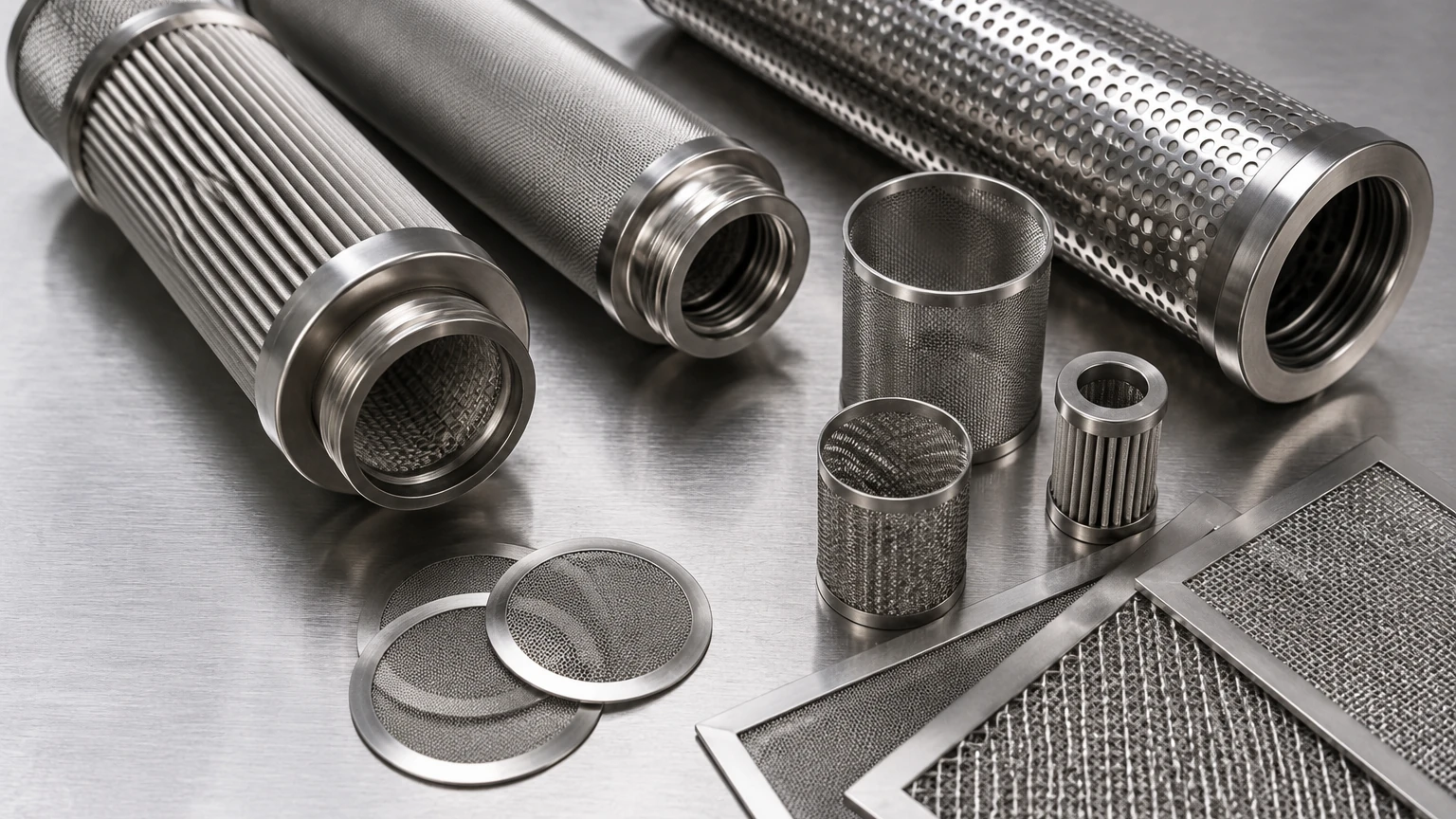
Depending on the required filtration accuracy and the nature of the fluid, different types of metal media are utilized. Kaifil specializes in various configurations to meet specific industrial needs.
Stainless Steel Wire Mesh Filters
Wire mesh filters offer precise pore sizes and high mechanical strength. They are available in various weaves, including plain, twilled, and Dutch weave. In sanitary applications, Dutch weave is often favored for its ability to provide fine filtration while maintaining a robust structure that can be easily backwashed. These filters are ideal for removing solid particulates from liquids and gases without shedding fibers into the process stream.
Sintered Metal Components
Sintered metal filters are created by fusing layers of wire mesh or metallic powders under high heat and pressure. This results in a porous structure that is extremely strong and heat-resistant. Sintered filters are often used in high-pressure hydraulic systems or for steam filtration, where the media must maintain its shape and filtration integrity under significant stress.
Pleated Filter Cartridges
To increase the surface area within a compact footprint, stainless steel media can be pleated. Pleated sanitary filters are particularly effective for high-flow applications, as the increased surface area reduces the flux rate (flow per unit area), leading to lower pressure drops and longer intervals between cleaning cycles.
Key Performance Metrics for Selection
When evaluating sanitary filters for a new or existing system, engineers should focus on several quantitative performance indicators:
1. Micron Rating (Absolute vs. Nominal): It is vital to distinguish between these two. A nominal rating indicates the filter can trap a percentage of particles of a certain size, while an absolute rating guarantees that 99.9% or more of particles above that size will be retained. In sanitary processes, absolute ratings are often required for critical stages.
2. Pressure Drop (ΔP): This is the difference in pressure between the inlet and outlet of the filter. A high initial pressure drop suggests the filter may be undersized for the flow rate, which will lead to premature clogging and increased energy costs for pumps.
3. Flow Velocity: Excessive velocity can cause particle breakthrough or damage the filter media. Designing for optimal velocity ensures stable filtration performance.
4. Dirt Holding Capacity: This determines how much contaminant the filter can retain before the pressure drop reaches a terminal level, necessitating a cleaning or replacement cycle.
Operational Integration: CIP and SIP
One of the most significant advantages of stainless steel sanitary filters is their ability to undergo rigorous sterilization protocols without degradation.
Clean-in-Place (CIP)
CIP involves circulating cleaning detergents and rinses through the filtration system without disassembly. Sanitary filters must be designed to allow these chemicals to reach all surfaces. The durability of stainless steel ensures that the filter media is not eroded by caustic or acidic cleaning agents.
Steam-in-Place (SIP)
For pharmaceutical and biotech applications, sterilization with saturated steam is often required. Stainless steel filters can typically withstand temperatures up to 200°C or higher, far exceeding the capabilities of polymer-based filters. This allows for repeated sterilization cycles, ensuring a sterile environment for every production batch.
Custom OEM Solutions and Customization
Standard off-the-shelf filters do not always meet the unique requirements of specialized industrial processes. Customization is often necessary to optimize performance. Engineering teams should look for manufacturers capable of providing:
* Custom Dimensions: Tailoring the length, diameter, and connection types to fit existing housings or restricted spaces.
* Layered Media Configurations: Combining different mesh counts to create a gradient filtration effect, which can significantly extend the life of the filter by capturing larger particles in the outer layers and finer particles in the inner layers.
* Specialized End Caps: Designing specific end-cap geometries (e.g., 222, 226, or flat gaskets) to ensure a leak-proof fit within the filter housing.
Kaifil’s manufacturing expertise allows for the development of these bespoke solutions, ensuring that the filtration component is perfectly aligned with the system's operational parameters.
Evaluating Total Cost of Ownership (TCO)
While the initial purchase price of a stainless steel sanitary filter is higher than that of a disposable plastic cartridge, the Total Cost of Ownership (TCO) is often significantly lower in industrial settings.
* Durability: Stainless steel filters can last for years with proper maintenance, whereas disposable filters must be replaced frequently, leading to higher long-term material costs.
* Reduced Downtime: High-quality metal filters are less prone to failure and can be cleaned quickly via backwashing or CIP, reducing the time the production line is offline.
* Waste Reduction: Using permanent, cleanable filters aligns with sustainability goals by eliminating the environmental impact of disposing of used plastic filter cartridges.
* Process Consistency: Metal filters do not suffer from the media migration or fiber shedding that can occur with some synthetic filters, ensuring consistent product quality over time.
Conclusion
Selecting the right sanitary filters is a multi-faceted decision that impacts the safety, efficiency, and profitability of industrial operations. By prioritizing high-grade materials like 316L stainless steel, adhering to strict Ra surface finish standards, and choosing the appropriate media configuration, engineers can ensure their systems operate at peak performance.
Whether the application involves fine chemical processing or high-volume food production, understanding the technical nuances of filtration is essential. For those seeking reliable, precision-engineered components, reviewing the options available at the Main Page provides a starting point for developing a robust filtration strategy. Partnering with an experienced manufacturer like Kaifil ensures that technical requirements are met with high-quality, durable, and customized filtration solutions.
