


Sanitary Strainers Stainless Steel
In hygienic processing industries, the integrity of the final product depends heavily on the removal of particulate contaminants during various stages of production. Sanitary strainers stainless steel components are fundamental to these systems, providing a robust barrier against unwanted solids while maintaining the strict cleanliness standards required in food, beverage, pharmaceutical, and biotechnology applications. Unlike standard industrial strainers, sanitary versions are engineered specifically to eliminate areas where bacteria can grow and to withstand rigorous cleaning protocols.
Selecting the appropriate filtration hardware requires a deep understanding of metallurgy, fluid dynamics, and regulatory compliance. For engineers and procurement specialists, the choice of a strainer is not merely about mesh size, but about the total integration of the component into a sterile or hygienic process line. This guide examines the technical nuances of sanitary strainers, focusing on material properties, design configurations, and the engineering considerations necessary for optimal performance.
The Role of Sanitary Strainers in Hygienic Processing
Sanitary strainers serve as the first line of defense for sensitive downstream equipment, such as pumps, heat exchangers, and spray nozzles. In a typical production line, these strainers remove oversized particles, such as seeds in fruit processing, undissolved ingredients in chemical mixing, or scale from piping systems. The primary distinction of a sanitary strainer is its design philosophy, which prioritizes "cleanability."
In hygienic environments, the presence of "dead legs"—areas where fluid can stagnate—is a significant risk. Stagnant fluid becomes a breeding ground for microbial colonies. Therefore, sanitary strainers stainless steel units are designed with smooth internal transitions and high-quality surface finishes to ensure that every part of the strainer is exposed to the flow of cleaning agents during Clean-in-Place (CIP) cycles. This level of engineering ensures that the system can be sterilized without the need for complete disassembly, reducing downtime and labor costs.
Material Specifications: Why Stainless Steel is Standard
The choice of stainless steel for sanitary applications is driven by its unique combination of corrosion resistance, durability, and non-reactive nature. The two most common grades used are AISI 304 and AISI 316L.
AISI 304 vs. 316L
While 304 stainless steel offers excellent durability and is suitable for many food-grade applications, 316L is the preferred choice for more demanding environments. The "L" in 316L stands for "low carbon," which minimizes carbide precipitation during welding, thereby enhancing the corrosion resistance of the welded joints. Furthermore, 316L contains molybdenum, which provides superior resistance to pitting and crevice corrosion, particularly in the presence of chlorides or acidic cleaning solutions common in the pharmaceutical and dairy industries.
Durability and Thermal Stability
Stainless steel maintains its structural integrity across a wide range of temperatures. In processes involving Steam-in-Place (SIP) sterilization, the strainer must withstand temperatures exceeding 121°C (250°F) without warping or losing its sealing properties. The thermal expansion coefficients of stainless steel are well-documented, allowing engineers to design housings and filter elements that maintain tight tolerances even under extreme thermal cycling.
Engineering Design and Surface Finish Requirements
The effectiveness of a sanitary strainer is largely determined by its surface topography. In the world of hygienic engineering, surface roughness is measured by the Ra (Roughness Average) value. For a component to be considered truly sanitary, internal surfaces typically require an Ra of 0.8 μm (32 micro-inches) or better.
Achieving High-Quality Finishes
To reach these specifications, manufacturers employ several finishing techniques:
1. Mechanical Polishing: Using progressively finer abrasives to smooth the metal surface.
2. Electropolishing: An electrochemical process that removes a microscopic layer of material from the surface. This not only reduces the Ra value but also removes surface impurities, leaving a chromium-rich oxide layer that further enhances corrosion resistance.
Eliminating Crevices
Every joint in a sanitary strainer must be expertly welded and polished. TIG (Tungsten Inert Gas) welding is the standard, followed by grinding and polishing the weld bead until it is flush with the surrounding material. This ensures there are no pits, cracks, or crevices where organic matter could lodge. When reviewing options on the Main Page, engineers should look for evidence of these manufacturing standards to ensure long-term compliance with FDA or 3-A standards.
Common Configurations of Sanitary Strainers
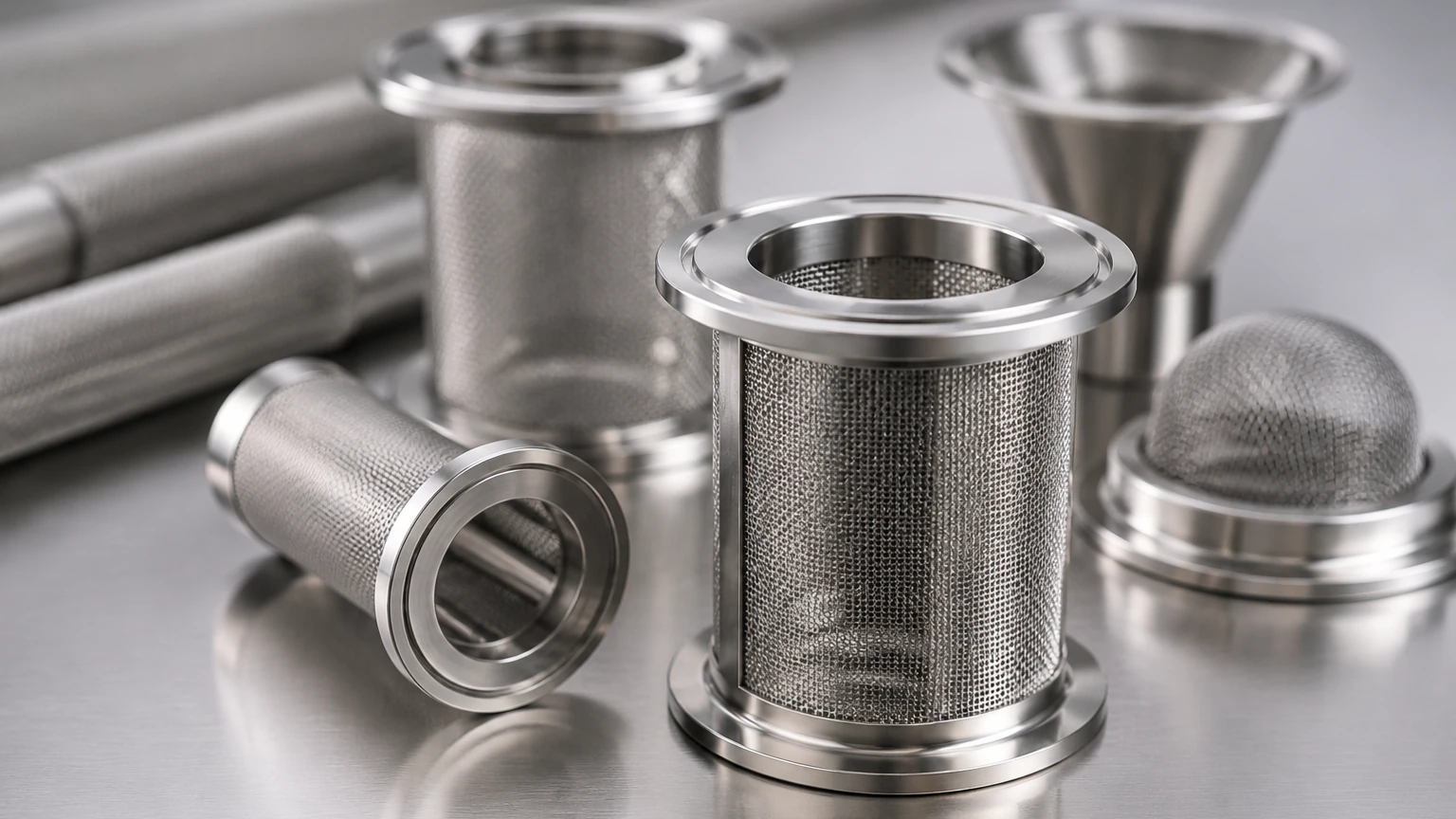
Sanitary strainers come in various geometries, each suited to specific flow patterns and space constraints within a facility. Choosing the right configuration is essential for minimizing pressure drop and simplifying maintenance.
Inline Strainers
Inline strainers are designed for straight-through flow. They are compact and ideal for systems where space is limited. The filter element is usually a perforated metal tube or a wire mesh sleeve held within a cylindrical housing. These are frequently used for "police" filtration at the final stage of a process.
L-Type (Side-Entry) Strainers
L-type strainers feature an inlet and outlet at a 90-degree angle. This design is particularly advantageous because it allows the filter element to be removed from the top or side of the housing without disconnecting the main piping. This simplifies the cleaning process and reduces the risk of spilling product during maintenance.
Y-Strainers in Sanitary Contexts
While common in industrial piping, Y-strainers used in sanitary applications must be specifically modified. They must feature sanitary tri-clamp connections and a body geometry that allows for full drainage. Y-strainers are often used in horizontal lines where the "leg" of the Y points downward to collect debris via gravity.
Technical Selection Criteria for Engineers
When specifying sanitary strainers stainless steel, technical professionals must evaluate several variables to ensure the component meets the application's demands without causing system inefficiency.
Flow Rate and Pressure Drop (ΔP)
Every filter media introduces resistance to flow. It is critical to calculate the clean pressure drop at the maximum expected flow rate. A high ΔP can lead to cavitation in pumps or reduced throughput. Engineers should aim for a strainer with a large "open area" ratio—the ratio of the total area of the holes in the mesh to the total area of the filter element. Generally, an open area ratio of 4:1 relative to the pipe cross-section is recommended to minimize resistance.
Mesh Count and Micron Rating
The filtration accuracy is defined by the size of the openings in the mesh. Wire mesh is typically categorized by "mesh count" (the number of wires per inch) or by a micron rating (the size of the largest particle that can pass through). For example, a 100-mesh screen has openings of approximately 140 microns. It is vital to distinguish between nominal and absolute micron ratings; nominal ratings indicate an approximate efficiency, while absolute ratings indicate that 99.9% of particles above that size will be captured.
Connection Types
Sanitary systems almost exclusively use Tri-Clamp (ISO 2852) or similar hygienic couplings (such as DIN 11851 or SMS). These connections are designed for quick assembly and disassembly while providing a crevice-free seal when used with the appropriate gasket.
Maintenance, Cleaning, and Operational Longevity
The longevity of sanitary strainers stainless steel depends on a consistent maintenance schedule and the correct choice of consumable parts, such as gaskets and seals.
Gasket Material Compatibility
Gaskets must be selected based on the chemical composition of the process fluid and the cleaning agents used. Common materials include:
* EPDM: Excellent for steam and general food applications, but poor resistance to fats and oils.
* PTFE (Teflon): Highly chemically inert and temperature resistant, but less resilient (harder to seal) than elastomers.
* FKM (Viton): Superior resistance to oils and chemicals, though more expensive.
* Silicone: Good for high-temperature pharmaceutical applications, though it can be permeable to certain gases.
Cleaning Protocols
During CIP, the flow velocity must be high enough to create turbulence within the strainer housing to dislodge particles. If the strainer is used in a high-solids application, it may require manual cleaning (COP – Clean-Out-of-Place). In these instances, the ease of disassembly becomes a primary factor in operational efficiency. Regular inspection of the mesh element is required to check for "blinding" (permanent clogging) or mechanical damage such as wire fraying, which could introduce metal fragments into the product stream.
Customization and OEM Solutions in Filtration
Standard off-the-shelf strainers do not always meet the unique requirements of specialized industrial processes. Customization is often necessary when dealing with high-viscosity fluids, extreme pressures, or non-standard piping layouts. Manufacturers like Kaifil specialize in developing bespoke filtration components that integrate seamlessly into existing systems.
Customization options can include:
* Reinforced Elements: Adding a perforated backup tube to a fine wire mesh to prevent collapsing under high differential pressure.
* Jacketed Housings: For products like chocolate or resins that must be kept at a specific temperature to maintain flow.
* Magnetic Inserts: Adding magnetic bars within the strainer to capture fine ferrous particles that might pass through a standard mesh.
By collaborating with a manufacturer that understands both the metallurgy and the application-specific challenges, engineering teams can optimize their filtration strategy for both performance and total cost of ownership. For further technical consultation and to explore a wide range of precision metal filter components, professionals can Review product options and application support to find solutions tailored to their specific industrial environment.
Conclusion
Sanitary strainers stainless steel are critical components that bridge the gap between process efficiency and product safety. By focusing on high-grade materials like 316L, adhering to strict surface finish requirements, and selecting the correct configuration for the flow dynamics of the system, engineers can ensure reliable operation. Whether for a simple food processing line or a complex pharmaceutical synthesis, the right strainer protects both the equipment and the consumer, making it an investment in quality and compliance.
