


Vacuum Erlenmeyer Flask
In the landscape of industrial filtration and laboratory-scale process development, the vacuum Erlenmeyer flask—often referred to as a Büchner flask or side-arm flask—serves as a fundamental tool for solid-liquid separation. While standard Erlenmeyer flasks are designed for mixing and storage, the vacuum-rated variant is engineered to withstand significant pressure differentials. For engineers and procurement professionals in industries such as chemical processing, pharmaceuticals, and food and beverage, understanding the technical specifications and integration requirements of these flasks is essential for ensuring both process efficiency and workplace safety.
At Kaifil, we recognize that high-performance filtration begins with the right equipment and precision-engineered media. Whether you are conducting pilot-scale testing or small-batch production, the synergy between your vacuum vessel and the internal filtration components determines the purity and yield of your final product. This guide explores the engineering considerations, material selection, and safety protocols associated with vacuum Erlenmeyer flasks in an industrial context.
The Role of Vacuum Erlenmeyer Flasks in Industrial R&D
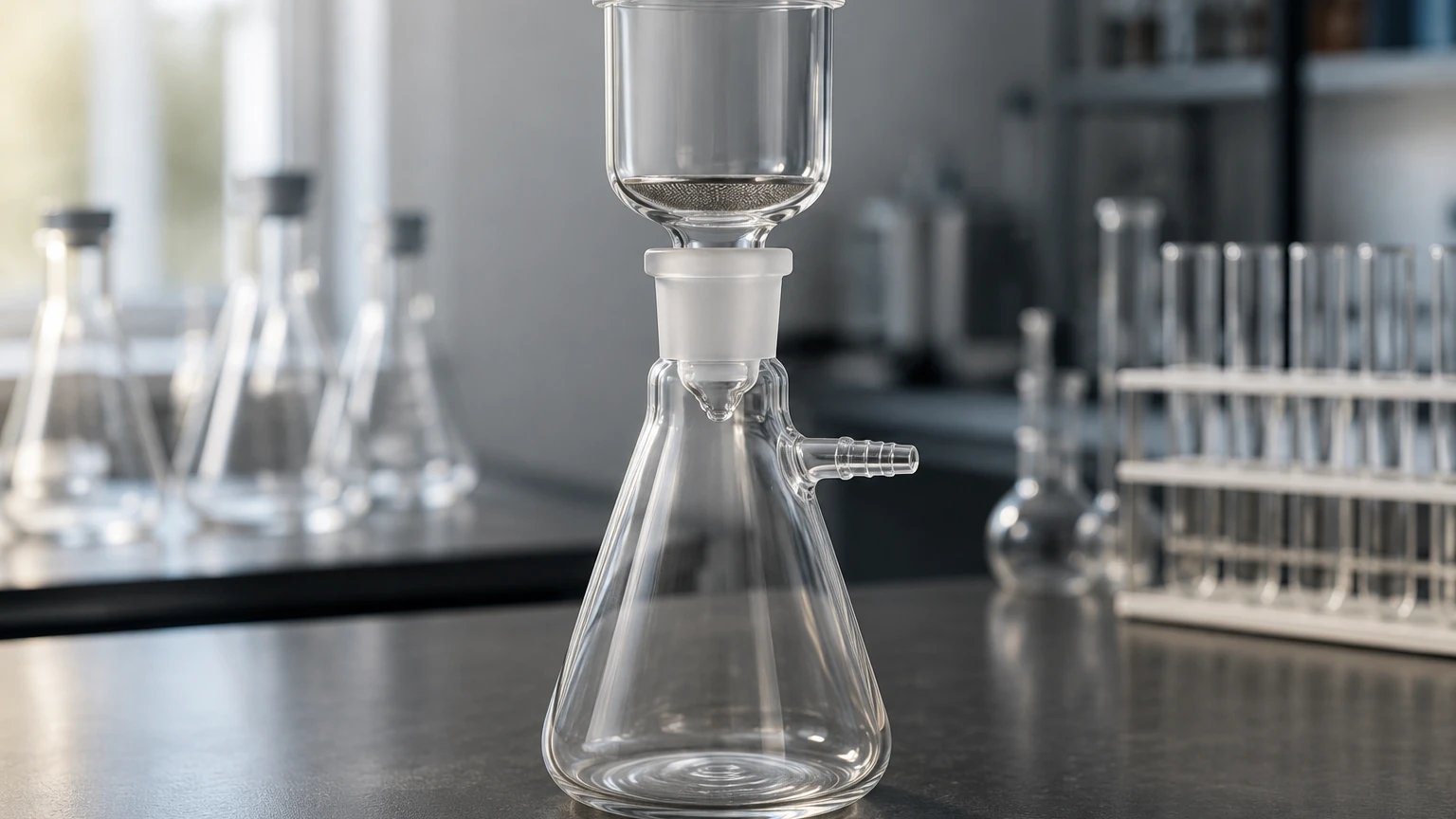
The vacuum Erlenmeyer flask is primarily used in vacuum filtration setups to accelerate the separation of solids from a liquid medium. Unlike gravity filtration, which relies solely on the weight of the fluid to pass through a filter, vacuum filtration utilizes a pressure gradient. By connecting the flask's side arm to a vacuum pump or water aspirator, the pressure inside the flask is reduced, forcing the atmospheric pressure to push the liquid through the filter media at a much higher velocity.
In industrial R&D and quality control labs, this setup is indispensable for:
* Catalyst Recovery: Separating expensive catalysts from reaction mixtures for reuse.
* Precipitation Analysis: Isolating solids for gravimetric analysis or further chemical processing.
* Clarification: Removing trace impurities from high-value liquids to meet stringent purity standards.
For technical teams, the vacuum flask is often the first step in validating a filtration process before scaling up to larger stainless steel filter cartridges or industrial-scale wire mesh systems. Ensuring that the flask is compatible with the intended chemicals and pressure levels is the foundation of a successful scale-up strategy.
Structural Engineering and Pressure Resistance
The most critical distinction between a standard flask and a vacuum Erlenmeyer flask is wall thickness. When a vacuum is applied, the exterior of the flask is subjected to approximately 14.7 psi (1 bar) of atmospheric pressure. If the glass is too thin or contains structural flaws, the vessel can suffer a catastrophic implosion.
Wall Thickness and Geometry
Industrial-grade vacuum flasks are manufactured with significantly thicker walls than standard laboratory glassware. The conical shape of the Erlenmeyer design provides inherent structural strength, distributing the external pressure more evenly across the surface area. However, the transition points—specifically where the side arm meets the body and the neck of the flask—are areas of high stress concentration. Engineers should specify flasks that have reinforced tubulations and uniform glass distribution to minimize the risk of failure under deep vacuum conditions.
Side Arm (Tubulation) Design
The side arm is the interface between the flask and the vacuum source. In industrial applications, this arm must be robust enough to handle repeated connections with heavy-walled vacuum tubing. Some advanced designs feature a threaded side arm or a plastic hose connection to reduce the risk of glass breakage during setup and teardown. When selecting a flask, verifying the outer diameter (OD) of the side arm is necessary to ensure a leak-proof seal with existing laboratory infrastructure.
Material Selection for Chemical and Thermal Stability
Material compatibility is a primary concern for engineers working with aggressive solvents, corrosive acids, or high-temperature processes. While borosilicate glass is the industry standard, other materials may be required depending on the application.
Borosilicate 3.3 Glass
Most high-quality vacuum Erlenmeyer flasks are made from Borosilicate 3.3 glass. This material is favored for its low coefficient of thermal expansion, which provides excellent resistance to thermal shock. In processes where the filtrate is collected at elevated temperatures or where the flask must be autoclaved for sterility (as in pharmaceutical or food and beverage applications), Borosilicate 3.3 is the preferred choice. It also offers broad chemical resistance to most acids, neutral solutions, and organic solvents.
Stainless Steel Alternatives
In certain heavy-duty industrial environments where glass breakage poses a significant safety risk or where the process involves hydrofluoric acid or strong alkalis that attack glass, stainless steel vacuum vessels may be used. These vessels integrate seamlessly with custom stainless steel filtration solutions. While they lack the transparency of glass, they offer unmatched durability and can be engineered to much higher pressure ratings. For teams looking to transition from glass to more permanent industrial setups, reviewing specialized metal components on our Main Page can provide insights into more robust alternatives.
Optimizing Filtration Efficiency with Precision Media
A vacuum Erlenmeyer flask is only as effective as the filter media used with it. Traditionally, these flasks are paired with a Büchner funnel and filter paper. However, in modern industrial applications, there is an increasing shift toward more durable and precise filtration media, such as stainless steel wire mesh and sintered metal filters.
Integrating Stainless Steel Wire Mesh
For applications requiring precise pore size control and high durability, stainless steel wire mesh discs can be used in place of, or in conjunction with, traditional filter paper. These metal filters offer several advantages:
1. Reusability: Unlike paper, stainless steel mesh can be cleaned and reused, reducing waste and long-term costs.
2. Chemical Compatibility: Stainless steel (typically 304 or 316L) can withstand aggressive solvents that would degrade cellulose-based filters.
3. No Fiber Migration: In pharmaceutical and high-purity chemical processing, preventing the migration of filter fibers into the filtrate is critical. Metal filters provide a stable, non-shedding surface.
Micron Ratings and Selection
When selecting filtration media for a vacuum flask setup, engineers must consider the micron rating. A rating that is too fine will lead to rapid clogging (blinding) and excessively long filtration times, even under vacuum. Conversely, a rating that is too coarse will allow solids to pass through, compromising the purity of the filtrate. Kaifil specializes in providing custom stainless steel filter cartridges and mesh that can be tailored to the specific particle size distribution of your process.
Risk Mitigation and Safety Protocols in Vacuum Operations
Operating a vacuum Erlenmeyer flask involves inherent risks, primarily related to vessel implosion. An implosion can spray glass shards and hazardous chemicals across a workspace, making safety protocols a top priority for laboratory managers and engineers.
Inspection and Maintenance
Before every use, the flask must be inspected for physical defects. Even minor scratches, "stars," or chips can act as stress concentrators. Under vacuum, these flaws can propagate rapidly, leading to failure. It is a best practice in industrial labs to decommission any vacuum glassware that shows signs of surface wear.
Safety Shielding and PPE
Whenever a vacuum system is energized, appropriate safety shielding should be in place. This can include using plastic-coated glassware, which contains the shards in the event of an implosion, or placing a transparent safety shield between the operator and the vacuum setup. Personal Protective Equipment (PPE), including impact-resistant eye protection and heavy-duty gloves, is mandatory.
Avoiding Over-Evacuation
Using a vacuum pump that is too powerful for the flask size can also be dangerous. It is recommended to use a vacuum regulator to maintain the pressure at the minimum level required for effective filtration. This not only protects the flask but also prevents the "pull-through" of fine particles that might otherwise be retained by the filter cake.
Transitioning from Laboratory Scale to Industrial Production
The vacuum Erlenmeyer flask is a vital tool for the proof-of-concept phase, but as production volumes increase, the limitations of glass vessels become apparent. Manual filtration using flasks is labor-intensive and difficult to scale linearly.
Scaling the Process
When moving from the lab to a pilot plant, engineers typically transition to larger-scale stainless steel filtration housings. These systems utilize the same principles of pressure-driven separation but are built for continuous or semi-continuous operation. The data gathered during vacuum flask testing—such as flow rates, cake thickness, and filtration time—is critical for sizing these larger industrial systems.
Custom Filtration Solutions
At this stage, customization becomes key. Industrial filtration requirements often demand specific housing geometries, specialized coatings, or custom-configured filter elements. By working with a manufacturer like Kaifil, companies can develop filtration solutions that mirror the performance of their lab-scale vacuum setups while providing the durability and throughput required for full-scale manufacturing.
For engineers and purchasing teams, the journey from a simple vacuum Erlenmeyer flask to a sophisticated industrial filtration system requires a deep understanding of both the equipment and the media. By prioritizing material quality, structural integrity, and precise filtration specifications, organizations can ensure reliable performance at every stage of the process. For more information on professional filtration components and custom engineering support, please visit our Main Page.
