


Screen Filtration
In industrial processing, the efficiency of a filtration system is often the determining factor in product purity, equipment longevity, and overall operational cost. Screen filtration represents one of the most reliable and widely utilized methods of mechanical separation across various sectors, including chemical processing, food and beverage production, and hydraulic systems. Unlike depth filtration, which traps particles within a thick medium, screen filtration relies on a precise surface barrier to intercept contaminants larger than the specified pore size.
For engineers and procurement professionals, selecting the appropriate screen filtration solution requires a deep understanding of material science, fluid dynamics, and the specific mechanical stresses of the application environment. Kaifil, a specialist in custom stainless steel filtration, provides the engineering expertise necessary to navigate these variables, ensuring that filtration components meet exact industrial requirements.
Understanding the Fundamentals of Screen Filtration
Screen filtration is categorized as surface filtration. The primary mechanism involves a thin, perforated, or woven medium that acts as a sieve. As fluid passes through the screen, particles exceeding the pore dimensions are retained on the upstream surface. This process is highly predictable and offers several advantages in industrial settings, particularly regarding the ease of cleaning and the consistency of the filtration results.
One of the critical distinctions in screen filtration is the difference between absolute and nominal ratings. An absolute rating refers to the diameter of the largest spherical particle that can pass through the screen under specified laboratory conditions. In contrast, a nominal rating represents an approximate value, typically indicating the screen's ability to retain a high percentage (usually 60% to 90%) of particles of a certain size. For critical applications, such as pharmaceutical manufacturing or fine chemical processing, absolute-rated stainless steel mesh is often required to ensure process integrity.
Furthermore, screen filtration is often the first line of defense in a multi-stage system. By removing larger debris, screens protect downstream equipment—such as high-pressure pumps, spray nozzles, and membrane filters—from premature wear or clogging. This strategic placement reduces the total cost of ownership by extending the service life of more expensive secondary filtration stages.
Material Selection for Industrial Environments
The performance of a filtration screen is inseparable from the material used in its construction. While polymer screens exist, industrial-grade screen filtration almost exclusively utilizes metal alloys, specifically stainless steel, due to its mechanical strength and chemical resistance.
Stainless Steel 304 and 316L
Stainless steel 304 is the standard for many general-purpose industrial applications, offering good corrosion resistance and durability. However, in environments involving chlorides, high acidity, or pharmaceutical-grade requirements, 316L stainless steel is the preferred choice. The "L" denotes low carbon content, which improves weldability and prevents sensitization—a common cause of corrosion in the heat-affected zones of welded filter components.
Specialized Alloys
For extreme environments, such as those found in offshore oil and gas or high-temperature chemical reactors, specialized alloys like Monel, Inconel, or Hastelloy may be employed. These materials provide superior resistance to pitting and stress-corrosion cracking where standard stainless steels might fail. Choosing the right alloy is a balance between the chemical compatibility of the process fluid and the budget constraints of the project.
Critical Engineering Specifications: Beyond Micron Ratings
While the micron rating is the most discussed specification, several other engineering factors determine the success of a screen filtration component. Engineers must evaluate the relationship between flow rate, pressure drop, and the structural integrity of the filter media.
Open Area and Flow Velocity
The "open area" of a screen is the ratio of the total area of the holes to the total area of the screen. A higher open area generally results in a lower initial pressure drop ($\\Delta P$) and allows for higher flow velocities. However, increasing the open area often requires thinner wires or smaller support structures, which can compromise the screen's ability to withstand high differential pressures. Finding the optimal balance is essential for maintaining system throughput without risking mechanical failure.
Differential Pressure ($\\Delta P$)
Every filter creates a resistance to flow. As contaminants accumulate on the surface of the screen, the differential pressure increases. It is vital to design screen filtration systems with a clear understanding of the "terminal pressure drop"—the point at which the filter must be cleaned or replaced to prevent bypass, media deformation, or system shutdown. High-performance stainless steel cartridges from Kaifil are engineered to withstand significant pressure differentials, providing a safety margin in fluctuating process conditions.
Effective Filtration Area (EFA)
By pleating the screen media, manufacturers can significantly increase the Effective Filtration Area within the same footprint. An increased EFA leads to lower flux rates (flow per unit area), which reduces the rate of pressure buildup and extends the time between cleaning cycles. This is particularly beneficial in high-solids loading applications where standard flat screens would blind too quickly.
Comparison of Screen Structures: Wire Mesh vs. Perforated Metal
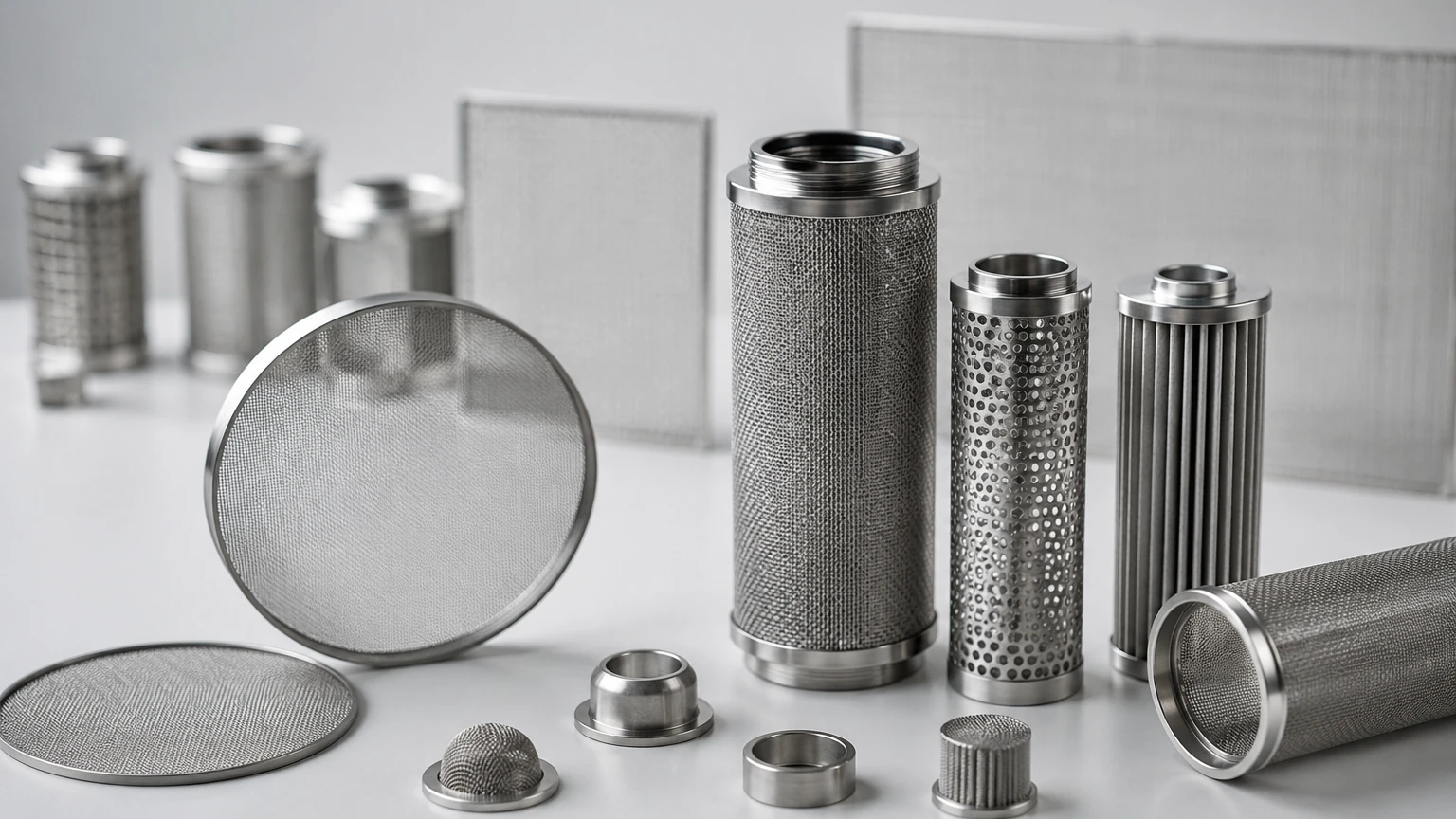
Industrial screen filtration components are typically constructed using one of three primary structures: woven wire mesh, perforated metal, or wedge wire. Each has distinct performance characteristics.
1. Woven Wire Mesh: This is the most versatile structure, capable of achieving very fine filtration levels (down to 5 microns or less). It is available in various weave patterns, such as plain weave, twilled weave, and Dutch weave. Dutch weaves, in particular, offer high mechanical strength and are ideal for high-pressure applications.
2. Perforated Metal: Perforated screens are typically used for coarse filtration or as a support layer for finer mesh. They are extremely robust and can be manufactured with specific hole patterns (round, square, or slotted) to optimize flow. In many custom filter cartridges, a perforated metal core provides the structural backbone while a fine wire mesh provides the actual filtration.
3. Wedge Wire: Constructed from V-shaped profiles, wedge wire screens are highly resistant to clogging. The V-shape creates a widening gap in the direction of flow, which helps particles pass through or be easily backwashed. This structure is commonly used in water intake screens and heavy-duty industrial strainers.
For a comprehensive overview of our standard and custom capabilities, engineers can visit our Main Page to review product options and application support.
Application-Specific Considerations
Different industries impose unique demands on screen filtration hardware. Understanding these nuances is critical during the procurement phase.
* Food and Beverage: Filters must comply with FDA and high-sanitary standards. This requires smooth surface finishes (often electropolished) and the absence of "dead zones" where bacteria could proliferate. Stainless steel is the material of choice due to its ability to withstand Clean-in-Place (CIP) procedures involving caustic chemicals and high-temperature steam.
* Chemical and Petrochemical: The primary concern here is chemical compatibility and the ability to handle high temperatures. Filters must maintain their pore geometry even when exposed to aggressive solvents or corrosive gases.
* Hydraulic and Lubrication Systems: In these applications, screen filtration is used to remove metallic wear particles and environmental contaminants. The screens must be able to handle high-viscosity fluids and rapid pressure pulsations without fatigue failure.
Maintenance, Cleaning, and Replacement Cycles
One of the primary economic benefits of stainless steel screen filtration is that the media is often cleanable and reusable. Unlike disposable depth filters, which represent a recurring operational expense and waste stream, metal screens can be restored to near-original performance levels through various cleaning methods.
Cleaning Techniques
* Backwashing: Reversing the flow of fluid through the screen to dislodge surface contaminants. This is often automated in continuous flow systems.
* Ultrasonic Cleaning: Using high-frequency sound waves in a cleaning solvent to create cavitation bubbles that remove fine particles trapped deep within the mesh.
* Chemical Cleaning: Using specific acids or alkalis to dissolve organic or inorganic scaling. This must be done with careful consideration of the filter's material compatibility.
Despite their cleanability, screens eventually reach the end of their functional life. Mechanical wear, wire thinning due to erosion, or irreversible fouling will eventually necessitate replacement. Establishing a regular inspection schedule and monitoring differential pressure trends are the best ways to predict replacement cycles and avoid unplanned downtime.
Customization and OEM Integration
In many industrial projects, off-the-shelf filtration products do not meet the specific spatial or performance requirements of the system. This is where custom engineering becomes indispensable. Customization can involve unique end-cap configurations, non-standard diameters, or multi-layered mesh laminates (sintered mesh) that combine the filtration accuracy of fine wire with the strength of heavy-duty plates.
As a professional manufacturer, Kaifil works closely with global customers to develop OEM filtration solutions. By focusing on the specific challenges of the application—whether it is extreme pressure, corrosive fluids, or limited installation space—Kaifil delivers components that optimize process efficiency and reliability.
When evaluating a partner for screen filtration, engineers should confirm the manufacturer’s ability to provide material certifications, pressure test reports, and technical drawings. These documents ensure that the final product will perform as expected within the larger industrial system. For more information on how to select the right filtration components for your specific industry, please refer to the technical resources available on our Main Page.
