


Screening and Filtration Solutions
Industrial processes across the globe rely on the precise separation of solids from liquids or gases to ensure product purity, protect downstream equipment, and maintain operational efficiency. While often used interchangeably, screening and filtration represent distinct mechanical processes within the broader category of industrial separation. Selecting the appropriate screening and filtration solutions requires a deep understanding of fluid dynamics, material science, and the specific environmental conditions of the application.
For engineers and procurement specialists, the challenge lies in balancing filtration accuracy with structural durability and cost-effectiveness. Whether the application involves high-pressure hydraulic systems or hygienic food processing, the choice of media—typically stainless steel wire mesh or sintered metal—determines the long-term success of the installation. This guide explores the technical considerations and engineering principles behind modern industrial filtration components.
Understanding the Fundamentals of Screening and Filtration
At its core, screening is a process of sizing. It involves passing a medium through a mesh or perforated surface where particles larger than the openings are retained, and smaller particles pass through. This is common in the early stages of water treatment or in bulk chemical processing where large debris must be removed to prevent damage to pumps and valves.
Filtration, conversely, often refers to finer separation, frequently involving the removal of microscopic contaminants. In industrial settings, this is achieved through either surface filtration or depth filtration.
* Surface Filtration: Contaminants are trapped on the surface of the filter medium. Stainless steel wire mesh is a primary example of a surface filter. It offers precise pore sizes and is easily cleaned through backwashing or ultrasonic methods.
* Depth Filtration: Particles are trapped within the thickness of the medium. While often associated with disposable polymer filters, industrial metal depth filters can be constructed using multi-layered sintered wire mesh or metal fibers to provide high dirt-holding capacity.
When evaluating screening and filtration solutions, engineers must first define the particle size distribution of the target contaminants and the desired cleanliness level of the effluent. This data informs the selection of the micron rating and the physical structure of the filter element.
Material Selection for Industrial Environments
The performance of a filter is only as reliable as the material from which it is constructed. In industrial environments characterized by extreme temperatures, corrosive chemicals, or high mechanical stress, stainless steel is the industry standard.
Stainless Steel 304 vs. 316L
Stainless steel 304 is suitable for general industrial applications where basic corrosion resistance is required. However, for more demanding environments—such as chemical processing or marine applications—stainless steel 316L is preferred. The addition of molybdenum in 316L provides superior resistance to chlorides and pitting, ensuring that the filter mesh maintains its structural integrity over thousands of cycles.
Specialized Alloys
In cases of extreme chemical aggression or temperatures exceeding 400°C, specialized alloys such as Inconel, Monel, or Hastelloy may be utilized. These materials ensure that the screening and filtration solutions do not fail due to oxidation or chemical breakdown, which could lead to catastrophic system contamination.
Key Performance Indicators for Filter Selection
Selecting a filter cartridge or mesh screen is not merely a matter of matching dimensions. Several engineering parameters must be calculated to ensure the component performs as expected within the system.
Micron Rating: Nominal vs. Absolute
One of the most critical specifications is the micron rating.
* Nominal Rating: Indicates the ability of the filter to retain a major percentage (e.g., 60% to 90%) of particles of a specific size.
* Absolute Rating: Refers to the diameter of the largest hard spherical particle that will pass through the filter under specified test conditions. For critical applications in the pharmaceutical or aerospace sectors, absolute-rated filters are mandatory to ensure consistent results.
Pressure Drop ($ΔP$)
Every filter introduces resistance to flow. The initial pressure drop must be low enough to allow the system to operate efficiently. As the filter accumulates contaminants, the pressure drop increases. Engineers must design systems with a clear understanding of the "terminal pressure drop"—the point at which the filter must be cleaned or replaced to prevent bypass or structural failure of the mesh.
Flow Rate and Effective Filtration Area
The effective filtration area (EFA) directly impacts the service life of the filter. By pleating the stainless steel wire mesh, manufacturers can significantly increase the EFA within the same physical footprint. This reduces the flow velocity through the mesh, lowering the initial pressure drop and extending the time between cleaning cycles.
Engineering Considerations for Custom Filter Design
Off-the-shelf filters often fail to meet the specific requirements of specialized industrial machinery. Custom screening and filtration solutions allow for the optimization of every component of the filter element.
1. End Cap Configurations: Whether the system requires DOE (Double Open End), SOE (Single Open End) with various O-ring codes (such as Code 7 or Code 3), or custom threaded connections, the interface must ensure a leak-proof seal.
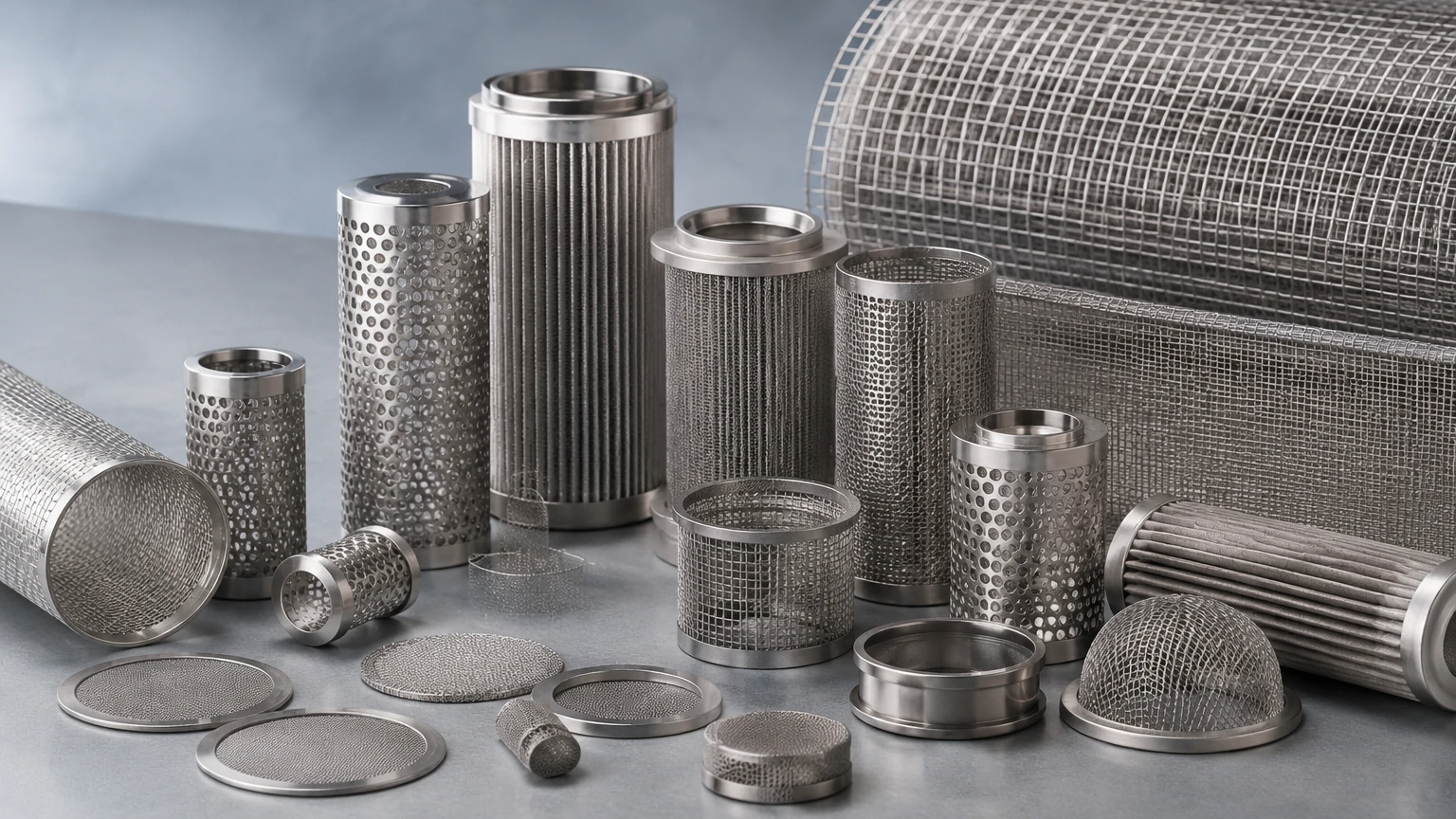
2. Support Structures: In high-pressure applications, the filter medium requires internal or external support cores. Perforated metal tubes or expanded metal cages prevent the mesh from collapsing or bursting under hydraulic surges.
3. Welding and Assembly: For high-purity applications, the use of adhesives is often prohibited due to outgassing or chemical incompatibility. Advanced TIG (Tungsten Inert Gas) welding or plasma welding ensures a robust, all-metal construction that can withstand thermal cycling.
By focusing on these engineering details, manufacturers like Kaifil provide reliable OEM components that integrate seamlessly into complex industrial systems. Detailed technical specifications and product options can be found on the Main Page of our technical resource center.
Application-Specific Requirements
Different industries impose unique constraints on screening and filtration solutions. A solution that works for a cooling water loop may be entirely inappropriate for a food-grade oil processing line.
Chemical and Petrochemical Processing
In these sectors, filters must withstand aggressive solvents and high temperatures. Stainless steel filter cartridges are often used to remove catalysts from process streams or to protect high-pressure nozzles from clogging. The ability to clean and reuse these metal filters provides a significant advantage over disposable alternatives in terms of waste reduction and chemical compatibility.
Food and Beverage Industry
Filtration in the food industry requires adherence to strict hygienic standards. Filters must be designed without dead spaces where bacteria could proliferate. Stainless steel wire mesh is ideal here because it can withstand CIP (Clean-in-Place) procedures, including high-temperature steam sterilization and caustic washdowns.
Hydraulic and Lubrication Systems
Precision metal filters are vital for protecting sensitive hydraulic valves and bearings. These filters must handle high-viscosity fluids and maintain their efficiency even during cold-start conditions where pressures can spike rapidly. The mechanical strength of a well-constructed stainless steel filter cartridge ensures that no media migration occurs, which would otherwise introduce new contaminants into the system.
Maintenance, Cleaning, and Total Cost of Ownership
One of the primary drivers for choosing stainless steel screening and filtration solutions over disposable polymer or paper media is the total cost of ownership (TCO). While the initial investment in a metal filter is higher, the longevity and cleanability of the product often result in lower costs over the lifecycle of the equipment.
Cleaning Methodologies
Stainless steel filters can be restored to near-original pressure drop levels through several methods:
* Backwashing: Reversing the flow of the fluid to dislodge surface contaminants.
* Ultrasonic Cleaning: Using high-frequency sound waves in a cleaning solvent to remove fine particles trapped deep within the mesh or sintered layers.
* Chemical Cleaning: Using specific acids or alkalis to dissolve organic or inorganic scaling, provided the material (e.g., 316L) is compatible with the cleaning agent.
* Burn-off/Pyrolysis: For polymer-based contaminants, heating the filter in a controlled environment can carbonize the debris, which is then removed via ultrasonic cleaning.
Replacement Cycles
Despite their durability, metal filters are not infinite. Fatigue from pressure pulsations or gradual erosion of the wire mesh will eventually necessitate replacement. Regular inspection of the mesh integrity and monitoring of the pressure drop trends are essential components of a predictive maintenance program.
Conclusion
Selecting the right screening and filtration solutions is an engineering decision that impacts the reliability and purity of industrial operations. By considering material compatibility, micron ratings, and structural design, technical professionals can optimize their processes for maximum uptime. As a manufacturer specializing in custom stainless steel filtration, Kaifil provides the technical expertise and manufacturing precision required to meet these demanding industrial standards. For more information on customized designs and technical specifications, visit the Main Page to review our full range of industrial filtration components.
