


Sea Water Filters
Sea water filtration is a critical process in marine and coastal industrial operations, serving as the primary defense mechanism for downstream equipment such as heat exchangers, desalination membranes, and cooling systems. Unlike freshwater applications, sea water presents a unique set of chemical and biological challenges that demand specialized engineering and material selection. For engineers and procurement professionals, selecting the right sea water filters involves balancing filtration efficiency with the long-term durability required to withstand corrosive environments and biological fouling.
Industrial sea water filtration systems must handle varying levels of suspended solids, organic matter, and microscopic organisms while maintaining consistent flow rates. Failure to implement an effective filtration strategy can lead to equipment erosion, reduced thermal efficiency, and significant downtime for maintenance. This guide examines the technical considerations, material requirements, and design configurations essential for high-performance sea water filtration.
Understanding the Challenges of Sea Water Filtration
Filtration in a marine environment is significantly more complex than standard industrial water treatment. Several factors contribute to the difficulty of maintaining effective filtration over time.
Corrosion and Chemical Attack
The high chloride content in sea water makes it highly corrosive to standard carbon steel and even many grades of stainless steel. Corrosion typically manifests as pitting or crevice corrosion, which can compromise the structural integrity of the filter element. In high-velocity systems, erosion-corrosion also becomes a factor, where the physical force of the water accelerates the chemical degradation of the metal.
Biofouling and Organic Growth
Sea water is a living medium. Microorganisms, algae, barnacles, and mollusks can quickly colonize the surfaces of filter meshes and housings. This biological growth, known as biofouling, increases the pressure drop across the filter and can eventually lead to complete blockage. Effective sea water filters must be designed to either resist this growth or allow for frequent, efficient cleaning without damaging the filter medium.
Seasonal and Geographic Variability
The composition of sea water varies based on location, depth, and season. Near-shore applications may face higher levels of sand, silt, and runoff debris, while offshore applications may deal more with plankton and jellyfish. A robust filtration system must be sized to handle peak loading conditions, such as those occurring during storm events or seasonal algae blooms.
Material Selection for Saline Environments
The most critical decision in the design of sea water filters is the choice of material. While 304 stainless steel is common in many industrial settings, it is generally unsuitable for sea water due to its vulnerability to chloride-induced pitting. Engineers must look toward higher-alloy materials to ensure a reasonable service life.
316L Stainless Steel
316L is often considered the minimum standard for sea water applications, particularly in systems where the water is continuously flowing and oxygenated. The addition of molybdenum improves its resistance to pitting. However, in stagnant sea water or high-temperature applications, even 316L can succumb to localized corrosion.
Duplex and Super Duplex Stainless Steels
For more demanding applications, Duplex (e.g., 2205) and Super Duplex (e.g., 2507) stainless steels are preferred. These materials offer a combination of high mechanical strength and exceptional resistance to chloride stress corrosion cracking and pitting. Their higher Pitting Resistance Equivalent Number (PREN) makes them ideal for critical sea water filters used in offshore oil and gas platforms and desalination plants.
Titanium and Special Alloys
In extreme cases, such as high-temperature sea water cooling or concentrated brine handling, titanium or nickel-based alloys may be required. While more expensive, these materials provide near-total immunity to sea water corrosion, reducing the total cost of ownership by eliminating the need for frequent replacements.
Design Configurations of Industrial Sea Water Filters
Sea water filtration is typically a multi-stage process, moving from coarse screening to fine particulate removal. The design of the filter element itself determines how well the system handles the specific contaminants present in the water.
Stainless Steel Wire Mesh Filters
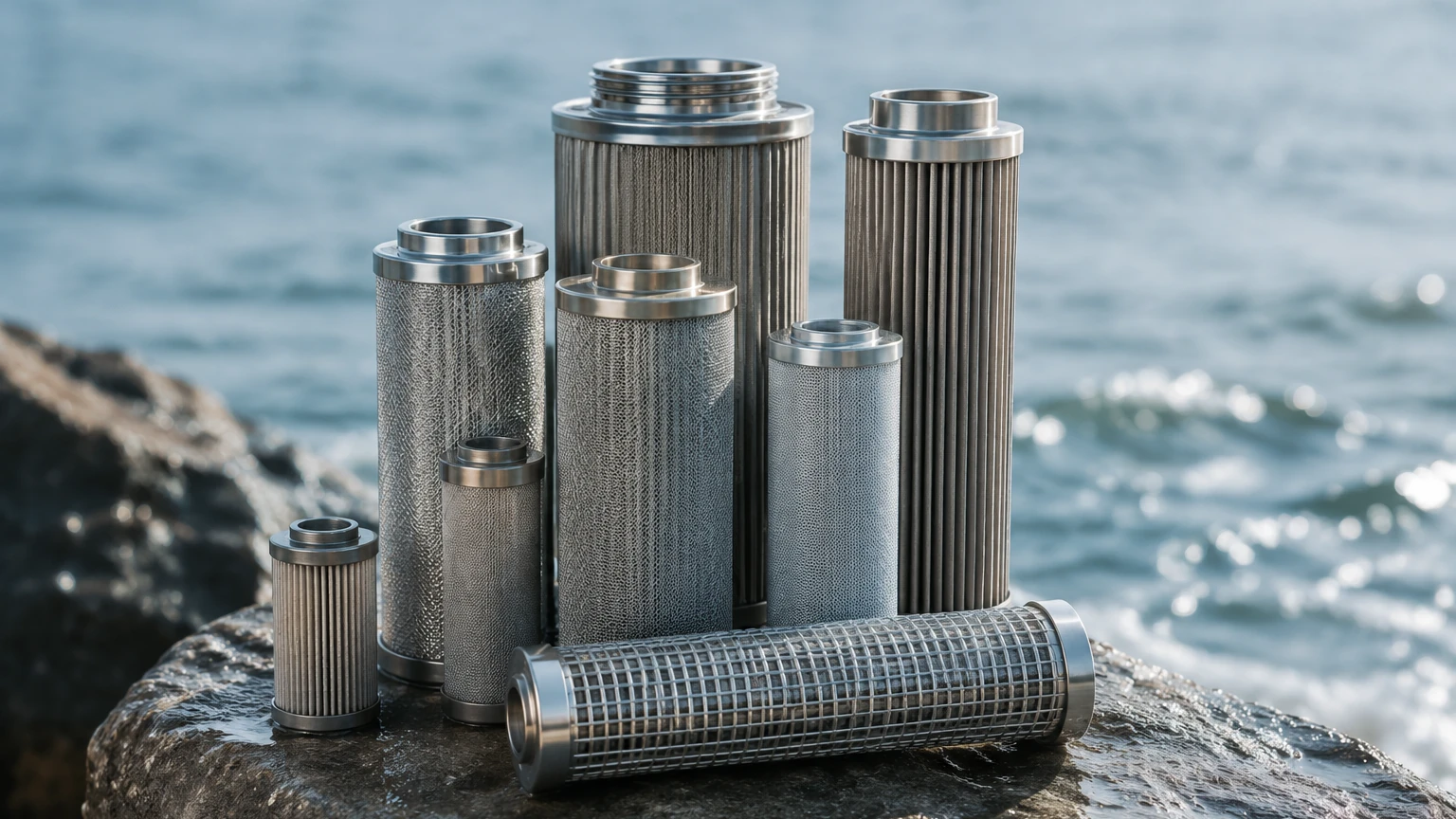
Precision-woven wire mesh is a staple in sea water filtration. It provides a fixed pore size, ensuring consistent filtration accuracy. For marine applications, multi-layered sintered wire mesh is often used. This process bonds multiple layers of mesh together through heat and pressure, creating a rigid, durable filter element that can withstand high differential pressures and repeated backwashing cycles.
Wedge Wire Screens
Wedge wire, or V-wire, is particularly effective for coarse sea water intake. The non-clogging design features a continuous slot that widens inwardly, allowing particles to pass through or be easily washed away. Wedge wire is highly resistant to mechanical stress and is often used in sea water intake screens to protect pumps and large-scale cooling systems from debris and marine life.
Sintered Metal Cartridges
When high-precision filtration is required (below 50 microns), sintered metal cartridges offer superior performance. These filters are constructed from metallic powders or fibers that are sintered into a porous structure. They provide depth filtration capabilities, allowing them to hold a higher volume of contaminants before requiring cleaning. These are frequently used in the pre-filtration stages of reverse osmosis (RO) desalination systems.
Technical Performance Parameters and Selection Criteria
When specifying sea water filters, engineers must evaluate several technical parameters to ensure the system meets the operational requirements of the facility.
Micron Rating and Filtration Efficiency
The micron rating defines the size of particles the filter is intended to remove. In sea water systems, a multi-stage approach is common:
- Coarse Filtration: 500 to 2,000 microns (protecting pumps and piping).
- Intermediate Filtration: 100 to 500 microns (protecting heat exchangers).
- Fine Filtration: 5 to 50 microns (pre-filtration for membranes or high-pressure nozzles).
Flow Rate and Flux
The flux rate—the volume of water passing through a unit area of filter media—must be carefully managed. High flux rates can force soft organic particles through the filter mesh and increase the rate of impingement corrosion. Sizing the filter with a conservative flux rate extends the interval between cleaning cycles and protects the integrity of the filter medium.
Differential Pressure ($ΔP$)
Monitoring the pressure drop across the filter is the primary method for determining when cleaning is required. A well-designed sea water filter should have a low clean pressure drop (typically less than 0.2 bar). The system should be engineered to withstand the maximum expected differential pressure during a breakthrough or heavy loading event without collapsing the filter element.
Maintenance, Cleaning, and Longevity in Marine Applications
The longevity of a sea water filter is directly tied to its maintenance regime. Because sea water is prone to causing scale and bio-deposits, the ability to restore the filter to its original condition is paramount.
Backwashing and CIP (Clean-in-Place)
Automated backwashing systems are common in sea water applications. These systems reverse the flow of water through the filter to dislodge accumulated debris. In cases of heavy biofouling, chemical cleaning (CIP) using mild acids or biocides may be necessary to remove organic films that backwashing cannot reach. The filter material must be chemically compatible with these cleaning agents.
Sacrificial Anodes and Cathodic Protection
To further protect stainless steel filter housings and elements from galvanic corrosion, sacrificial anodes (usually zinc or aluminum) are often installed. These anodes corrode preferentially, protecting the more expensive stainless steel components. Regular inspection and replacement of these anodes are essential parts of marine filter maintenance.
Replacement Cycles
While high-quality metal filters are designed for long-term use, they are not permanent. Wear from abrasive sand or eventual fatigue from pressure cycling will necessitate replacement. Establishing a clear replacement cycle based on historical performance data helps prevent catastrophic failures and unplanned outages.
Custom OEM Solutions for Sea Water Systems
Every sea water application has unique constraints, from the available footprint on a vessel to the specific salinity levels of a local estuary. Off-the-shelf solutions often fail to meet the rigorous demands of specialized marine engineering. This is where custom manufacturing becomes essential.
Customization allows for the optimization of filter geometry, the selection of specific alloy grades, and the integration of specialized fittings. For instance, a filter designed for a deep-sea subsea module will have vastly different pressure vessel requirements than a filter intended for a shore-based aquaculture facility. Working with a manufacturer that understands these nuances ensures that the filtration component is an asset rather than a point of failure.
For engineers seeking detailed technical specifications and customized filtration components, visiting the Main Page provides access to a range of stainless steel filtration solutions designed for demanding industrial environments. From material selection to precision manufacturing, professional guidance is available to help navigate the complexities of sea water filtration.
Conclusion
Sea water filters are indispensable components in modern industrial and marine infrastructure. By addressing the dual threats of corrosion and biofouling through advanced metallurgy and robust mechanical design, these systems ensure the reliability of critical equipment. Whether the application involves protecting a desalination plant or ensuring the cooling of a maritime propulsion system, the selection of high-quality, application-specific filtration is a fundamental requirement for operational success. Engineers must prioritize material integrity, appropriate micron ratings, and ease of maintenance to achieve a cost-effective and durable filtration solution.
