


Seawater Filters
In industrial marine and offshore applications, the management of seawater as a process fluid presents unique engineering challenges. Seawater is not merely water; it is a highly corrosive electrolyte containing dissolved salts, suspended solids, and a diverse range of biological organisms. Effective filtration is the primary defense mechanism for downstream equipment, such as heat exchangers, desalination membranes, and cooling systems. Selecting and implementing high-performance seawater filters is critical to maintaining system integrity, preventing biofouling, and minimizing unplanned downtime in demanding environments.
Industrial seawater filtration requires a sophisticated balance between filtration precision, mechanical strength, and chemical resistance. Unlike freshwater applications, marine environments demand materials that can withstand chloride-induced corrosion while managing high flow rates and variable particulate loads. As a specialized manufacturer, Kaifil provides precision-engineered stainless steel filtration solutions designed to meet these rigorous industrial standards.
The Critical Role of Seawater Filters in Industrial Applications
Seawater filters serve as the first line of protection in various sectors, including oil and gas, power generation, and chemical processing. The primary objective of these filters is to remove macro-impurities—such as sand, shells, and organic debris—and micro-particulates that could impair the efficiency of sensitive industrial components.
One of the most common applications is in Seawater Reverse Osmosis (SWRO) desalination plants. In these systems, pre-filtration is essential to protect high-pressure pumps and delicate RO membranes from abrasive particles and silt. Without adequate filtration, membranes can suffer from rapid fouling, leading to increased energy consumption and frequent, costly replacements. Similarly, in offshore oil platforms, seawater is often injected into reservoirs to maintain pressure; this water must be filtered to a specific micron level to prevent the plugging of the rock formation pores.
In cooling systems, seawater is used as a heat transfer medium. If the water is not properly filtered, debris can accumulate in heat exchanger tubes, leading to a phenomenon known as "macro-fouling." This not only reduces heat transfer efficiency but also creates sites for localized corrosion. High-quality seawater filters ensure that the cooling medium remains free of obstructive materials, preserving the thermal performance of the entire plant.
Material Science: Combating Corrosion in Marine Environments
When specifying seawater filters, material selection is the most critical engineering decision. The high chloride concentration in seawater (typically around 19,000 mg/L) makes standard carbon steel and even some lower grades of stainless steel susceptible to rapid degradation through pitting, crevice corrosion, and stress corrosion cracking (SCC).
Stainless Steel 316L
For many standard marine applications, 316L stainless steel is the baseline material. The addition of molybdenum (2-3%) enhances its resistance to chloride pitting compared to 304 stainless steel. 316L is widely used for filter housings and internal mesh components due to its excellent weldability and relative cost-effectiveness. However, in stagnant or high-temperature seawater, even 316L can be vulnerable to localized attack.
Duplex and Super Duplex Stainless Steels
For more aggressive environments or high-pressure systems, engineers often turn to Duplex (e.g., S32205) or Super Duplex (e.g., S32750) stainless steels. These materials feature a dual-phase microstructure of austenite and ferrite, providing significantly higher yield strength and superior resistance to chloride-induced corrosion. The Pitting Resistance Equivalent Number (PREN) for Super Duplex is typically above 40, making it highly reliable for long-term immersion in seawater. Kaifil specializes in utilizing these advanced alloys to manufacture filter components that survive where standard materials fail.
Surface Passivation
Beyond the base alloy, the surface treatment of the filter media is vital. Electropolishing and chemical passivation remove surface iron and contaminants, creating a dense, protective chromium-oxide layer. This process is essential for maintaining the longevity of wire mesh filters in seawater, as it minimizes the initiation sites for corrosion.
Engineering Design and Filtration Accuracy
The performance of seawater filters is defined by their ability to maintain a specific micron rating while handling high flux rates. Industrial filters typically utilize stainless steel wire mesh or sintered metal media to achieve precise particle separation.
Wire Mesh Structures
Stainless steel wire mesh is a preferred medium for seawater filtration due to its predictable pore size and high open-area ratio. Common weave patterns include:
* Plain Weave: Suitable for coarse filtration where high flow and low pressure drop are required.
* Twill Weave: Allows for thicker wires and higher mechanical strength for a given micron rating.
* Dutch Weave: Provides a dense, tortuous path for fine filtration, often used in high-pressure applications to ensure particle retention.
Pleated vs. Cylindrical Designs
To maximize the filtration surface area within a compact housing, filter elements are often pleated. Pleating increases the available surface area by 3 to 5 times compared to a standard cylindrical element. This design reduces the "flux" (flow per unit area), which in turn lowers the initial pressure drop and extends the time between cleaning cycles. In seawater applications where particulate loading can be high, pleated stainless steel cartridges offer superior dirt-holding capacity.
Managing Biofouling and Particulate Loading
A unique challenge for seawater filters is biofouling. Seawater contains larvae, algae, and bacteria that can colonize the filter surface. Once attached, these organisms grow, creating a biological film that increases flow resistance and can lead to "under-deposit corrosion."
To mitigate this, filtration systems must be designed for easy cleaning. In many industrial setups, automatic backwashing filters are used. These systems monitor the differential pressure ($ΔP$) across the filter. When the $ΔP$ reaches a pre-set threshold, a portion of the filtered fluid is diverted to flush the accumulated debris and biofilm from the mesh surface. For manual systems, the use of removable and cleanable stainless steel cartridges is standard. Unlike disposable polymer filters, stainless steel media can be cleaned using ultrasonic baths or chemical agents to restore original flow characteristics, significantly reducing the total cost of ownership.
Engineers must also account for seasonal variations in particulate loading. During certain times of the year, plankton blooms or storm-induced silt can rapidly increase the solids content in seawater. A robustly designed filter must have the mechanical integrity to withstand the resulting increase in differential pressure without collapsing or bypassing.
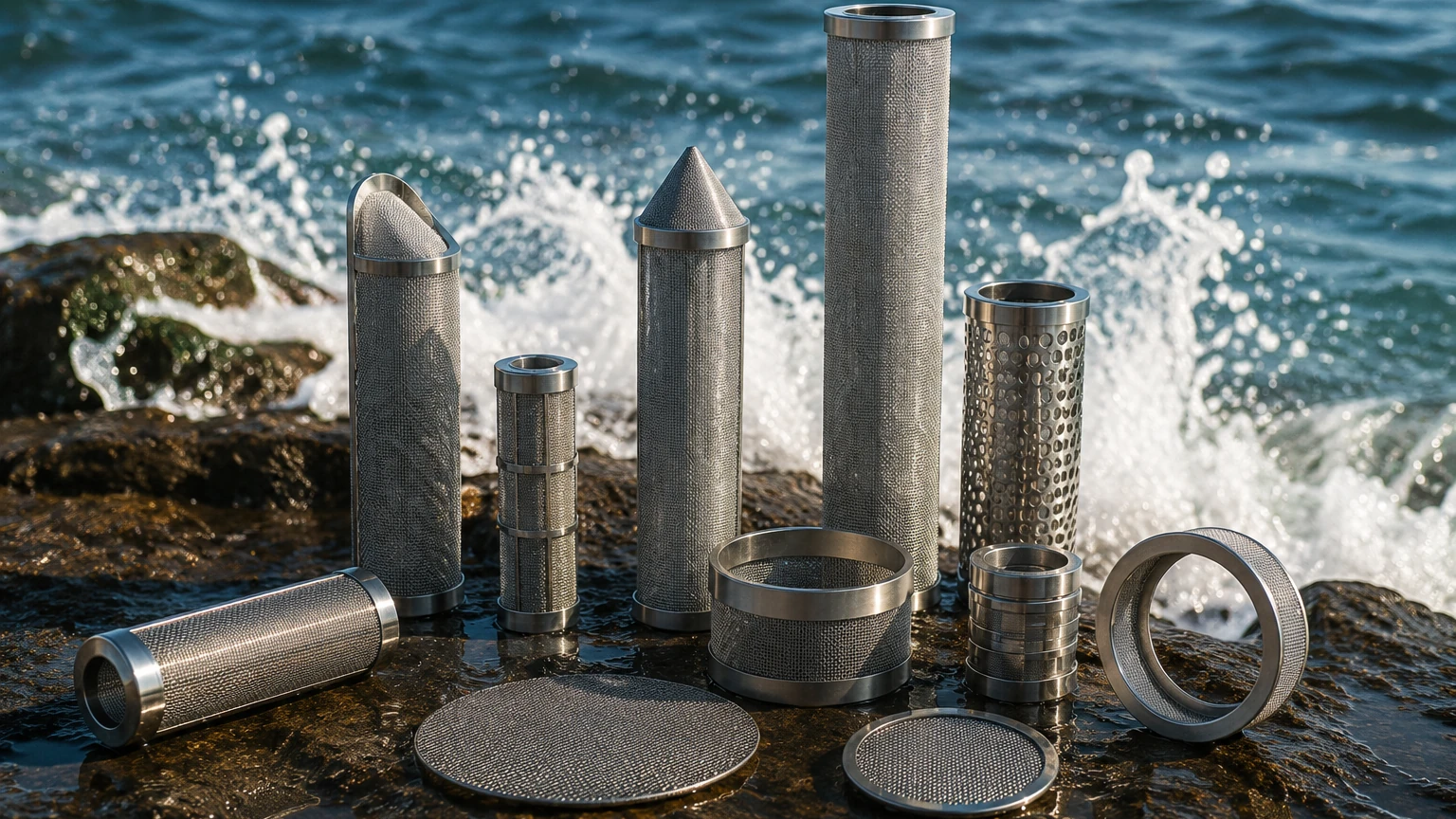
Customization and OEM Capabilities for Specialized Marine Systems
Standard off-the-shelf filters often fail to meet the specific spatial or performance requirements of complex industrial skids. Customization is frequently necessary to integrate filtration into existing hydraulic or water treatment systems. Kaifil provides extensive OEM capabilities, allowing engineers to specify exact dimensions, connection types (such as ANSI/DIN flanges or NPT threads), and structural reinforcements.
Customization involves more than just changing the size. It includes engineering the internal support structures—such as perforated cores or outer cages—to ensure the filter can handle high-pressure surges common in marine pumping systems. Furthermore, for specialized chemical processing or pharmaceutical applications using seawater, the filtration media can be tailored to specific chemical compatibility requirements, ensuring that the filter does not leach contaminants into the process stream.
By working closely with a manufacturer that understands the nuances of metal fabrication and filtration science, purchasing teams can procure components that are optimized for their specific operating parameters. For more information on tailored solutions, you can visit the Main Page to review product options and application support.
Maintenance, Cleaning, and Lifecycle Management
The longevity of seawater filters depends heavily on a structured maintenance regime. Because stainless steel filters are a capital investment, maximizing their service life is a priority for facility managers.
Monitoring Differential Pressure
Continuous monitoring of the pressure drop across the filter is the most effective way to determine the state of the filter media. A sudden drop in $ΔP$ might indicate a media breach or a seal failure, while a rapid increase suggests heavy fouling. Establishing a baseline $ΔP$ for a clean filter at a specific flow rate is the first step in effective lifecycle management.
Cleaning Procedures
Stainless steel filters are prized for their cleanability. Depending on the type of fouling, different methods can be employed:
1. Backflushing: Effective for removing loose particulates and surface debris.
2. Chemical Cleaning (CIP): Using mild acids or specialized detergents to dissolve mineral scales or organic biofilms. It is vital to ensure the cleaning agents are compatible with the specific grade of stainless steel (e.g., avoiding high concentrations of hydrochloric acid which can cause pitting).
3. Ultrasonic Cleaning: High-frequency sound waves in a liquid bath can dislodge fine particles trapped deep within the weave of a dutch-weave mesh.
Replacement Cycles
While stainless steel filters are durable, they are not infinite. Over years of service, repeated cleaning and exposure to high-velocity seawater can lead to erosion of the wire mesh or fatigue of the pleats. Regular visual inspections for signs of thinning wire or localized corrosion spots are necessary. Replacing a filter element before a catastrophic failure occurs is significantly less expensive than repairing a downstream pump or heat exchanger damaged by bypass debris.
Selecting the Right Seawater Filtration Solution
For engineers and purchasing professionals, selecting the correct seawater filter requires a comprehensive understanding of the application's technical boundaries. To ensure the optimal choice, the following parameters should be confirmed before procurement:
* Required Micron Rating: What is the smallest particle that must be removed to protect downstream equipment?
* Flow Rate (Minimum/Maximum): What is the range of water volume the filter must process?
* Operating Pressure and Temperature: Will the filter be subject to high-pressure spikes or elevated process temperatures?
* Fluid Chemistry: Are there specific chemical additives in the seawater (e.g., biocides or corrosion inhibitors) that might affect material compatibility?
* Space Constraints: Does the filter need to fit into a specific footprint or integrate with existing piping?
By addressing these factors, technical teams can specify a filtration solution that provides reliable performance, durability, and cost-efficiency. Kaifil’s expertise in custom stainless steel filtration ensures that these industrial requirements are met with precision, providing dependable components for the most demanding marine environments.
