


Seawater Filtration System
In industrial engineering, the management of seawater presents a unique set of challenges that differ significantly from freshwater processing. Whether utilized for desalination, offshore oil and gas operations, marine cooling systems, or ballast water treatment, seawater is a highly aggressive medium. A robust seawater filtration system is not merely a peripheral component but a critical safeguard for downstream equipment such as heat exchangers, high-pressure pumps, and sensitive membranes.
Selecting the appropriate filtration technology requires a deep understanding of fluid dynamics, metallurgy, and the specific biological profile of the source water. For engineers and procurement specialists, the goal is to balance filtration precision with structural longevity in an environment characterized by high salinity, varying particulate loads, and the constant threat of biofouling.
Understanding the Complexity of Seawater as a Process Fluid
Seawater is a complex electrolyte solution containing dissolved salts, suspended solids, organic matter, and living organisms. The primary challenge in designing a seawater filtration system is the corrosive nature of chloride ions, which can penetrate the passive protective layer of many standard metals.
Beyond chemical corrosion, the filtration system must handle a wide range of suspended solids. These include inorganic materials like sand and silt, as well as organic materials such as algae, plankton, and larvae. In coastal or shallow-water intakes, the particulate load can fluctuate significantly due to seasonal changes, weather events, and tidal movements. A system designed only for average conditions will likely fail during peak turbidity events, leading to unscheduled downtime and potential damage to downstream infrastructure.
Material Selection: The First Line of Defense Against Corrosion
The most critical decision in the engineering of filtration components for seawater is the choice of material. Standard 304 or even 316 stainless steel, while effective in many industrial applications, often proves inadequate for long-term seawater immersion due to pitting and crevice corrosion.
The Importance of PREN
Engineers often use the Pitting Resistance Equivalent Number (PREN) to evaluate the suitability of an alloy for seawater service. The formula, typically $PREN = \%Cr + 3.3 \times (\%Mo + 0.5 \times \%W) + 16 \times \%N$, provides a numerical value for corrosion resistance. For seawater applications, materials with a PREN greater than 40 are generally preferred.
Recommended Alloys
1. 316L Stainless Steel: Often used as a baseline, but primarily suitable for temporary exposure or highly controlled environments where oxygen levels and flow rates are optimized to prevent stagnation.
2. 904L Stainless Steel: A non-stabilized austenitic stainless steel with low carbon content, providing higher resistance to chloride attack than 316L.
3. Duplex Stainless Steel (e.g., 2205): Offers a combination of high mechanical strength and excellent resistance to stress corrosion cracking. It is a cost-effective alternative to high-nickel alloys in many seawater filtration systems.
4. Super Duplex Stainless Steel (e.g., 2507): With a PREN often exceeding 40, Super Duplex is the industry standard for demanding offshore and desalination applications, offering superior resistance to pitting in high-temperature seawater.
5. Titanium: While more expensive, titanium is virtually immune to corrosion in seawater, making it the preferred choice for mission-critical components where failure is not an option.
Filtering Media Options: From Wire Mesh to Sintered Metal
The internal filtration element is the heart of the seawater filtration system. The choice of media depends on the required filtration rating (micron size) and the mechanical stresses the element will endure.
Stainless Steel Wire Mesh
Woven wire mesh is a versatile and widely used medium. It provides a precise pore size and a high open area, which translates to lower pressure drops. In seawater applications, multi-layered mesh designs are often used to provide both filtration accuracy and structural support. Common weave types include:
* Plain Weave: Simple over-under patterns for coarse filtration.
* Dutch Weave: A denser weave that provides higher strength and finer filtration ratings, often used in high-pressure environments.
Sintered Metal Fiber and Mesh
For applications requiring extreme durability and fine filtration, sintered metal media are utilized. Sintering involves bonding multiple layers of wire mesh or metal fibers using heat and pressure without the use of binders. This creates a monolithic structure that is highly resistant to fatigue and can withstand high differential pressures. Sintered elements are particularly effective in seawater systems that undergo frequent backwashing, as the bonded structure prevents media migration or pore enlargement over time.
Wedge Wire
Wedge wire screens are often employed in the primary stage of a seawater filtration system. Their V-shaped profile is inherently non-clogging, as particles only contact the two leading edges of the wire. This design is ideal for removing large debris, shells, and seaweed at the intake stage.
Engineering Considerations for System Design and Integration
When specifying a seawater filtration system, engineers must look beyond the micron rating. Several operational parameters dictate the long-term success of the installation.
Flow Rate and Velocity
Fluid velocity through the filter media must be carefully managed. High velocities can lead to "impingement corrosion" and can force deformable organic particles through the mesh. Conversely, velocities that are too low may encourage the settling of solids and the formation of stagnant zones where crevice corrosion can thrive.
Pressure Drop (Delta P)
The clean pressure drop is the initial resistance the filter offers to the flow. As the filter accumulates debris, the pressure drop increases. A well-engineered system will have a clearly defined "terminal pressure drop," at which point the filter must be cleaned or replaced. In automated systems, this differential pressure triggers a backwash cycle.
Structural Integrity
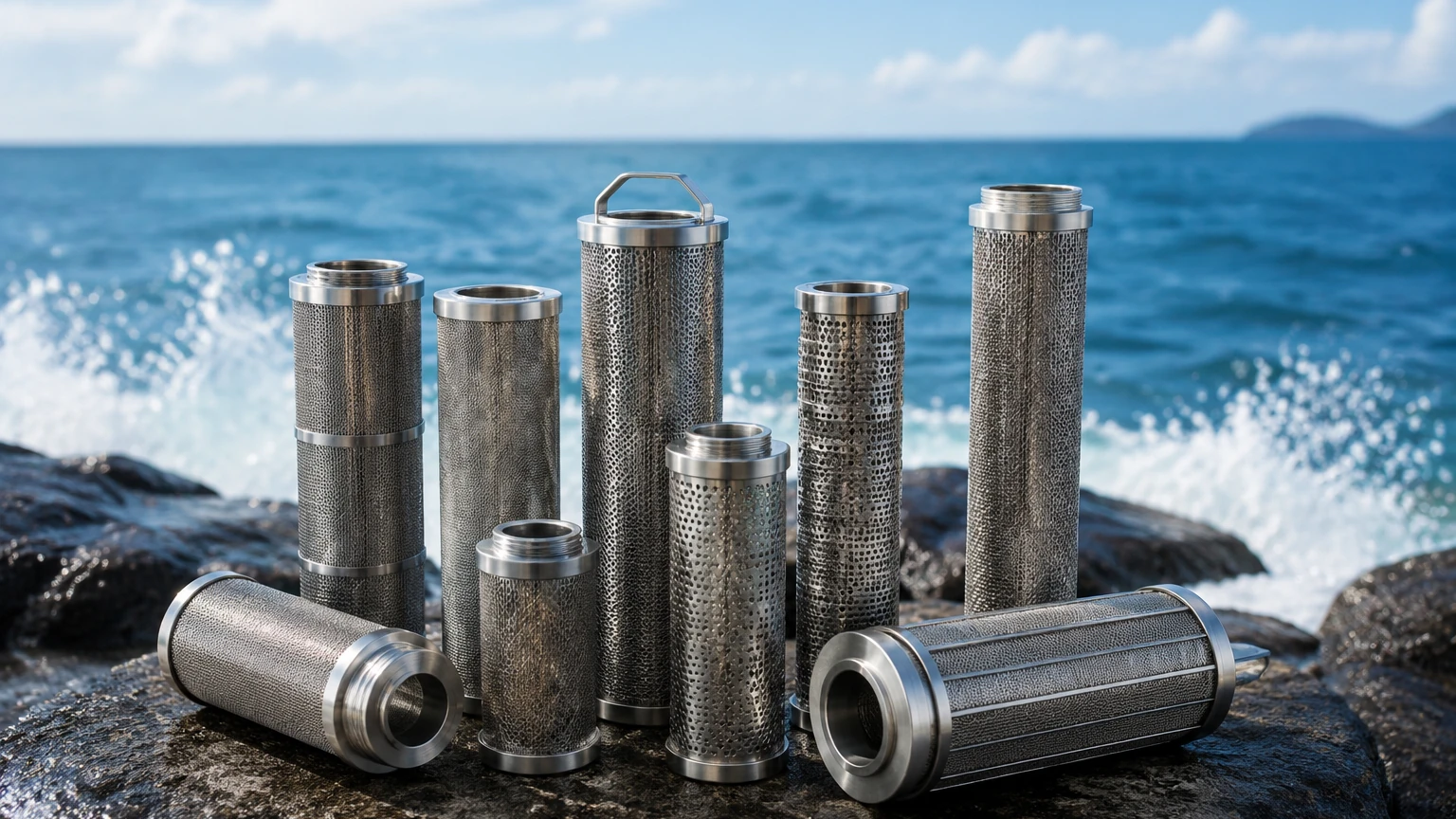
Seawater systems often operate under high pressure, especially in Reverse Osmosis (RO) desalination plants. Filter cartridges and mesh elements must be designed to resist collapsing or bursting. This often requires internal support cores made of heavy-gauge perforated metal or external cages to maintain the geometry of the pleats under stress.
Operational Challenges: Biofouling, Scaling, and Maintenance
One of the most persistent issues in seawater filtration is biofouling. Microorganisms, such as bacteria and algae, can colonize the surface of the filter media, creating a biofilm. This biofilm not only increases the pressure drop but can also create a localized acidic environment that accelerates microbiologically influenced corrosion (MIC).
Mitigation Strategies
* Chemical Dosing: The use of biocides like chlorine or sodium hypochlorite at the intake can help control biological growth. However, the filter materials must be compatible with these chemicals.
* Backwashing: Automated backwash systems use a portion of the filtered water (or air) to flush trapped particles from the media. The effectiveness of backwashing depends on the strength of the filter media and the design of the nozzles.
* Ultrasonic Cleaning: For removable filter cartridges, ultrasonic cleaning can be used to dislodge stubborn mineral scales or biological residues that backwashing cannot remove.
The Role of Customization in Industrial Seawater Applications
No two seawater intakes are identical. Variations in salinity, temperature, and local ecology mean that "off-the-shelf" solutions often underperform. Customization is essential for optimizing the performance of a seawater filtration system.
Customization options include:
* Tailored Micron Ratings: Adjusting the mesh density to target specific local contaminants, such as fine volcanic sand or specific seasonal algae blooms.
* Specialized End Caps and Fittings: Ensuring the filter element fits perfectly into existing housings to prevent bypass—where unfiltered water leaks around the filter element.
* Reinforced Designs: Adding additional support layers for systems prone to high-pressure spikes or water hammer.
For engineers looking to optimize their specific application, it is beneficial to Review product options and application support on the Main Page to understand how different configurations of stainless steel and alloy filters can be adapted to unique environmental conditions.
Evaluating Total Cost of Ownership (TCO) in Filtration Procurement
In the B2B procurement process, the initial purchase price (CAPEX) is often overshadowed by the long-term operating expenses (OPEX). For a seawater filtration system, the TCO is influenced by several factors:
1. Replacement Frequency: A cheaper 316L filter that needs replacement every six months is significantly more expensive over five years than a Super Duplex filter that lasts three years.
2. Cleaning Costs: Elements that are easy to clean and restore to "like-new" condition reduce the need for spare parts inventory.
3. Energy Consumption: A filter design that maintains a low pressure drop for a longer period reduces the energy required by the pumps to maintain flow.
4. Downstream Protection: The most significant cost of a sub-par filtration system is the damage it allows to occur to expensive downstream components like RO membranes or high-pressure turbines.
Selection Checklist for Procurement Teams
Before finalizing a specification for a seawater filtration system, technical teams should confirm the following data points with their manufacturer:
* Water Analysis: What is the typical and peak Total Suspended Solids (TSS) count? What is the chloride concentration and temperature range?
* Compatibility: Are the filter materials resistant to the specific chemicals used for Clean-in-Place (CIP) or biocide dosing?
* Mechanical Limits: What is the maximum allowable differential pressure before the element risks structural deformation?
* Certification: Does the manufacturing process meet industrial standards for welding and material traceability (e.g., MTRs)?
By addressing these technical details during the design and procurement phase, industrial operators can ensure that their seawater filtration system provides reliable, long-term protection in one of the world's most demanding environments. The transition from standard filtration to a high-performance, alloy-based solution is an investment in system uptime and operational security.
