


Self-cleaning Filters
In modern industrial processing, the transition from manual batch filtration to continuous automated systems is driven by the need for higher efficiency, reduced labor costs, and improved safety. Self-cleaning filters represent a critical advancement in this evolution, providing a solution for applications where high particulate loads or the need for uninterrupted flow make traditional bag or cartridge filters impractical. For engineers and procurement teams, understanding the mechanical principles, material requirements, and operational variables of these systems is essential for optimizing plant performance.
Industrial self-cleaning filters are designed to remove solids from fluids automatically, using a cleaning cycle that is triggered by either a timer or a pressure differential. Unlike manual systems that require a process shutdown for element replacement, these systems maintain flow during the cleaning process, ensuring that downstream equipment remains protected without the overhead of constant maintenance. This guide explores the technical nuances of self-cleaning filtration technology and the engineering considerations necessary for successful implementation.
Understanding Self-Cleaning Filtration Technology
The primary objective of any self-cleaning filter is to maintain a consistent flow rate while capturing contaminants. As fluid passes through the filter media—typically a stainless steel mesh or wedge wire element—solids accumulate on the surface. This accumulation creates a "filter cake," which initially improves filtration efficiency but eventually leads to an increase in differential pressure (DP).
When the DP reaches a pre-set threshold, the self-cleaning mechanism is activated. This automation is the defining characteristic of the system. In many B2B industrial environments, such as chemical processing or water treatment, the ability to handle high-solids loading without manual intervention significantly reduces the Total Cost of Ownership (TCO). By integrating these systems, facilities can move away from the recurring costs of disposable filter media and the environmental impact of disposing of contaminated cartridges.
Core Mechanisms of Automatic Self-Cleaning Filters
There are several mechanical approaches to self-cleaning, each suited to different fluid types, particle sizes, and flow requirements. Selecting the right mechanism is the first step in engineering a reliable filtration solution.
1. Backwashing Systems
Backwashing filters utilize a reversal of flow to dislodge particles from the filter media. When the cleaning cycle begins, a valve opens to a lower-pressure drain, causing a portion of the filtered fluid (or an external clean fluid source) to flow backward through the element. This high-velocity reverse flow carries the accumulated debris out of the system. Backwashing is highly effective for low-viscosity fluids like water and light oils, where the particles are not "sticky" and can be easily flushed from the mesh.
2. Mechanical Scraper Filters
For highly viscous fluids or applications with adhesive contaminants (such as resins, paints, or food products), mechanical scraping is the preferred method. These filters use a blade or brush that moves across the surface of the filter element. The scraper physically removes the solids, which then settle into a collection chamber at the bottom of the housing to be purged. This method is particularly advantageous because it does not require a reversal of flow and can handle much higher solids concentrations than backwashing systems.
3. Suction Scanning
Suction scanning technology combines aspects of backwashing with localized high-velocity cleaning. A small nozzle or "scanner" moves across the internal surface of the filter screen. Because the nozzle covers only a small fraction of the total surface area at any given time, the cleaning process uses very little flush water and does not interrupt the main flow. This is often the choice for large-scale water filtration where water conservation is a priority.
The Role of Stainless Steel Filter Media in Self-Cleaning Systems
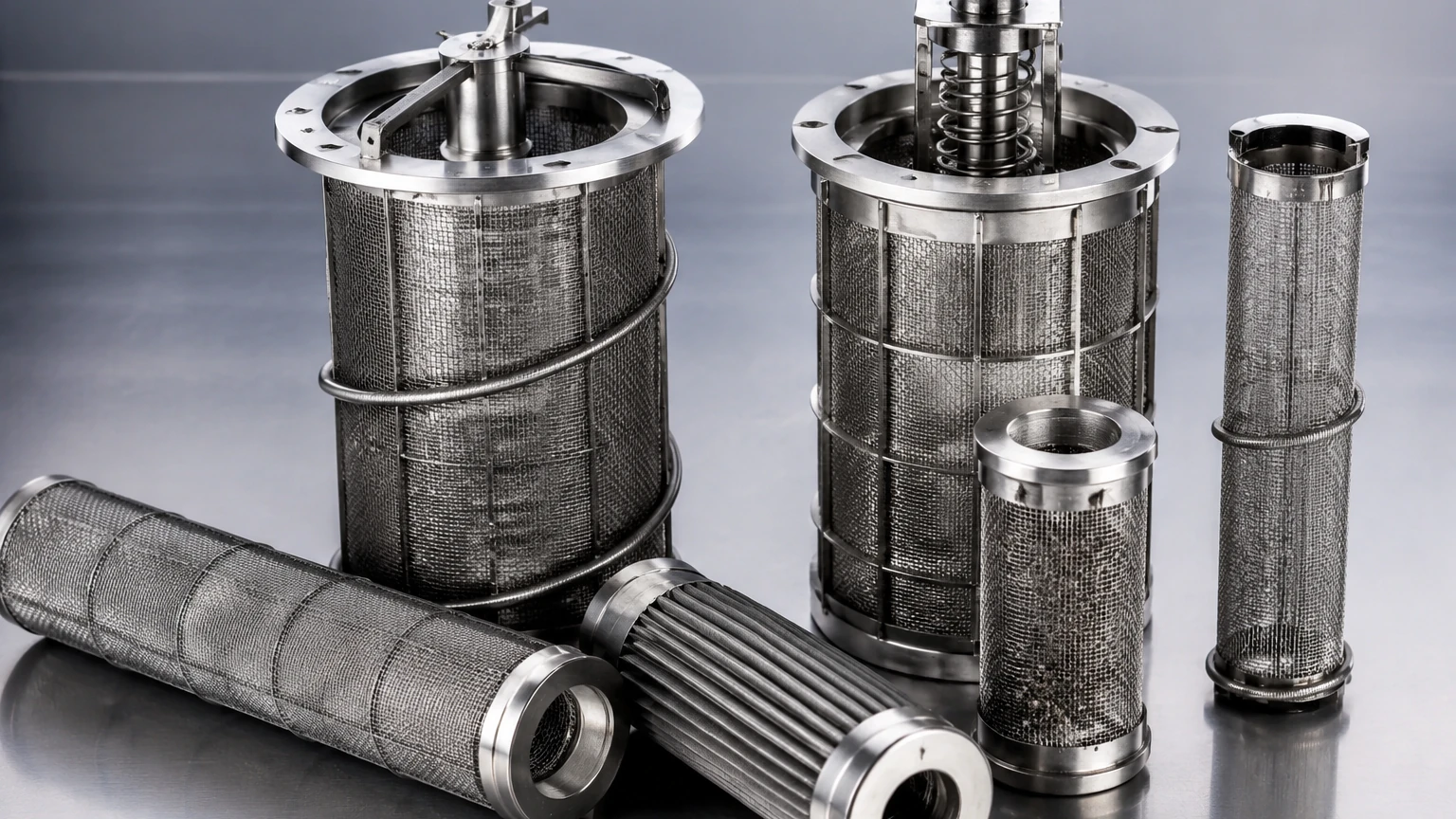
The performance of any self-cleaning filter is fundamentally limited by the quality and design of its internal filter element. Stainless steel is the industry standard for these components due to its mechanical strength, corrosion resistance, and ability to withstand repeated cleaning cycles. As a specialized manufacturer, Kaifil focuses on producing the precision components that allow these systems to function under high-pressure and high-temperature conditions.
Wire Mesh vs. Wedge Wire
Two primary types of media are used in self-cleaning filters:
- Stainless Steel Wire Mesh: Multi-layered or sintered wire mesh provides high porosity and precise micron ratings. It is ideal for capturing fine particulates but requires careful engineering to ensure the mesh does not deform under the mechanical stress of a scraper or the pressure of a backwash.
- Wedge Wire: Constructed from V-shaped profiles welded to support rods, wedge wire elements are exceptionally robust. The V-shape creates a narrow slot on the surface that widens inward, which helps prevent "pegging" (particles getting stuck in the openings). Wedge wire is the preferred choice for heavy-duty mechanical scraper filters.
Material selection usually involves choosing between 304 and 316L stainless steel. While 304 is suitable for many general industrial applications, 316L offers superior resistance to chlorides and acids, making it necessary for pharmaceutical and chemical processing environments. For more information on material compatibility and custom element design, you can visit the Main Page.
Critical Engineering Parameters for Selection
When specifying self-cleaning filters, engineers must look beyond simple pipe size. Several variables dictate whether a filter will provide years of service or become a constant source of mechanical failure.
Micron Rating and Particle Distribution
It is vital to distinguish between absolute and nominal micron ratings. In self-cleaning systems, the "cleanability" of the media is as important as its capture rate. If the micron rating is too fine for the specific particle distribution of the process fluid, the filter may enter a continuous cleaning loop, leading to excessive wear on moving parts and high fluid loss during purging.
Flow Rate and Flux
Flux—the flow rate per unit of filter area—is a key metric. High flux rates can drive particles deep into the mesh, making them difficult to remove during the cleaning cycle. Sizing the filter housing to maintain a conservative flux rate ensures that the self-cleaning mechanism remains effective over the long term.
Fluid Viscosity and Temperature
Viscosity significantly impacts the pressure drop across the filter. As viscosity increases, the power required for mechanical scrapers increases, and the effectiveness of backwashing decreases. Similarly, temperature affects both the viscosity of the fluid and the thermal expansion of the internal components. Precision manufacturing ensures that the tolerances between scrapers and filter elements remain consistent across the operating temperature range.
Maintenance, Reliability, and Operational Risks
While self-cleaning filters are designed to reduce maintenance, they are not "set and forget" systems. Reliability depends on the integrity of the seals, the calibration of the control system, and the durability of the filter element.
- Seal Integrity: In scraper-style filters, the internal seals are subject to constant friction. Using high-performance polymers or mechanical seals is necessary to prevent bypass—where unfiltered fluid leaks into the clean stream.
- Differential Pressure Calibration: If the DP sensors are not calibrated correctly, the system may fail to trigger a cleaning cycle, leading to a collapsed filter element or a complete blockage of the process line.
- Mechanical Wear: Moving parts, such as motors, shafts, and bearings, require periodic inspection. In abrasive applications, the filter element itself may eventually thin or develop holes, requiring replacement of the internal cartridge.
To mitigate these risks, engineers should prioritize designs that allow for easy access to internals without removing the entire filter housing from the piping. This "top-entry" or "swing-away" design is a hallmark of high-quality industrial filtration equipment.
Cost-Benefit Analysis and Total Cost of Ownership
The initial capital expenditure (CAPEX) for a self-cleaning filter is higher than that of a simple duplex basket strainer or a bag filter housing. However, the operational expenditure (OPEX) is significantly lower.
1. Labor Savings: Manual filter changes can take hours of technician time per week. Self-cleaning systems reclaim this labor for more productive tasks.
2. Reduced Consumable Costs: The cost of purchasing, stocking, and disposing of filter bags or cartridges adds up quickly. A stainless steel self-cleaning element can last for years with proper maintenance.
3. Product Loss Prevention: Every time a manual filter is opened, a certain amount of process fluid is lost or contaminated. Automated purging systems can be tuned to minimize fluid loss, which is especially critical when dealing with expensive chemicals or food products.
4. Safety and Compliance: In industries handling hazardous materials, reducing the frequency with which operators must open the filtration system improves safety and simplifies environmental compliance.
Selecting a Custom Filtration Partner
Because every industrial process has unique requirements, a one-size-fits-all approach to self-cleaning filters often leads to sub-optimal results. Working with a manufacturer that offers OEM and customized filtration solutions allows for the fine-tuning of the filter media, housing materials, and mechanical interfaces to match the specific demands of the application.
Whether the challenge is a high-temperature chemical reaction, a sanitary food processing line, or a high-pressure hydraulic system, the core of the solution is the filter element. Ensuring that this component is manufactured to precise tolerances with high-grade materials is the best way to guarantee the longevity of the entire system. For technical specifications on custom stainless steel filter cartridges and wire mesh components, engineers are encouraged to Review product options and application support on the company's Main Page.
By focusing on engineering fundamentals—material science, mechanical reliability, and process compatibility—technical professionals can select self-cleaning filters that provide stable, long-term performance in the most demanding industrial environments.
