


Self-cleaning Filters for Slurry
In industrial fluid processing, the management of slurries—liquids containing a high concentration of suspended solids—presents a significant engineering challenge. Traditional filtration methods often fail in these environments due to rapid blinding of the filter media, leading to frequent downtime, high labor costs, and inconsistent flow rates. Self-cleaning filters for slurry have emerged as the standard solution for maintaining continuous operation in sectors ranging from chemical processing and mining to food production and wastewater treatment. By automating the removal of accumulated solids, these systems ensure that the filtration process remains efficient without the need for manual intervention or process interruption.
Selecting the right filtration system requires a deep understanding of the physical properties of the slurry and the mechanical principles of the filter. For engineers and procurement specialists, the goal is to balance initial capital expenditure with long-term operational reliability. This guide examines the technical considerations, material requirements, and performance metrics essential for implementing effective slurry filtration solutions.
Understanding the Dynamics of Slurry Filtration
Slurry is not a uniform substance; its behavior depends on the concentration, size, shape, and density of the suspended particles, as well as the viscosity of the carrier liquid. In many industrial applications, slurries are abrasive, corrosive, or non-Newtonian, meaning their viscosity changes under stress. These characteristics dictate the type of self-cleaning mechanism required.
When a slurry passes through a filter medium, the solids are retained on the surface or within the depth of the media. In high-solids applications, a "filter cake" builds up rapidly. If not removed, this cake increases the differential pressure (ΔP) across the system, eventually halting the flow. Self-cleaning filters for slurry are designed to detect this pressure increase or operate on a timed cycle to clear the media surface while the system remains online.
Key factors influencing filtration performance include:
* Particle Size Distribution (PSD): Understanding the range of particle sizes ensures the micron rating of the filter is sufficient to protect downstream equipment without causing premature clogging.
* Solids Loading: The percentage of solids by weight or volume determines the frequency of the cleaning cycle and the volume of waste (purge) generated.
* Fluid Viscosity: Higher viscosity liquids require more force to push through the filter media and may impact the efficiency of the cleaning mechanism, particularly in backwashing systems.
Mechanisms of Self-Cleaning Systems
There are several mechanical approaches to self-cleaning, each suited to different slurry profiles. The two most common designs in heavy industrial use are mechanical scraper systems and backwashing systems.
Mechanical Scraper Filters
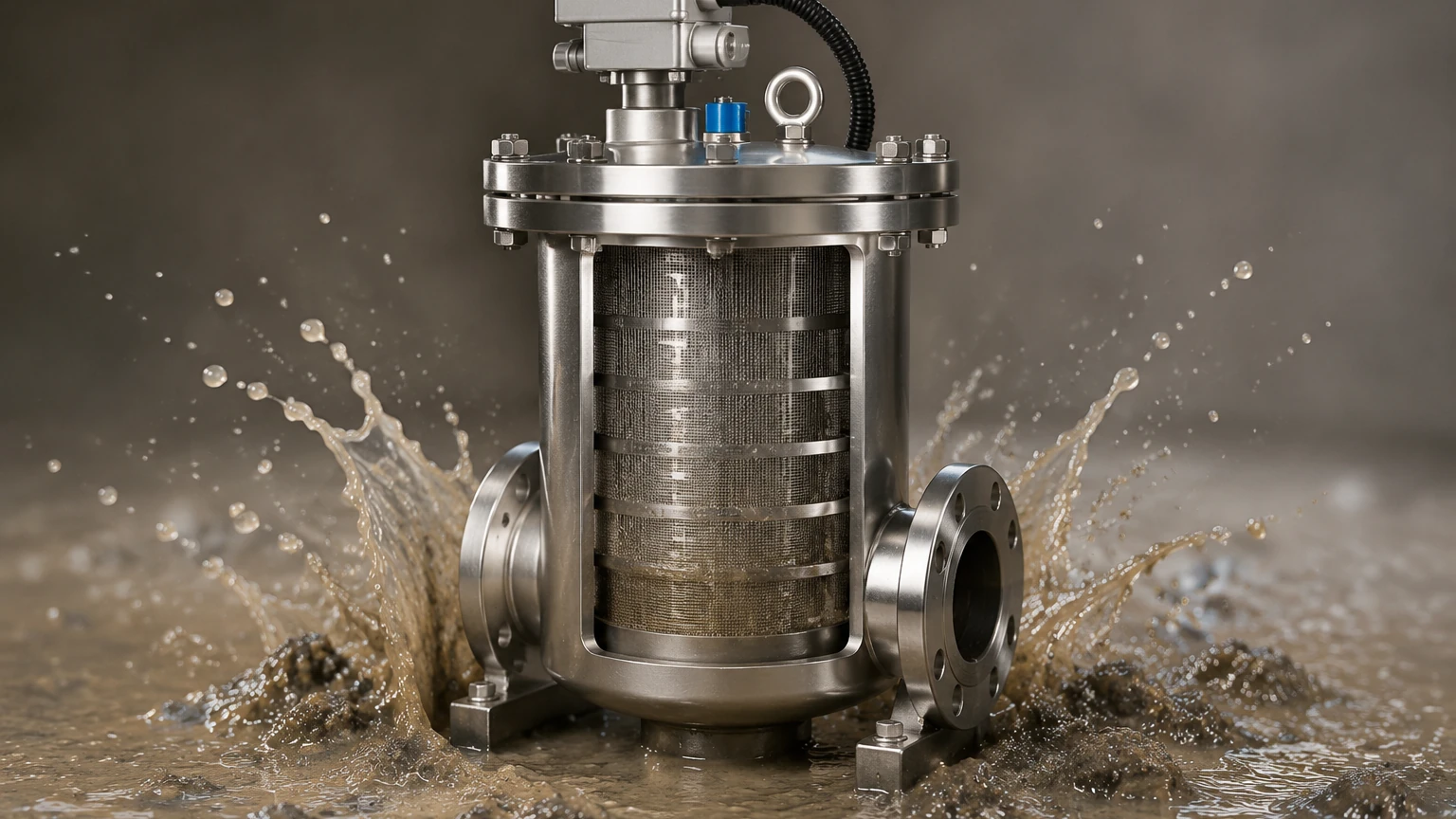
Mechanical scraper filters are ideal for highly viscous slurries or those containing sticky, organic solids. These filters typically utilize a cylindrical stainless steel screen. A scraper—made of metal or high-performance plastics like PTFE—moves across the surface of the screen, physically dislodging the accumulated solids. These solids then settle into a collection chamber at the bottom of the filter housing, where they are periodically purged.
This method is advantageous because it does not require a reversal of flow and loses very little process fluid during the cleaning cycle. It is particularly effective for slurries in the food and beverage industry, such as chocolate, syrups, or fats, where maintaining a constant temperature and flow is critical.
Backwashing Filters
Backwashing systems use a portion of the filtered fluid (or an external clean fluid) to flush the filter media in the reverse direction. This sudden reversal of flow dislodges particles trapped in the mesh or wedge wire. Backwashing is highly effective for inorganic slurries with non-sticky particles, such as sand, scale, or metal fines.
In a multi-element backwashing filter, individual filter cartridges are cleaned one at a time while the remaining elements continue to provide filtration. This ensures that the overall process flow is never interrupted. However, engineers must account for the "backwash volume"—the amount of fluid used for cleaning—which must be treated or recirculated.
Material Selection and Engineering Considerations
The abrasive nature of many slurries necessitates the use of high-durability materials. Stainless steel is the industry standard due to its mechanical strength and resistance to both corrosion and abrasion. When specifying a filter, material grades such as 304, 316, and 316L are commonly used.
* 304 Stainless Steel: Suitable for general industrial applications with low corrosive potential.
* 316/316L Stainless Steel: Contains molybdenum, providing superior resistance to chlorides and acidic environments, making it the preferred choice for chemical processing and marine applications.
* Wedge Wire Technology: Many self-cleaning filters for slurry utilize wedge wire (V-wire) screens rather than traditional woven wire mesh. The V-shaped profile of the wire creates a slot that widens inwardly. This design ensures that any particle small enough to pass through the initial opening will continue through without getting wedged in the screen, significantly reducing the risk of permanent blinding.
Beyond the housing and media, internal components such as seals, bearings, and the cleaning drive motor must be rated for the specific environment. For example, in pharmaceutical or food applications, the internal surfaces must be polished to a specific Ra (Roughness Average) value to prevent bacterial growth and ensure compliance with sanitary standards.
Optimizing Performance and Total Cost of Ownership
While the initial cost of an automated self-cleaning filter is higher than that of a manual basket strainer, the Total Cost of Ownership (TCO) is significantly lower in slurry applications. The primary drivers of ROI include:
1. Reduced Labor Costs: Manual cleaning of filters in a high-solids environment may require several man-hours per day. Automation eliminates this requirement.
2. Increased Uptime: Systems do not need to be shut down for filter changes, allowing for 24/7 continuous production.
3. Minimized Product Loss: Self-cleaning systems are designed to concentrate the waste solids, ensuring that the maximum amount of process fluid remains in the system.
4. Safety: In applications involving hazardous chemicals or high temperatures, reducing the need for operators to open the filter housing significantly improves workplace safety.
To ensure optimal performance, engineers should consult with manufacturers to determine the correct sizing. An undersized filter will clean too frequently, leading to excessive wear on mechanical components and higher purge volumes. Conversely, an oversized filter may lead to low flow velocities that allow solids to settle in dead zones within the housing.
Integration and Customization
Every industrial process has unique requirements. Customization of self-cleaning filters for slurry often involves specialized inlet/outlet configurations, specific micron ratings ranging from 10 to 2000 microns, and the integration of PLC-based control systems. These controls allow operators to monitor differential pressure in real-time and adjust cleaning cycles based on changing process conditions.
For those seeking to evaluate specific hardware configurations or request technical support for a custom filtration project, visiting the Main Page of a specialized manufacturer like Kaifil provides access to detailed product specifications and engineering resources. Professional manufacturers offer the expertise needed to navigate material compatibility and design constraints, ensuring the filtration system meets the rigorous demands of industrial slurry handling.
Maintenance and Long-Term Reliability
Despite their automated nature, self-cleaning filters require a structured maintenance program to ensure longevity. For slurry applications, the most critical maintenance tasks include:
* Inspection of Wear Parts: Scraper blades and seals are sacrificial components. In abrasive slurry environments, these should be inspected regularly and replaced according to the manufacturer’s schedule to prevent damage to the more expensive filter screens.
* Monitoring Differential Pressure: While the system is automated, tracking the baseline ΔP over time can help identify "media seasoning" or deep-seated fouling that may eventually require ultrasonic cleaning or chemical treatment.
* Purge Valve Functionality: The purge valve is responsible for removing the concentrated solids. If this valve fails to seal correctly or becomes clogged, the efficiency of the entire system will drop.
By selecting a system designed for the specific rheology of the slurry and maintaining it through proactive engineering practices, industrial facilities can achieve a reliable, high-performance filtration process that supports both operational efficiency and product quality. Whether the application involves chemical catalysts, food pulps, or industrial wastewater, the transition to automated self-cleaning technology represents a critical step in modernizing fluid handling infrastructure.
