


Semiconductor Filters
In the highly controlled environment of semiconductor manufacturing, the margin for error is measured in nanometers. As integrated circuit (IC) designs continue to shrink, the sensitivity of the fabrication process to particulate contamination increases exponentially. Semiconductor filters are the critical components responsible for ensuring that the gases, chemicals, and water used during production meet the extreme purity standards required to maintain high yields. For engineers and procurement professionals, selecting the right filtration solution involves a complex evaluation of material compatibility, particle retention efficiency, and long-term mechanical reliability.
Industrial filtration in the semiconductor sector is not merely about removing debris; it is about maintaining a sterile, chemically inert, and particle-free environment through every stage of the photolithography, etching, and deposition processes. This guide examines the technical requirements, engineering considerations, and selection criteria for high-performance semiconductor filters.
The Critical Role of Filtration in Semiconductor Fabrication
The semiconductor manufacturing process involves hundreds of individual steps, many of which utilize aggressive chemicals and high-purity gases. Any particulate matter introduced into these systems can lead to "killer defects," where a single microscopic particle shorts a circuit or interferes with the lithographic pattern, rendering the entire wafer useless.
Semiconductor filters are deployed across several key areas:
1. Gas Delivery Systems: Ultra-high purity (UHP) gases such as nitrogen, argon, and specialty process gases must be filtered to remove particles down to the sub-micron level. Metal filters are often preferred here due to their ability to withstand high pressures and temperatures without outgassing.
2. Chemical Distribution: Acids, bases, and solvents used in cleaning and etching require filters that can resist corrosion while maintaining high flow rates.
3. Ultrapure Water (UPW): Water is used extensively for wafer rinsing. UPW filtration must remove not only particles but also bacteria and organic carbon to ensure the wafer surface remains pristine.
4. Photolithography: The chemicals used in the lithography process, including photoresists and developers, are extremely sensitive. Filters in this stage must provide precise retention without shearing the delicate polymer chains within the fluids.
Engineering Considerations for Metal Semiconductor Filters
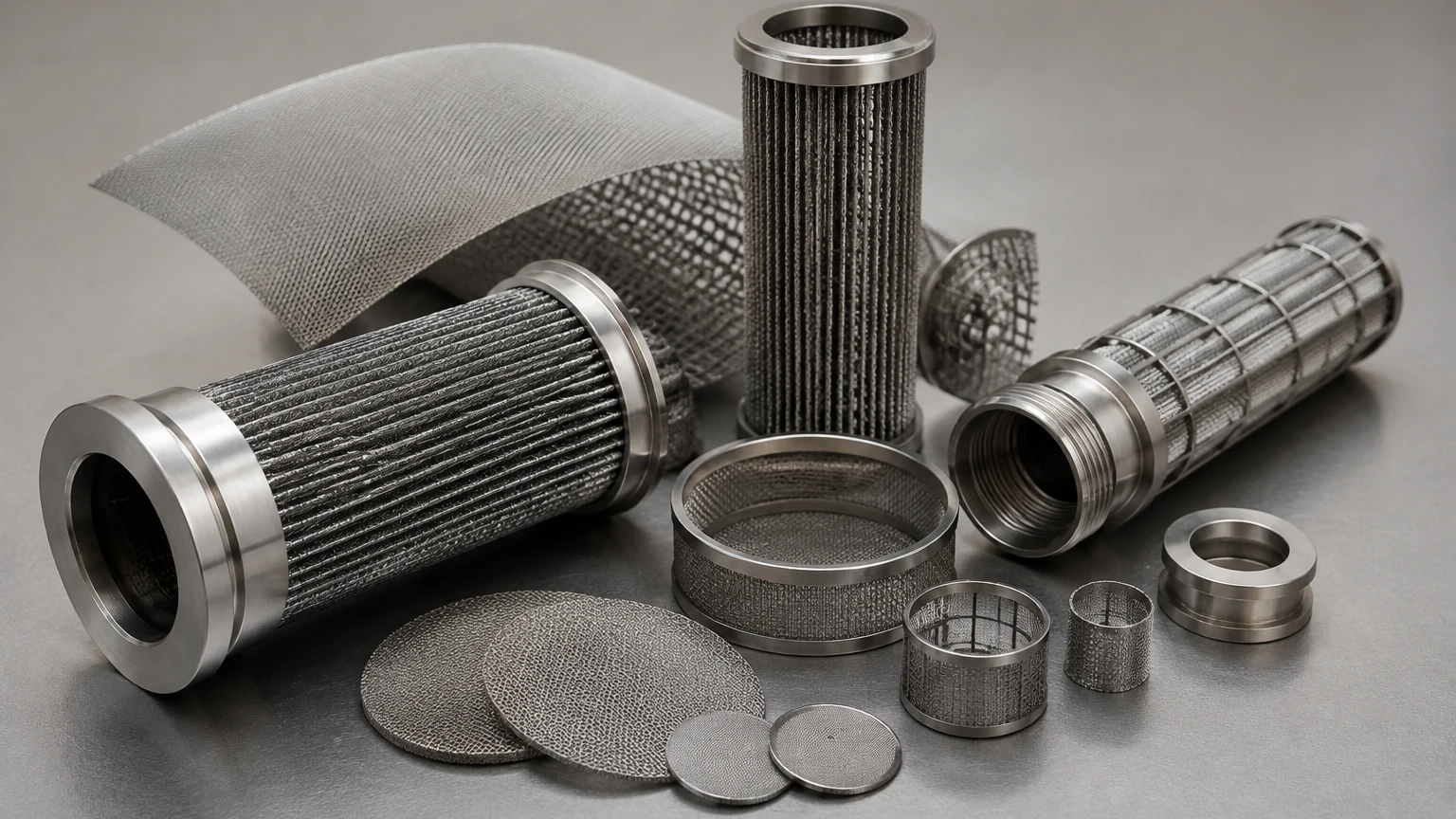
While polymer-based filters are common in some applications, stainless steel and specialized metal mesh filters are essential in demanding semiconductor environments. As a manufacturer specializing in custom stainless steel filtration, Kaifil provides solutions that address the specific mechanical and chemical challenges of the industry.
Material Integrity and Chemical Compatibility
In semiconductor applications, the filter material must be as inert as possible. 316L stainless steel is the industry standard for many gas and solvent applications due to its excellent corrosion resistance and mechanical strength. For more aggressive environments involving halides or high-temperature acids, nickel-based alloys or Hastelloy may be utilized. The goal is to prevent any metallic ion leaching, which could contaminate the silicon substrate.
Surface Finish and Electropolishing
For semiconductor filters, the internal surface finish is just as important as the filtration media itself. Electropolishing the stainless steel components reduces the surface roughness, minimizing the areas where particles can become trapped or where bacteria can grow. A smooth, passivated surface also enhances corrosion resistance, ensuring the filter does not become a source of contamination over time.
Thermal and Pressure Stability
Unlike polymer filters, metal semiconductor filters can operate at extreme temperatures and withstand significant pressure differentials. This is particularly important in Chemical Vapor Deposition (CVD) and Atomic Layer Deposition (ALD) processes, where gases are often heated to facilitate reactions. Metal filters maintain their structural integrity and pore size distribution under these stresses, providing consistent performance that plastic alternatives cannot match.
Technical Specifications: Particle Retention and Flow Rates
When evaluating semiconductor filters, engineers must balance the need for fine particle retention with the requirement for high flow rates. A filter with an extremely small pore size may provide excellent retention but could cause an unacceptable pressure drop, slowing down production or requiring more powerful pumping systems.
Absolute vs. Nominal Ratings
In the semiconductor industry, absolute filtration ratings are the standard. An absolute rating signifies that the filter will capture 99.9% (or higher) of particles at a specific micron size. Nominal ratings, which are based on an average, are generally insufficient for the precision required in wafer fabrication. Engineers must confirm the "Beta Ratio" of a filter to understand its true efficiency at various particle sizes.
Outgassing and Extractables
One of the primary risks with non-metallic filters is outgassing—the release of volatile organic compounds (VOCs) or other vapors from the filter material itself. In vacuum environments or UHP gas lines, outgassing can contaminate the process chamber. Stainless steel filters are inherently low-outgassing, making them the preferred choice for vacuum and high-purity gas delivery systems.
Differential Pressure (∆P)
Monitoring the differential pressure across a filter is the primary method for determining its remaining service life. A high initial ∆P indicates that the filter may be undersized for the application, while a rapid increase in ∆P suggests high levels of incoming contamination. Designing systems with adequate surface area—often through pleated wire mesh designs—helps to minimize initial pressure drop and extend the interval between filter changes.
Challenges in Semiconductor Fluid Handling
The fluids used in semiconductor manufacturing are among the most challenging to handle in any industrial sector. Filtration systems must be designed to overcome several specific hurdles:
* Corrosive Etchants: Chemicals like hydrofluoric acid (HF) and various alkaline cleaners can degrade standard materials. Selecting the correct alloy for the filter housing and media is vital to prevent catastrophic failure.
* Slurry Filtration: In Chemical Mechanical Planarization (CMP), slurries containing abrasive particles are used to level the wafer surface. Filters in these lines must remove large "oversized" particles that could scratch the wafer while allowing the functional abrasive particles to pass through.
* Micro-bubbling: In high-purity liquid lines, the pressure drop across a filter can cause dissolved gases to come out of solution, forming micro-bubbles. These bubbles can cause defects in the photoresist layer. High-permeability metal mesh filters help mitigate this by reducing the pressure drop.
Maintenance, Replacement Cycles, and Total Cost of Ownership
In a B2B procurement context, the initial price of a semiconductor filter is only one part of the total cost of ownership (TCO). Engineers must also consider the cost of downtime, the risk of wafer loss, and the labor associated with filter replacement.
Predictive Maintenance
Rather than replacing filters on a fixed schedule, many advanced fabrication facilities use predictive maintenance based on real-time differential pressure data. This ensures that filters are used to their maximum capacity without risking a breakthrough or a significant drop in flow rate.
Cleanability and Reusability
While many semiconductor filters are disposable, certain stainless steel and metal mesh filters can be cleaned and reused, depending on the contaminant. Ultrasonic cleaning and chemical backwashing can restore the permeability of metal filters, offering a more sustainable and cost-effective solution for non-critical or high-load applications. However, for the most sensitive UHP stages, single-use high-purity cartridges remain the standard to eliminate the risk of cross-contamination.
Customization and OEM Solutions for Semiconductor Equipment
Standard off-the-shelf filters often fail to meet the unique spatial or performance requirements of specialized semiconductor manufacturing equipment. This is where custom engineering becomes a necessity. OEMs (Original Equipment Manufacturers) of lithography machines, etch tools, and gas cabinets require filtration components that fit specific footprints and meet exact flow specifications.
Kaifil works closely with global customers to develop customized filtration solutions. By controlling the entire manufacturing process—from wire mesh weaving to final assembly and testing—Kaifil ensures that each filter meets the rigorous demands of the semiconductor industry. Whether it is a unique fitting, a specific alloy requirement, or a custom pore structure, tailored solutions provide the reliability that mission-critical applications demand.
For those seeking to explore specific product configurations or technical support for industrial applications, you can Review product options and application support to find the right match for your system requirements. The ability to customize the dimensions and filtration accuracy of stainless steel filter cartridges allows for seamless integration into existing semiconductor toolsets.
Conclusion: Strategic Filter Selection for High-Yield Manufacturing
Semiconductor filters are more than just consumables; they are strategic assets that directly impact the profitability and technical capability of a fabrication facility. As the industry moves toward even smaller process nodes, the requirements for filtration will only become more stringent. Engineers must prioritize materials that offer the highest levels of purity, such as electropolished stainless steel, and designs that balance retention efficiency with operational throughput.
By understanding the engineering principles behind particle retention, chemical compatibility, and mechanical stability, purchasing teams can make informed decisions that reduce the total cost of ownership and protect the integrity of the manufacturing process. Partnering with a manufacturer that understands these technical boundaries is essential for achieving the consistent, high-purity performance required in the modern semiconductor landscape.
