


Single Belt Press
In the landscape of industrial solid-liquid separation, the single belt press stands as a critical component for continuous dewatering and filtration. Unlike batch processes that require downtime for cake discharge and cleaning, the single belt press—often encompassing gravity belt thickeners and horizontal vacuum belt filters—offers a streamlined, high-throughput solution for industries ranging from municipal wastewater treatment to specialized chemical processing. For engineers and procurement managers, understanding the mechanical nuances and the critical role of the filtration medium is essential for optimizing operational efficiency and reducing the total cost of ownership.
As a specialized manufacturer of stainless steel filtration solutions, Kaifil provides the high-precision wire mesh and filter components that serve as the functional heart of these systems. To explore our full range of industrial filtration products, you can visit our Main Page.
The Fundamental Mechanics of Single Belt Press Systems
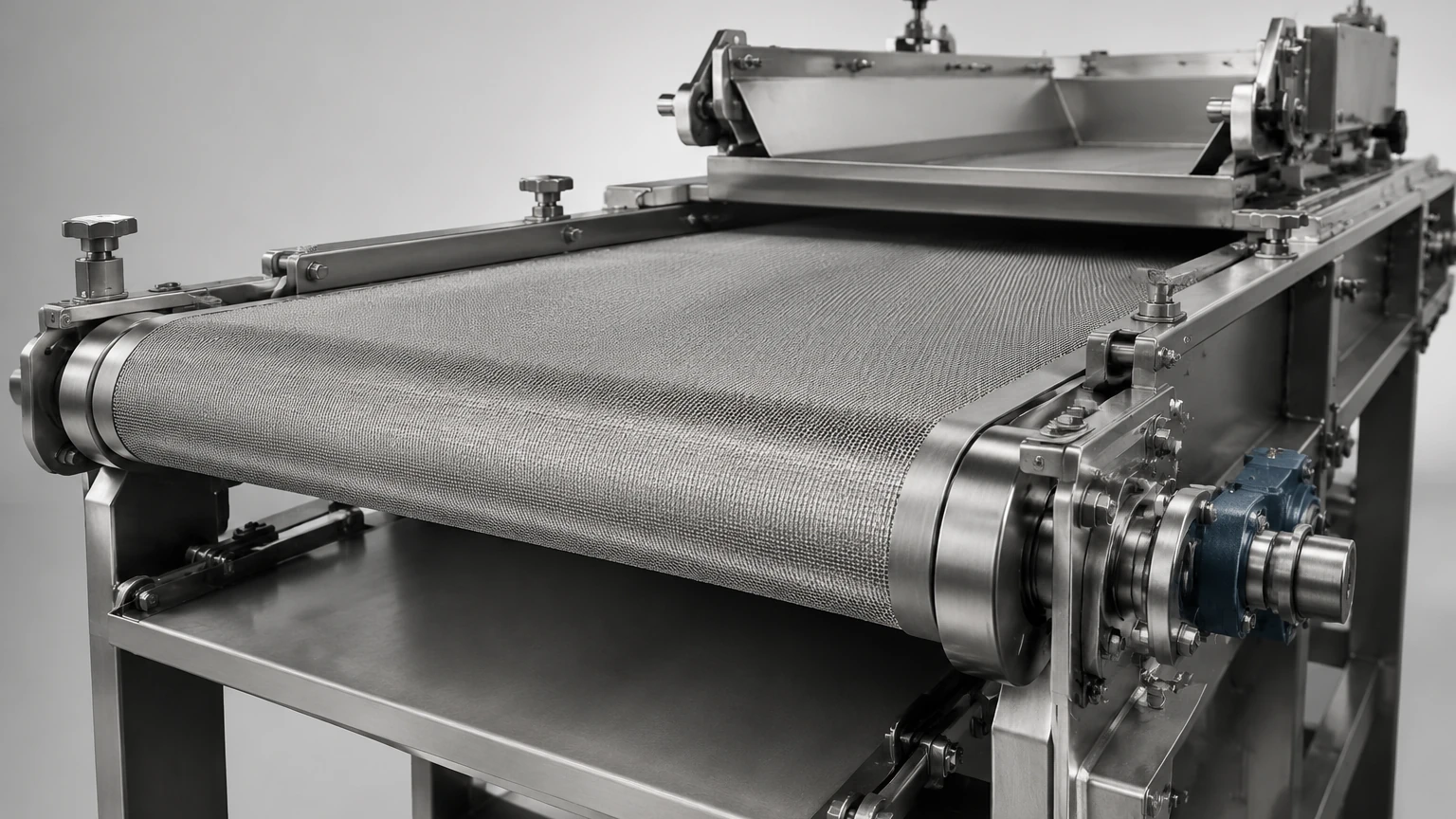
A single belt press operates on the principle of continuous filtration using a moving porous belt. The process typically begins with the introduction of a slurry or sludge, often pre-conditioned with flocculants to aggregate fine particles. This mixture is distributed evenly across the width of the moving belt.
In a standard gravity belt thickener (a common form of the single belt press), the primary mechanism for separation is hydrostatic pressure. As the belt moves, water drains through the mesh by gravity, leaving the solids on the surface. To enhance this process, many systems incorporate "chicanes" or "plows" that gently turn the sludge, creating new channels for water to escape. This initial stage is crucial, as it can remove up to 90% of the free water before the sludge reaches subsequent processing stages.
In more advanced configurations, such as the horizontal vacuum belt filter, a vacuum box is positioned beneath the belt. This creates a pressure differential that pulls the liquid through the filtration medium with significantly more force than gravity alone. This allows for the processing of finer particles and the production of a drier filter cake. The belt in these systems must not only be highly permeable but also capable of withstanding the mechanical stresses of the vacuum seal and the continuous tension required for tracking.
Material Selection: The Role of Stainless Steel Wire Mesh
The performance of a single belt press is inextricably linked to the quality and specification of the filter belt. While synthetic materials are common in some low-temperature or non-corrosive applications, stainless steel wire mesh is the preferred choice for demanding industrial environments.
Stainless steel, particularly grades like 304, 316, and 316L, offers several technical advantages:
1. Mechanical Strength: Stainless steel mesh can handle higher tension loads without stretching or deforming. This is vital for maintaining proper belt tracking and preventing the "necking" that often occurs with polymer belts over time.
2. Thermal Resistance: In applications involving hot slurries or high-temperature cleaning cycles, stainless steel maintains its structural integrity where plastics might soften or fail.
3. Chemical Compatibility: Industrial processes often involve extreme pH levels or aggressive solvents. 316L stainless steel provides superior resistance to pitting and crevice corrosion, ensuring a longer service life in chemical and pharmaceutical applications.
4. Surface Smoothness and Cleanability: The metallic surface of a stainless steel belt is less prone to "blinding" (the clogging of pores by fine particles) than fibrous synthetic materials. This allows for more effective backwashing and chemical cleaning, maintaining high flow rates throughout the production cycle.
At Kaifil, we focus on the precision engineering of these mesh components, ensuring that the weave pattern and wire diameter are optimized for the specific solids-loading requirements of the client's application.
Engineering Parameters for High-Performance Filtration
When specifying a single belt press or replacing its filtration medium, engineers must evaluate several key performance indicators. These parameters dictate the throughput, the clarity of the filtrate, and the dryness of the resulting cake.
Filtration Rating and Mesh Count
The mesh count (the number of wires per inch) determines the filtration rating, or pore size. A higher mesh count provides finer filtration but may increase the resistance to flow (pressure drop). Engineers must balance the need for high solids capture (preventing fines from escaping into the filtrate) with the required drainage rate.
Weave Type
The style of the weave significantly impacts the belt's performance.
* Plain Weave: Offers a straightforward, symmetrical structure suitable for general-purpose dewatering.
* Twilled Weave: Allows for a heavier wire diameter in a given mesh count, increasing the belt's durability and resistance to mechanical wear.
* Dutch Weave: Provides a three-dimensional pore structure that is excellent for fine filtration and high-pressure environments, often used in vacuum-assisted single belt press systems.
Permeability and Open Area
The percentage of open area determines the hydraulic capacity of the belt. In a single belt press, the goal is to maximize the open area while maintaining the structural strength necessary to support the weight of the filter cake. High-permeability belts are essential for high-speed operations where rapid drainage is required to prevent slurry overflow.
Industrial Applications: From Food Processing to Chemical Slurries
The versatility of the single belt press makes it a staple in various sectors. Each industry presents unique challenges that influence the design of the filtration system.
Food and Beverage Industry
In the production of fruit juices, vegetable extracts, and plant-based proteins, the single belt press is used for continuous extraction. Here, hygiene is paramount. Stainless steel belts are favored because they can be sanitized using high-pressure steam or caustic cleaners without degrading. The ability to achieve a high solids-capture rate ensures that the final liquid product is clear and free of unwanted pulp or fibers.
Chemical and Pharmaceutical Processing
Chemical processes often involve corrosive intermediates or the recovery of expensive catalysts. The single belt press provides a closed or semi-closed environment for handling these materials. The use of 316L stainless steel mesh ensures that the filtration medium does not react with the process fluids, maintaining product purity and preventing equipment failure.
Mining and Mineral Processing
In mineral tailings dewatering, the volume of material is massive. The single belt press must be exceptionally rugged. Stainless steel belts used in this sector are often designed with larger wire diameters to resist the abrasive nature of mineral slurries. The continuous nature of the belt press allows for the efficient management of waste streams, facilitating water recycling and reducing the environmental footprint of mining operations.
Operational Maintenance and Belt Longevity
The service life of a single belt press is largely determined by how well the belt is maintained. Even the highest-quality stainless steel mesh will eventually show signs of wear or reduced performance if not managed correctly.
Cleaning and Blinding Prevention
Blinding is the most common cause of reduced throughput. It occurs when particles become lodged within the mesh pores or when a biofilm or chemical scale builds up on the surface. Most single belt press systems include a continuous spray bar that washes the belt after the cake has been discharged. Engineers should monitor the pressure and coverage of these spray bars. In some cases, ultrasonic cleaning or periodic chemical baths may be necessary to restore the belt's original permeability.
Tracking and Tensioning
Proper tracking is essential to prevent the belt from rubbing against the machine frame, which can cause rapid edge wear or catastrophic tearing. Automated tracking systems use sensors to detect the belt's position and adjust the alignment rollers accordingly. Tension must be kept within the manufacturer's specified range; too little tension leads to slippage and poor drainage, while too much tension can cause premature fatigue of the wire mesh.
Wear Patterns
Regular inspection of the belt surface can reveal issues with the feed distribution or the discharge mechanism. Uneven wear often indicates that the slurry is not being spread uniformly across the belt, leading to localized stress. Identifying these issues early can extend the interval between belt replacements and prevent unexpected downtime.
Procurement and Customization: What Engineers Need to Confirm
Before purchasing a single belt press or ordering replacement components, several technical details must be confirmed to ensure compatibility and performance. At Kaifil, we work closely with engineering teams to define these specifications during the design phase.
* Slurry Characteristics: What is the particle size distribution (PSD)? Is the slurry abrasive, corrosive, or shear-sensitive? These factors dictate the choice of stainless steel grade and weave type.
* Throughput Requirements: The desired volume of processed material per hour determines the width and length of the belt, as well as the required belt speed.
* Cake Discharge Method: Will the cake be removed by a doctor blade, a discharge roller, or gravity? The mesh must be durable enough to withstand the mechanical action of the discharge system.
* Seam Configuration: For many belt presses, the belt is installed as an open strip and then joined on the machine. The type of seam (e.g., clipper seam, pin seam, or welded joint) must be chosen based on the tension requirements and the potential for the seam to mark the filter cake.
By focusing on these technical details, organizations can ensure that their single belt press remains a reliable and efficient part of their production line. For those seeking specialized filtration components or custom-engineered solutions, reviewing the options available on our Main Page is a recommended first step in the procurement process.
In conclusion, while the single belt press is a conceptually simple machine, its successful operation depends on the precise integration of mechanical design and material science. High-quality stainless steel filtration media provide the durability and precision necessary to meet the rigorous demands of modern industrial processing, ensuring consistent performance and long-term value.
