


Sinter Filter
In industrial filtration, the requirement for components that can withstand extreme pressures, corrosive chemicals, and high temperatures often leads engineers to select the sinter filter. Sintering is a metallurgical process where metal particles, fibers, or wire meshes are fused together using heat and pressure in a controlled atmosphere furnace, without reaching the melting point of the material. This process creates a porous yet structurally rigid medium capable of precise particulate separation in demanding environments.
For technical professionals and procurement teams, understanding the nuances of sintered metal technology is essential for optimizing system performance and longevity. As a specialized manufacturer, Kaifil provides a range of custom stainless steel filtration solutions designed to meet these rigorous industrial standards. To explore specific configurations, you may Main Page to review product options and application support.
Understanding Sintered Metal Filtration Technology
The production of a sinter filter involves several critical stages that determine its final mechanical properties and filtration efficiency. The process typically begins with the selection of the base media—either metal powder, metal fiber felt, or multi-layer wire mesh. This media is placed into a mold or layered in a specific sequence and then subjected to a high-temperature sintering furnace, often operating under vacuum or a hydrogen-reducing atmosphere.
During sintering, atomic diffusion occurs at the contact points between the metal elements, creating metallurgical bonds. This results in a monolithic structure where the individual wires or particles are permanently joined. Unlike resin-bonded or pleated paper filters, a sintered filter does not rely on adhesives or binders, which eliminates the risk of media migration or chemical leaching into the process stream. The resulting structure is characterized by high porosity, excellent mechanical strength, and predictable pore size distribution.
Material Selection and Metallurgical Properties
The choice of material is the primary factor in determining the filter’s resistance to corrosion and thermal degradation. Stainless steel is the most common material due to its versatility and cost-effectiveness.
1. 316L Stainless Steel: The industry standard for most sinter filter applications. The "L" denotes low carbon content, which minimizes carbide precipitation during welding and sintering, enhancing corrosion resistance in acidic or marine environments.
2. 304L Stainless Steel: Suitable for less aggressive environments where general corrosion resistance is required at a lower price point.
3. Hastelloy (C-276, C-22): Utilized in highly corrosive chemical processing involving wet chlorine gas, ferric chlorides, or strong oxidizing salts.
4. Inconel (600, 625): Specified for extreme high-temperature applications where oxidation resistance is critical.
5. Monel 400: Often used in applications involving hydrofluoric acid or seawater due to its excellent resistance to stress corrosion cracking.
Engineers must balance the chemical compatibility of these alloys with the operating temperature and the specific contaminants present in the fluid stream to ensure the filter does not suffer from pitting or intergranular corrosion.
Types of Sintered Filter Media
Sintered filters are categorized based on the geometry of the starting material. Each type offers distinct advantages depending on whether the application requires surface filtration or depth filtration.
Sintered Wire Mesh
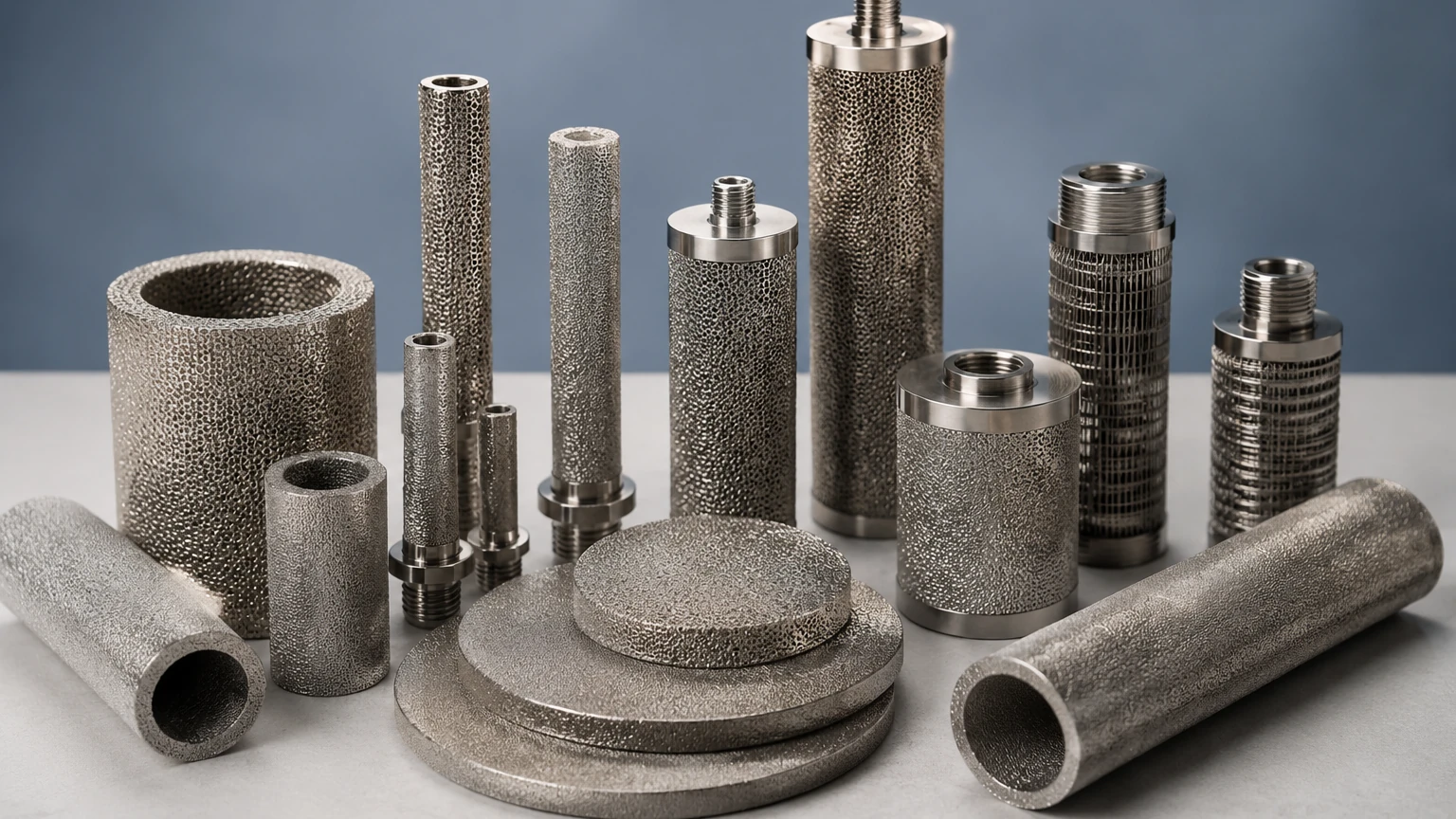
This media consists of multiple layers of stainless steel wire mesh (typically 2 to 7 layers) that are sintered together. The layers usually include a fine filtration layer, a protective layer, and several support layers for mechanical rigidity. Sintered mesh filters provide excellent permeability and are easy to clean via backwashing. They are preferred in applications like polymer filtration and hydraulic systems where high flow rates and low pressure drops are required.
Sintered Metal Powder
Constructed by sintering spherical or irregular metal powders, this type of sinter filter creates a complex, tortuous path for the fluid. This is a form of depth filtration where particles are trapped throughout the thickness of the porous wall. Sintered powder filters are ideal for achieving very fine filtration (down to 0.1 microns) and are widely used in gas sparging, steam filtration, and catalyst recovery.
Sintered Metal Fiber Felt
Produced from non-woven stainless steel fibers, this media is sintered to form a high-porosity mat. It combines the benefits of mesh and powder, offering high dirt-holding capacity and low resistance to flow. It is particularly effective in high-viscosity liquid filtration, such as in the production of synthetic fibers and films.
Engineering Performance Metrics: Pore Size and Permeability
When specifying a sinter filter, engineers must distinguish between nominal and absolute filtration ratings. A nominal rating refers to the ability of the filter to retain a certain percentage (usually 60% to 90%) of particles of a specific size. An absolute rating, verified through bubble point testing (ISO 4003), indicates the diameter of the largest spherical particle that can pass through the filter under specific test conditions.
Permeability is another critical metric. It defines the ease with which a fluid passes through the porous medium. High permeability reduces the initial pressure drop ($ΔP$) across the filter, which in turn reduces energy consumption for pumps and compressors. The relationship between flow rate, fluid viscosity, and pressure drop is typically governed by Darcy’s Law for laminar flow. In sintered media, the challenge for designers is to maximize porosity (to improve flow) while maintaining the required pore size and structural integrity.
Industrial Applications and Chemical Compatibility
The robustness of the sinter filter makes it indispensable across several high-stakes industries:
* Chemical and Petrochemical: Used for the filtration of aggressive solvents, acids, and catalysts. The ability to withstand high pressure differentials is vital during the filtration of high-viscosity polymers.
* Food and Beverage: Sintered stainless steel filters are used for steam filtration (culinary steam) and the carbonation of beverages. Their smooth surface and lack of binders make them compliant with food safety standards.
* Pharmaceuticals: In the production of Active Pharmaceutical Ingredients (APIs), sintered filters provide precise separation and can be sterilized in place (SIP) or cleaned in place (CIP).
* Aerospace and Defense: Applied in hydraulic systems and fuel filtration where reliability under extreme vibration and temperature fluctuations is mandatory.
* Water Treatment: Specifically in high-pressure desalination processes and the protection of sensitive RO membranes from particulate matter.
Maintenance, Cleaning, and Service Life
One of the primary economic advantages of a sinter filter over disposable alternatives is its cleanability. Because the structure is metallurgically bonded, it can withstand aggressive cleaning cycles that would destroy other filter types.
Cleaning Methods
* Backwashing/Backpulsing: Reversing the flow of the fluid to dislodge particles trapped on the surface. This is most effective for sintered wire mesh.
* Ultrasonic Cleaning: Using high-frequency sound waves in a cleaning solvent to create cavitation bubbles that reach deep into the pores of sintered powder filters.
* Chemical Cleaning: Using acids, alkalis, or surfactants to dissolve organic or inorganic deposits. The filter material must be compatible with the cleaning agent.
* Thermal Burn-off: Heating the filter in a controlled environment to carbonize and remove organic contaminants, followed by ultrasonic cleaning.
Proper maintenance schedules extend the service life of the filter, often allowing it to remain in operation for years. However, if the pressure drop fails to return to the "clean" baseline after multiple cleaning attempts, it may indicate permanent pore plugging or structural fatigue, signaling the need for replacement.
Specifying Sintered Filters for OEM Applications
For original equipment manufacturers (OEMs), the integration of a sinter filter requires precise mechanical interfacing. Customization options typically include:
* End Fittings: NPT/BSP threads, flanges, sanitary tri-clamp fittings, or custom O-ring interfaces to ensure a leak-proof seal within the housing.
* Structural Reinforcement: Internal cores or external cages to prevent collapse or bursting under high-pressure spikes.
* Geometry: While cylindrical cartridges are standard, sintering allows for the creation of discs, plates, cones, and complex manifold shapes.
When consulting with a manufacturer like Kaifil, it is important to provide the operating temperature, maximum allowable pressure drop, fluid chemistry, and the nature of the solids being removed. This data allows for the selection of the optimal sintering technique and material grade.
For further technical specifications and to view our range of industrial filtration components, please visit the Main Page. Our engineering team works closely with global clients to develop high-performance, durable filtration solutions tailored to specific industrial environments, ensuring that every sinter filter provides reliable and cost-effective performance throughout its lifecycle.
