


Sintered Disc
In the landscape of industrial filtration, the sintered disc represents a pinnacle of engineering achieved through the metallurgical process of diffusion bonding. These components are critical in environments where standard woven wire mesh or polymer-based filters fail due to high pressure, extreme temperatures, or aggressive chemical exposure. For engineers and procurement specialists, understanding the technical nuances of sintered discs—from their internal pore structure to their mechanical load-bearing capacity—is essential for optimizing process efficiency and ensuring the longevity of filtration systems.
As a specialized manufacturer, Kaifil provides precision-engineered stainless steel filtration solutions designed to meet these rigorous industrial standards. By integrating advanced manufacturing techniques with high-grade materials, these components offer a level of reliability that supports the continuous operation of complex industrial cycles. For more information on comprehensive filtration systems, you can visit our Main Page.
Understanding Sintered Disc Technology and Manufacturing
The performance of a sintered disc is fundamentally rooted in its manufacturing process. Unlike traditional filters that rely on mechanical weaving or adhesive bonding, a sintered disc is created through a thermal process known as sintering. This involves placing layers of stainless steel wire mesh or metal powder into a high-temperature vacuum furnace.
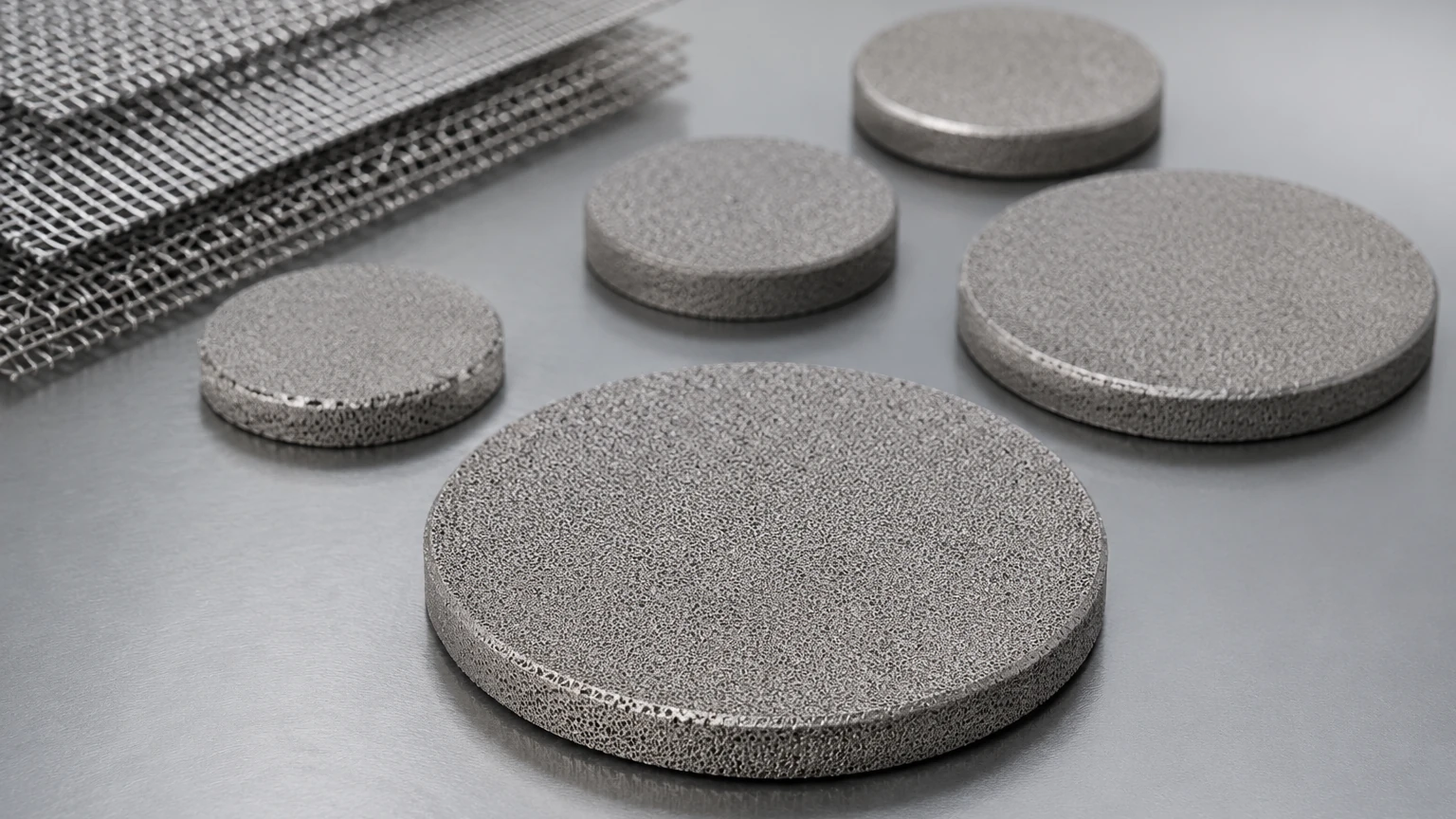
During this process, temperatures are raised to just below the melting point of the metal. Under controlled atmospheric conditions and specific pressure, the contact points of the metal particles or wire strands fuse together through molecular diffusion. This creates a monolithic structure where the individual layers or particles are permanently bonded. The result is a filter medium that retains the porosity of the original material but gains the structural integrity of a solid metal plate.
From an engineering perspective, this diffusion bonding eliminates the risk of media migration. In standard mesh filters, individual wires can shift or break under high-pressure pulses, leading to downstream contamination. A sintered disc, however, maintains its pore geometry even under significant mechanical stress, ensuring consistent filtration accuracy throughout its service life.
Material Selection and Metallurgical Properties
The choice of material for a sintered disc determines its resistance to corrosion, oxidation, and thermal degradation. While various alloys can be sintered, stainless steel remains the industry standard due to its versatility and cost-effectiveness.
1. 316L Stainless Steel: This is the most common material for sintered discs used in chemical and pharmaceutical applications. The "L" denotes low carbon content, which minimizes carbide precipitation during welding and sintering, enhancing corrosion resistance. The addition of molybdenum provides superior resistance to pitting and crevice corrosion in chloride-containing environments.
2. 304 Stainless Steel: Suitable for less aggressive environments, 304 stainless steel offers excellent mechanical properties and is widely used in food and beverage processing where high-temperature sterilization is required.
3. Hastelloy and Inconel: In extreme cases involving highly acidic or alkaline fluids at elevated temperatures, nickel-based superalloys like Hastelloy C-276 or Inconel 600 are utilized. These materials maintain their structural integrity at temperatures exceeding 800°C.
When selecting a material, engineers must consider the pH of the process fluid, the presence of oxidizing agents, and the maximum operating temperature. Kaifil’s expertise in material science ensures that every sintered disc is matched to the specific chemical profile of its intended application.
Structural Variations: Wire Mesh vs. Metal Powder Discs
Sintered discs are generally categorized into two types based on their base media: sintered wire mesh and sintered metal powder. Each offers distinct advantages depending on the filtration requirements.
Sintered Wire Mesh Discs
These are constructed by laminating multiple layers of woven wire mesh. A typical 5-layer configuration includes a fine filtration layer, two protective layers, and two support layers.
* Filtration Layer: Determines the micron rating.
* Protective Layers: Shield the delicate filtration mesh from mechanical damage during cleaning or installation.
* Support Layers: Provide the necessary rigidity to withstand high differential pressures.
This multi-layer structure allows for high permeability and high dirt-holding capacity while maintaining a thin profile.
Sintered Metal Powder Discs
Produced by sintering spherical or irregular metal powders, these discs create a tortuous path for the fluid. The depth filtration characteristic of powder discs makes them exceptionally effective at capturing irregularly shaped particles. They are often preferred for gas filtration or applications requiring extremely fine micron ratings (down to 0.5 microns). Because they are thicker than mesh discs, they offer superior mechanical strength but may have a higher initial pressure drop.
Key Performance Metrics for Industrial Filtration
To evaluate the suitability of a sintered disc for a specific process, engineers must analyze several key performance indicators (KPIs):
* Filtration Accuracy (Micron Rating): This refers to the size of the smallest particle the disc can reliably capture. Sintered discs offer absolute ratings, meaning the pore size is fixed and does not enlarge under pressure.
* Permeability and Pressure Drop: Permeability defines how easily a fluid passes through the disc. A high-quality sintered disc balances fine filtration with low resistance to flow, minimizing the energy required for pumping systems.
* Porosity: This is the ratio of void space to the total volume of the disc. Higher porosity generally leads to better flow rates and higher dirt-holding capacity, but it must be balanced against the required mechanical strength.
* Bubble Point Pressure: This is a standard test used to verify the integrity and pore size of the disc. By measuring the pressure required to force air through a liquid-saturated disc, manufacturers can confirm that there are no defects or oversized pores.
Critical Applications in Process Engineering
Sintered discs are utilized across a broad spectrum of industries where precision and durability are non-negotiable.
Chemical and Petrochemical Processing
In these sectors, sintered discs serve as catalyst recovery filters, gas-liquid separators, and polymer melt filters. Their ability to withstand corrosive reagents and high-temperature steam makes them ideal for continuous chemical reactors.
Pharmaceutical and Biotechnology
Strict hygiene standards require filters that can be sterilized repeatedly. Sintered discs made of 316L stainless steel are compatible with Autoclaving and Steam-in-Place (SIP) procedures. They are commonly used in the filtration of active pharmaceutical ingredients (APIs) and as air vents for fermentation tanks.
Food and Beverage Industry
From carbonation stone applications in breweries to the filtration of edible oils, sintered discs provide a non-toxic, cleanable solution that meets FDA compliance standards. Their robust nature prevents any metallic shedding into the product stream.
Aerospace and Hydraulics
In hydraulic systems, a sintered disc acts as a last-chance filter to protect sensitive valves and actuators from particulate contamination. Their high collapse pressure rating is vital in high-pressure hydraulic circuits.
Engineering Selection Criteria and Customization
When specifying a sintered disc, the "one size fits all" approach is rarely effective. Engineers must provide detailed application data to ensure the component performs as expected. Key considerations include:
1. Flow Rate and Velocity: High fluid velocities can lead to erosion of the filter surface. The disc diameter must be sized to keep the face velocity within acceptable limits.
2. Differential Pressure (ΔP): Engineers must calculate both the clean pressure drop and the maximum allowable pressure drop before cleaning or replacement is required. Sintered discs can often handle ΔP in excess of 20 MPa if properly supported.
3. Edge Treatments and Sealing: To prevent bypass, the edges of the sintered disc must be properly sealed. Options include solid metal borders (frames), PTFE gaskets, or specialized welding interfaces for integration into larger housings.
4. Custom Geometries: While circular discs are standard, sintering technology allows for the production of square, oval, or complex annular shapes to fit specific equipment footprints.
Kaifil works closely with technical teams to develop customized filtration components that address these specific variables, ensuring that the final product integrates seamlessly into existing infrastructure.
Maintenance, Cleaning, and Total Cost of Ownership
One of the primary advantages of a sintered disc over disposable polymer filters is its cleanability. While the initial capital expenditure for a stainless steel sintered disc is higher, the total cost of ownership (TCO) is often significantly lower due to its extended service life.
Cleaning Methodologies
* Backwashing/Backpulsing: In automated systems, a reverse flow of clean fluid or gas can dislodge accumulated cake from the surface of the disc.
* Ultrasonic Cleaning: For deep-seated contaminants, especially in powder-sintered discs, ultrasonic baths use high-frequency sound waves to create cavitation bubbles that strip away particles from within the pores.
* Chemical Cleaning: Soaking the disc in compatible solvents, acids, or alkalis can dissolve organic or inorganic scaling without damaging the stainless steel structure.
* Thermal Burn-off: In applications like polymer filtration, the disc can be heated in a controlled oven to carbonize and remove plastic residues.
Determining Replacement Cycles
Despite their durability, sintered discs are not infinite. Over many cleaning cycles, the structural integrity may eventually degrade, or the pores may become permanently blinded by "incapable" particles. Engineers should monitor the rate of pressure increase after each cleaning cycle. A steady rise in the "clean" pressure drop indicates that the disc is reaching the end of its functional life.
By choosing a high-quality sintered disc from a reputable manufacturer like Kaifil, industrial operators can ensure they are receiving a component engineered for maximum recovery cycles and consistent performance. Our commitment to quality and technical support helps engineers navigate the complexities of filter selection and maintenance.
For technical specifications, CAD drawings, or to discuss a custom filtration project, please refer to the resources available on our Main Page. Whether you are designing a new system or looking to optimize an existing process, the right sintered disc is a critical investment in operational reliability.
