


Sintered Disk
In industrial filtration, the sintered disk represents a critical component for high-precision separation and fluid control. As a specialized filtration medium, it is engineered to withstand extreme temperatures, high pressures, and corrosive environments that would typically compromise standard wire mesh or polymer-based filters. For engineers and technical procurement teams, understanding the mechanical properties, manufacturing nuances, and performance variables of a sintered disk is essential for optimizing system reliability and filtration efficiency.
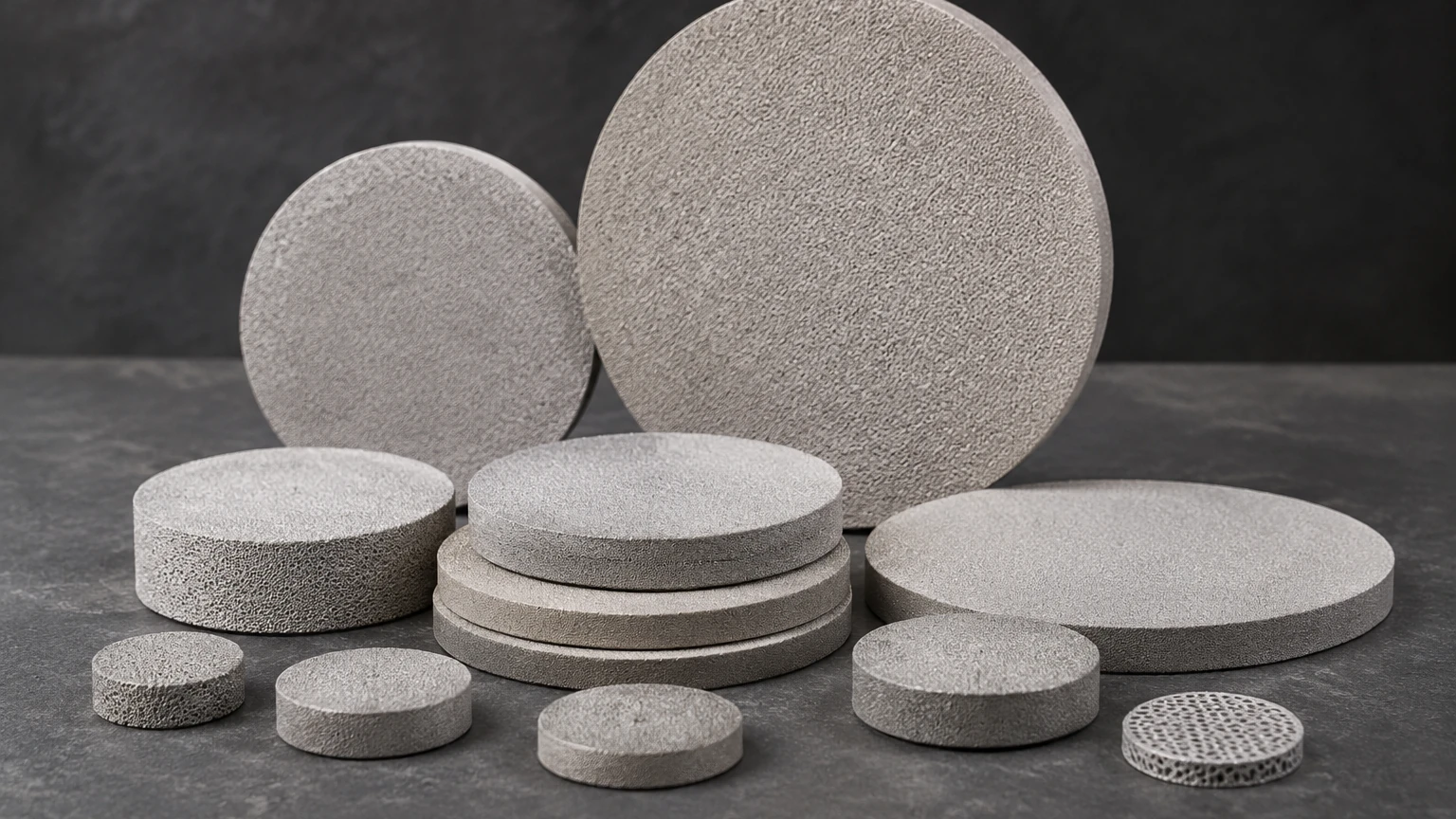
At its core, a sintered disk is a porous metal structure created through a process called sintering, where layers of metal wire mesh or metal powders are fused together using heat and pressure in a controlled atmosphere. This process creates a robust, integrated unit with precise pore distribution and high structural integrity. As a manufacturer specializing in custom stainless steel filtration solutions, Kaifil provides these components to industries ranging from pharmaceutical manufacturing to heavy hydraulic systems.
Understanding Sintered Disk Technology in Industrial Filtration
The primary advantage of a sintered disk over traditional single-layer wire mesh lies in its mechanical stability. In standard filtration applications, single-layer mesh may deform under high differential pressure, leading to pore migration and inconsistent filtration accuracy. Sintering eliminates these risks by diffusion-bonding the contact points of the metal wires or particles.
When multiple layers of wire mesh are sintered together, the resulting disk benefits from a combination of different mesh counts. For example, a typical five-layer sintered disk might include a fine filtration layer protected by coarser drainage and support layers. This composite structure ensures that the fine mesh remains protected from mechanical stress while maintaining high permeability. For those seeking specific technical data on these structures, the Main Page offers detailed insights into the engineering capabilities behind these custom components.
Manufacturing Processes: Multilayer Mesh vs. Powder Sintering
There are two primary methods for producing a sintered disk, each suited to specific industrial requirements:
Sintered Wire Mesh Disks
These are constructed by stacking several layers of woven stainless steel wire mesh. The stack is placed in a vacuum furnace and heated to just below the melting point of the metal. Under pressure, the molecular structures of the wires fuse together. This results in a disk with highly predictable pore sizes and excellent flow rates. Because the wire mesh is woven, the geometry of the pores is uniform, making these disks ideal for applications requiring absolute filtration ratings.
Sintered Metal Powder Disks
In this process, spherical or irregular metal powders are compacted into a mold and then sintered. The resulting disk has a tortuous path for the fluid to travel through, which provides exceptional depth filtration. Powder-sintered disks are often preferred for gas sparging, flame arrestors, and applications requiring very fine micron ratings (down to 0.5 microns). The density and porosity of the disk can be adjusted by varying the powder grain size and the sintering pressure.
Material Selection and Chemical Compatibility
The performance of a sintered disk is heavily dependent on the alloy used in its construction. Industrial environments often involve aggressive chemicals or high-temperature steam sterilization (SIP), necessitating careful material selection.
1. 316L Stainless Steel: The industry standard for most filtration tasks. The low carbon content (indicated by the 'L') provides superior corrosion resistance, particularly after welding or sintering, making it suitable for pharmaceutical and food-grade applications.
2. 304 Stainless Steel: A cost-effective alternative for less demanding environments where high corrosion resistance is not the primary concern.
3. Hastelloy & Inconel: These nickel-based alloys are utilized in extreme chemical processing where stainless steel would succumb to pitting or stress corrosion cracking. They are frequently used in the production of specialty chemicals and in high-temperature aerospace applications.
4. Titanium: Used primarily for its high strength-to-weight ratio and exceptional resistance to seawater and chlorine-based solutions.
Engineers must evaluate the pH levels, operating temperatures, and the presence of specific ions (such as chlorides) in the process fluid before finalizing the material specification for a sintered disk.
Key Performance Indicators for Engineering Specification
When selecting or designing a sintered disk, several technical parameters must be quantified to ensure the component meets the application requirements:
Filtration Rating (Micron Rating)
Filtration can be categorized as nominal or absolute. A sintered disk typically offers an absolute rating, meaning it will stop 99.9% of particles above a specific size. This is critical in industries like semiconductor manufacturing or hydraulic systems where even a single oversized particle can cause catastrophic failure.
Permeability and Pressure Drop
Permeability refers to the ability of the disk to allow fluid to pass through. A higher porosity usually leads to a lower pressure drop ($ΔP$). However, there is always a trade-off between filtration efficiency and permeability. Engineers must calculate the maximum allowable pressure drop across the filter to prevent system strain and ensure the disk does not reach its collapse pressure.
Mechanical Strength and Structural Integrity
Because the sintered disk is a rigid component, it can function as a self-supporting element within a filter housing. It must be able to withstand both forward and reverse flow (backwashing) without shedding media or deforming. The thickness of the disk and the number of support layers are the primary factors determining its burst strength.
Industrial Applications and Operating Environments
The versatility of the sintered disk makes it a staple in various high-stakes industrial sectors:
* Pharmaceutical and Biotech: Used in chromatography frit, solvent filtration, and carbon removal. The smooth surface of sintered stainless steel allows for easy cleaning and sterilization, meeting stringent cGMP requirements.
* Chemical Processing: Sintered disks serve as catalyst recovery filters and polymer melt filters. Their ability to operate at temperatures exceeding 400°C (750°F) is vital for these processes.
* Food and Beverage: Employed in the filtration of cooking oils, beverage clarification, and steam filtration. The inert nature of 316L stainless steel ensures that no flavors or contaminants are leached into the product.
* Aerospace and Hydraulics: Protecting sensitive valves and actuators from particulate contamination. The high fatigue resistance of sintered metal is essential for systems subject to frequent pressure pulsations.
Cleaning, Maintenance, and Service Life Optimization
One of the most significant advantages of a metal sintered disk over disposable filters is its cleanability. A properly maintained disk can last for several years, significantly reducing the total cost of ownership.
Cleaning Methods
* Backwashing: Reversing the flow of the fluid to dislodge particles trapped on the surface of the disk.
* Ultrasonic Cleaning: Using high-frequency sound waves in a cleaning solution to remove fine particles from deep within the porous structure. This is often the most effective method for powder-sintered disks.
* Chemical Cleaning: Using acids, caustic solutions, or specialized solvents to dissolve organic or inorganic fouling. It is imperative to ensure the cleaning agent is compatible with the disk material.
* Heat Treatment/Burn-off: For polymer applications, the disk may be heated to carbonize and remove trapped resins.
Monitoring Service Life
Technicians should monitor the differential pressure across the sintered disk. A consistent increase in baseline $ΔP$ after cleaning cycles indicates that the disk is reaching the end of its functional life due to permanent fouling or pore constriction.
Selection Criteria for Procurement and OEM Customization
For purchasing teams and engineers, specifying the correct sintered disk requires a comprehensive data set. When consulting with a manufacturer like Kaifil, the following information should be confirmed:
1. Dimensions: Outer diameter (OD), inner diameter (ID) if applicable, and thickness. Tolerances are critical for ensuring a leak-proof fit in the housing.
2. Operating Conditions: Maximum operating temperature, maximum differential pressure, and flow rate.
3. Fluid Characteristics: Viscosity, chemical composition, and the nature of the contaminants (slimy, hard, abrasive).
4. Edge Treatment: Sintered disks can be supplied with raw edges, or they can be framed with solid metal rings (welded or crimped) to provide a better sealing surface and increased peripheral strength.
Customization is often necessary because off-the-shelf solutions rarely meet the specific flow dynamics of a proprietary system. OEM services allow for the adjustment of layer configurations, pore sizes, and overall geometry to match the exact needs of the equipment.
Conclusion
The sintered disk is more than a simple filter; it is a precision-engineered component that ensures the purity of products and the longevity of industrial machinery. By leveraging the mechanical strength of diffusion-bonded metal, these disks provide a level of reliability that polymer or simple mesh filters cannot match. Whether the goal is to protect a high-pressure hydraulic pump or to ensure the sterility of a pharmaceutical batch, selecting the right material, micron rating, and structural design is paramount. For further technical specifications and to explore custom filtration options, professionals are encouraged to review the resources available on the Main Page.
