


Sintered Filter Cup
In industrial filtration, the sintered filter cup represents a critical component for high-precision gas and liquid separation. Unlike standard mesh filters, these components are engineered through a thermal bonding process that creates a rigid, porous structure capable of withstanding extreme pressures and temperatures. For engineers and procurement specialists, selecting the right sintered filter cup requires a deep understanding of metallurgy, pore geometry, and fluid dynamics.
As a specialized manufacturer, Kaifil focuses on delivering custom stainless steel filtration solutions that meet these rigorous technical demands. By exploring the engineering principles behind these components, industrial professionals can better evaluate their performance in demanding environments such as chemical processing, aerospace, and pharmaceutical manufacturing.
Understanding the Sintering Process for Filter Components
The performance of a sintered filter cup is fundamentally determined by its manufacturing process. Sintering is a powder metallurgy technique where metal particles or multiple layers of wire mesh are heated in a controlled-atmosphere furnace to a temperature just below their melting point. This process causes the contact points of the particles or wires to fuse together through molecular diffusion.
For sintered metal powder cups, the resulting structure is a tortuous path of interconnected pores. The size and distribution of these pores are controlled by the spherical or irregular shape of the original metal powder and the compaction pressure applied before sintering. In contrast, sintered mesh cups utilize layers of woven wire cloth that are bonded together to provide a more predictable pore size and higher mechanical strength.
The primary advantage of this process is the creation of a monolithic part. Because the filter medium is fused into a single piece, there is no risk of media migration—a common failure point in fiber-based or non-bonded filters where small fragments of the filter material can break off and contaminate the downstream flow.
Key Material Properties and Selection Criteria
Material selection is the first line of defense against premature filter failure. Most industrial applications utilize stainless steel due to its balance of mechanical strength and corrosion resistance. However, the specific grade must be matched to the chemical environment.
1. 316L Stainless Steel: This is the industry standard for sintered filter cups. The "L" denotes low carbon content, which prevents intergranular corrosion after welding. It offers excellent resistance to organic acids and many industrial chemicals.
2. 304 Stainless Steel: Suitable for less aggressive environments, 304 provides a cost-effective solution for water treatment and general industrial air filtration.
3. Nickel-Based Alloys (Inconel, Monel, Hastelloy): For applications involving high-temperature oxidation or highly corrosive mineral acids, these exotic alloys are necessary. They maintain structural integrity at temperatures exceeding 600°C (1112°F).
4. Titanium: Often used in medical or highly acidic environments where weight and biocompatibility are prioritized.
When specifying a sintered filter cup, engineers must consider the pH levels, operating temperatures, and potential for galvanic corrosion within the housing assembly.
Engineering Performance: Filtration Accuracy and Permeability
The primary function of a sintered filter cup is to remove particulates of a specific size while allowing fluid to pass with minimal resistance. This balance is defined by two technical metrics: filtration rating (micron grade) and permeability.
Filtration Rating: Absolute vs. Nominal
In the context of sintered metal, an "absolute" rating implies that 99.9% of particles at the specified micron size will be captured. Sintered powder cups excel at providing high-efficiency filtration in the sub-micron range (0.5 to 20 microns), while sintered mesh cups are typically used for coarser filtration (20 to 200+ microns). The depth-loading characteristics of powder-based cups allow them to hold a significant volume of contaminants before the pressure drop becomes critical.
Permeability and Pressure Drop
Permeability refers to the ease with which a fluid passes through the porous medium. A common engineering challenge is the "initial pressure drop." A filter with very fine pores will naturally offer higher resistance. To optimize the system, engineers must calculate the required flow rate against the available surface area of the cup. Increasing the length or diameter of the sintered filter cup can compensate for a high pressure drop by providing more flow paths for the fluid.
Structural Design and Customization Options
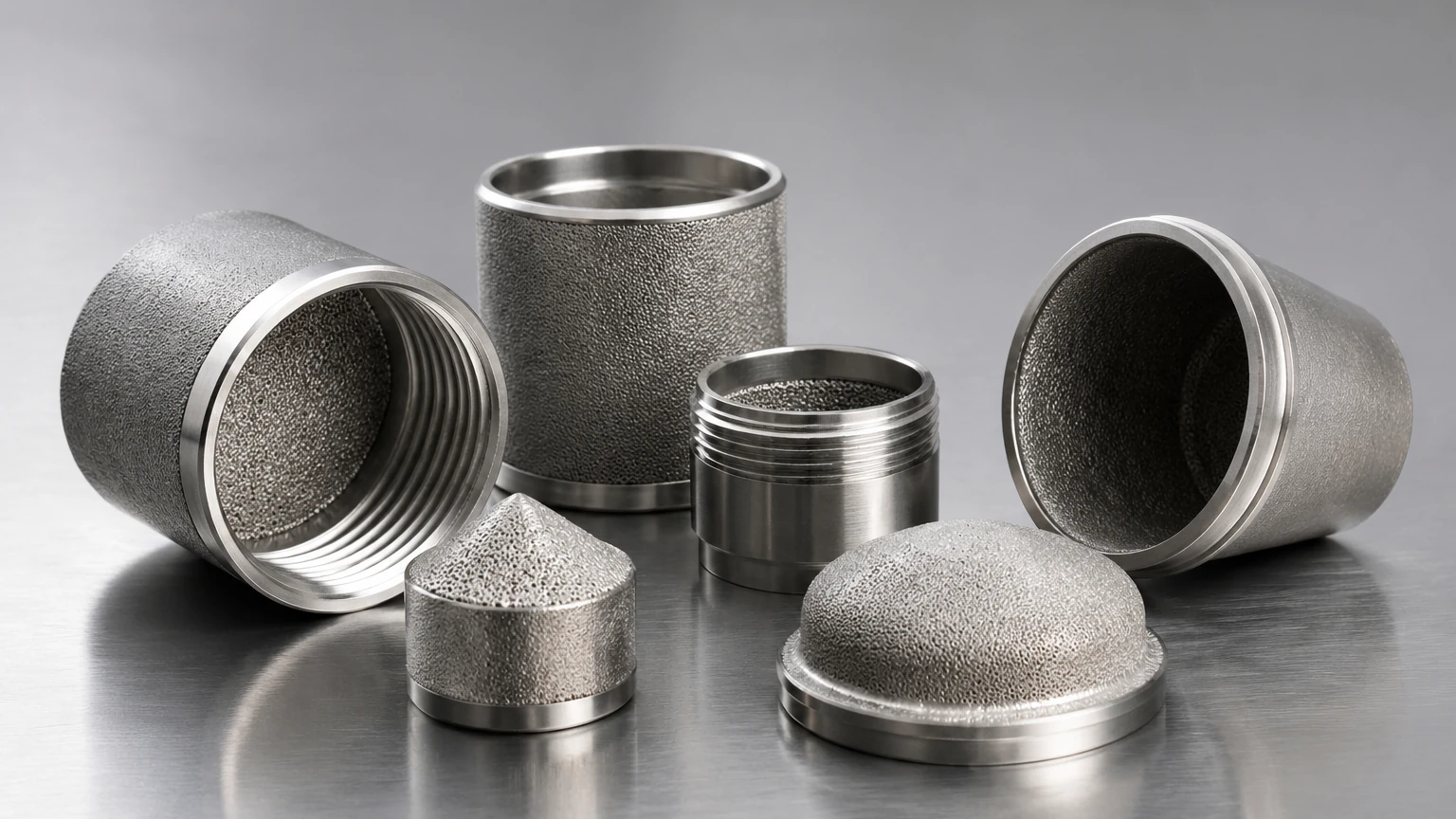
A sintered filter cup is rarely a standalone component; it must be integrated into a larger mechanical system. Customization is essential to ensure a leak-proof seal and structural stability under high differential pressures.
Geometry and Dimensions
The cup shape is inherently strong, providing high resistance to collapse or bursting. Manufacturers can adjust the wall thickness to balance strength and flow. For high-pressure hydraulic systems, thicker walls are required, whereas gas diffusion applications might prioritize thinner walls for maximum permeability.
Fittings and Integration
To facilitate installation, sintered filter cups can be manufactured with various integrated fittings, including:
* Threaded Connectors (NPT, BSP, or Metric): For secure, high-pressure attachments.
* Flanges: Used in larger piping systems or where frequent removal is necessary.
* Welded Caps and Bases: To ensure the fluid is forced through the porous side walls rather than bypassing the media.
Precision machining post-sintering ensures that these attachment points meet tight tolerances, which is vital for maintaining system integrity in vacuum or high-pressure gas applications.
Industrial Applications for Sintered Filter Cups
The versatility of the sintered filter cup allows it to serve multiple roles beyond simple particulate removal. Its rigid structure makes it ideal for specialized industrial processes.
* Gas Sparging: In chemical reactors, sintered cups are used to introduce gases into liquids in the form of thousands of tiny bubbles. The controlled pore size ensures a high surface area for gas-liquid contact, improving reaction efficiency.
* Flame Arrestors: Because the sintered structure can dissipate heat rapidly, these cups are used to prevent the passage of flames in gas pipelines or storage tanks while still allowing gas flow.
* Sensor Protection: Delicate electronic sensors used in environmental monitoring or industrial exhaust systems are often encased in a sintered filter cup. This protects the sensor from dust and liquid droplets while allowing the gas to reach the sensing element for accurate measurement.
* Polymer Filtration: In the production of synthetic fibers and plastics, sintered cups filter out gels and impurities from molten polymers at high temperatures and pressures.
Maintenance and Cleaning for Long-Term Reliability
One of the most significant advantages of stainless steel sintered filter cups is their cleanability. Unlike disposable polymer or paper filters, sintered metal components can be restored to near-original performance levels through various cleaning protocols.
Ultrasonic Cleaning
This is the most effective method for removing fine particles trapped within the depth of the porous structure. High-frequency sound waves create cavitation bubbles that dislodge contaminants from the tortuous paths.
Chemical Cleaning
Depending on the nature of the contaminant, chemical solvents or caustic baths can be used to dissolve organic residues or mineral scales. It is crucial to ensure that the cleaning agent is compatible with the filter material (e.g., avoiding high-chloride solutions for 304 stainless steel).
Backwashing and Backpulsing
In automated systems, the flow of fluid is periodically reversed to push contaminants off the surface of the filter. The high mechanical strength of the sintered filter cup allows it to withstand these sudden pressure reversals without deforming.
By implementing a regular maintenance schedule, the total cost of ownership for sintered metal filters is significantly lower than that of disposable alternatives, despite the higher initial investment.
Conclusion and Selection Support
Selecting a sintered filter cup involves balancing filtration efficiency, mechanical durability, and chemical compatibility. For engineers, the goal is to find a solution that minimizes downtime and protects downstream equipment from contamination. Whether the application involves high-temperature gas diffusion or high-pressure hydraulic filtration, the structural integrity of a sintered component provides a level of reliability that other media cannot match.
For detailed technical specifications, material certifications, or to discuss custom engineering requirements for your filtration system, you can visit the Main Page to review product options and application support. Working directly with a manufacturer like Kaifil ensures that the final component is optimized for your specific industrial environment, from the initial micron rating to the final mechanical fitting.
