


Sintered Filters
In high-pressure and high-temperature industrial environments, standard filtration media often fail due to mechanical stress or chemical degradation. Sintered filters represent a specialized class of porous metal components engineered to withstand these demanding conditions. By utilizing a thermal bonding process known as sintering, manufacturers like Kaifil create robust filtration structures that offer superior mechanical strength, precise pore size distribution, and exceptional reusability. For engineers and procurement teams, understanding the technical nuances of these components is essential for optimizing system performance and reducing long-term operational costs.
To explore the full range of custom filtration components available for industrial applications, professionals can visit the Main Page of the Kaifil manufacturing facility.
Understanding Sintered Metal Filtration Technology
Sintering is a metallurgical process where metal particles or wire mesh layers are heated to a temperature just below their melting point. Under controlled atmospheric conditions, the contact points of the metal structures bond through atomic diffusion. This creates a rigid, integrated porous matrix that does not require binders or adhesives, which are common points of failure in polymer-based filters.
There are two primary types of sintered filters used in industrial settings:
1. Sintered Metal Powder Filters: These are produced by compacting spherical or irregular metal powders into a mold and then sintering them. The resulting structure is characterized by a tortuous path for the fluid, providing excellent depth filtration and high filtration accuracy for fine particles.
2. Sintered Wire Mesh Filters: These consist of multiple layers of stainless steel wire woven mesh that are laminated and sintered together. This structure combines the high porosity of wire mesh with the mechanical stability of a solid plate. It is often preferred for surface filtration where easy cleaning and backwashing are required.
From an engineering perspective, the choice between powder and mesh depends largely on the required flow rate, the nature of the contaminants, and the pressure drop limitations of the system.
Key Engineering Considerations for Material Selection
The chemical and thermal environment of the application dictates the material selection for sintered filters. While stainless steel is the industry standard, specific alloys are chosen based on corrosion resistance and mechanical requirements.
* Stainless Steel 316L: The most common material for sintered filters due to its excellent corrosion resistance, particularly against chlorides, and its ability to withstand temperatures up to 400°C (752°F) in oxidizing environments.
* Stainless Steel 304: Suitable for less aggressive environments and applications where cost-efficiency is a priority, though it lacks the molybdenum content found in 316L that provides superior pitting resistance.
* Hastelloy and Inconel: For extreme chemical processing, such as highly acidic or alkaline streams, these nickel-based superalloys offer superior resistance to oxidation and stress-corrosion cracking at temperatures exceeding 800°C.
* Titanium: Used primarily in applications requiring high strength-to-weight ratios and exceptional resistance to seawater or highly oxidizing acids.
Engineers must verify the compatibility of the filter material with the process fluid to prevent premature failure. Factors such as pH levels, the presence of oxidizing agents, and the operating temperature range must be documented before finalizing the material specification.
Performance Expectations: Micron Ratings and Permeability
One of the most critical aspects of specifying sintered filters is defining the filtration accuracy. Unlike fabric or paper filters, sintered metal provides a stable pore structure that does not shift under pressure.
Absolute vs. Nominal Ratings
Sintered filters are typically measured by their absolute micron rating, which indicates the size of the largest spherical particle that can pass through the media. Because the pores are fixed through the sintering process, these filters offer high consistency. Nominal ratings, while sometimes used for powder-based filters, are less precise as they refer to a percentage of particles retained rather than a hard physical limit.
Pressure Drop ($ΔP$) and Flow Rate
The permeability of a sintered filter is its ability to allow fluid to pass through at a given pressure. A common engineering challenge is balancing filtration fineness with flow capacity. Finer micron ratings generally result in higher initial pressure drops. To mitigate this, engineers can increase the effective filtration area by using pleated designs or multi-layered mesh structures that incorporate a coarse support layer to maintain structural integrity without significantly impeding flow.
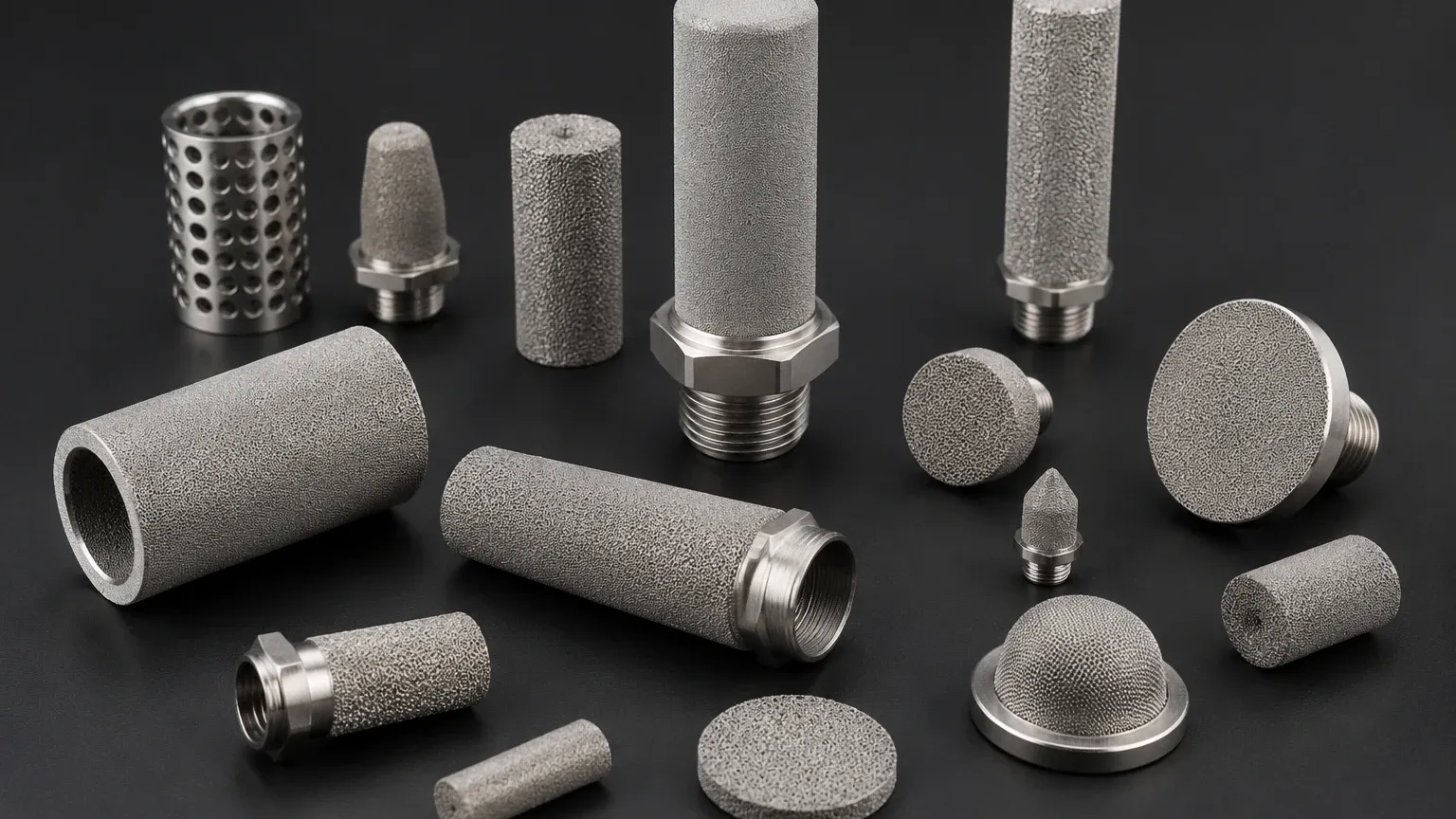
Customization Options for Industrial Applications
Industrial filtration systems rarely utilize off-the-shelf components. Customization is often necessary to ensure the filter fits existing housings and meets specific process requirements. Kaifil provides extensive OEM capabilities to address these needs.
Geometric Configurations
Sintered filters can be manufactured in various shapes, including:
* Cylindrical Cartridges: Standard for liquid and gas processing.
* Porous Discs and Plates: Often used in fluidization beds or gas sparging.
* Conical and Custom Shapes: Designed for specialized machinery or unique flow paths.
End Fittings and Connections
To ensure a leak-proof seal, the choice of end fittings is vital. Common options include:
* Threaded Connections (NPT, BSP): For secure mechanical attachment.
* O-Ring Interfaces (222, 226, DOE): Standard for sanitary and industrial housings.
* Flanged Ends: For high-pressure pipeline installations.
Structural Reinforcement
For high-differential pressure applications, sintered filters can be reinforced with internal perforated cores or external cages. This prevents the media from collapsing or bursting during pressure spikes or during the backpulsing cleaning cycle.
Maintenance, Cleaning, and Replacement Cycles
One of the primary advantages of sintered filters is their cleanability. Unlike disposable cartridges, sintered metal components can be restored to near-original performance levels through various cleaning methods, significantly extending their service life.
Cleaning Methods
1. Backpulsing/Backwashing: Reversing the flow of fluid through the filter to dislodge surface contaminants. This is highly effective for sintered wire mesh filters.
2. Ultrasonic Cleaning: Using high-frequency sound waves in a cleaning solvent to remove fine particles trapped deep within the porous matrix of sintered powder filters.
3. Chemical Cleaning: Utilizing acids, caustic solutions, or specialized solvents to dissolve organic or inorganic scaling. The chemical compatibility of the filter material must be verified before this process.
4. Heat Treatment (Burn-off): In applications involving organic polymers or resins, controlled heating can be used to carbonize and remove the contaminants.
Determining Replacement Cycles
While sintered filters are durable, they are not infinite. Replacement is typically required when the "clean" pressure drop after a cleaning cycle remains significantly higher than the original specification. This indicates permanent fouling or structural fatigue. Monitoring the $ΔP$ across the filter is the most reliable method for determining both cleaning intervals and the eventual end-of-life for the component.
Total Cost of Ownership and Procurement Guidance
When evaluating the cost of sintered filters, procurement teams must look beyond the initial purchase price. The Total Cost of Ownership (TCO) for sintered metal is often lower than disposable alternatives when considering the following factors:
* Reduced Waste: Eliminating the disposal costs associated with single-use cartridges.
* Process Uptime: The ability to clean filters in-situ or through rapid rotation reduces system downtime.
* Durability: Resistance to pressure surges and thermal shocks prevents catastrophic failures that could damage downstream equipment.
* Filtration Consistency: Stable pore structures ensure product quality remains consistent over the life of the filter.
For engineers preparing a request for quotation (RFQ), the following information should be confirmed:
1. Operating Conditions: Maximum temperature, operating pressure, and maximum allowable pressure drop.
2. Fluid Characteristics: Viscosity, chemical composition, and flow rate.
3. Contaminant Profile: Particle size distribution, concentration, and the nature of the solids (deformable vs. hard).
4. Mechanical Interface: Dimensions, housing type, and required sealing mechanism.
By focusing on these technical parameters, organizations can ensure they select a filtration solution that provides the necessary precision and longevity for their specific industrial application. For more information on manufacturing capabilities and technical specifications, visit the Main Page to consult with filtration specialists.
