


Ahu Filter
In industrial HVAC and process air systems, the Air Handling Unit (AHU) serves as the primary mechanism for regulating and circulating air. The performance of these units is fundamentally dependent on the quality and specification of the ahu filter installed within the system. Unlike residential or light commercial applications, industrial AHU filtration requires a rigorous focus on durability, chemical resistance, and precise particle capture to protect downstream components and maintain stringent air quality standards in environments such as chemical processing, pharmaceutical manufacturing, and food production.
Selecting the correct filtration solution involves balancing air quality requirements with energy consumption and maintenance costs. For many heavy-duty industrial applications, standard disposable filters are insufficient, leading to the adoption of custom-engineered stainless steel and metal mesh solutions that offer superior longevity and performance in harsh conditions.
The Role of AHU Filters in Industrial Environments
An AHU filter is designed to remove airborne contaminants from the air stream before it reaches the cooling/heating coils, fans, and the internal environment of a facility. In an industrial context, the role of these filters extends beyond simple comfort. They are critical for:
1. Equipment Protection: By capturing dust, debris, and corrosive particles, filters prevent the fouling of heat exchangers and the erosion of fan blades. This maintains the thermal efficiency of the AHU and extends the service life of the entire system.
2. Process Integrity: In industries like electronics or pharmaceuticals, even minor particulate contamination can result in product defects. AHU filters act as the first line of defense in maintaining controlled environments.
3. Health and Safety: Filters reduce the concentration of allergens, pathogens, and industrial byproducts in the air, ensuring compliance with occupational health standards.
For engineers managing complex systems, the choice of filter media is paramount. While synthetic and glass fiber media are common, industrial environments involving high humidity, extreme temperatures, or chemical vapors often necessitate the use of stainless steel filtration components. These robust materials prevent media migration and structural failure under high-pressure loads.
Filtration Standards and Efficiency Ratings
Understanding the classification of an ahu filter is essential for proper specification. The industry primarily relies on the MERV (Minimum Efficiency Reporting Value) rating system, defined by ASHRAE 52.2, or the ISO 16890 standard. These ratings indicate the filter's ability to capture particles between 0.3 and 10 microns.
* Coarse Filters (MERV 1-4): Typically used as pre-filters to capture large debris like lint and sand. In industrial AHUs, these are often metal mesh filters that can be washed and reused.
* Medium Filters (MERV 5-12): Designed to capture smaller particles such as mold spores, dust, and fine process powders. These are frequently used in general manufacturing areas.
* High-Efficiency Filters (MERV 13-16): Essential for hospital environments and high-end industrial processes. They capture bacteria and very fine smoke particles.
* HEPA and ULPA: These are used for cleanroom applications, offering efficiencies up to 99.999% for particles as small as 0.1 microns.
When evaluating a Main Page for filtration solutions, engineers must confirm that the filter's efficiency rating aligns with the particle size distribution of the specific industrial process. Over-specifying can lead to unnecessary energy costs due to high pressure drop, while under-specifying can lead to equipment damage and poor air quality.
Material Selection: The Shift Toward Stainless Steel
In demanding industrial sectors, material compatibility is a primary engineering consideration. Standard AHU filters with cardboard frames or synthetic media often fail when exposed to:
* High Humidity and Moisture: In food processing or cooling tower proximity, moisture can cause synthetic media to sag or promote microbial growth. Stainless steel wire mesh filters are inherently resistant to moisture and do not support fungal growth.
* Chemical Exposure: Volatile Organic Compounds (VOCs) and acidic or alkaline vapors can degrade traditional filter adhesives and media. Using 304 or 316L stainless steel ensures the filter remains structurally sound in corrosive atmospheres.
* High Temperatures: Industrial processes may involve air streams exceeding 100°C (212°F). Metal filters, often featuring pleated stainless steel mesh, can operate at these temperatures without off-gassing or losing integrity.
Kaifil specializes in manufacturing these durable filtration components, providing custom stainless steel wire mesh filters that replace disposable units in high-stress environments. These metal filters offer a significant advantage in terms of sustainability and long-term cost, as they can be cleaned and returned to service multiple times.
Engineering Parameters: Airflow, Resistance, and Velocity
When integrating an ahu filter into a system, engineers must analyze several critical performance metrics to ensure the AHU operates within its design envelope.
Initial and Final Resistance
Resistance, or pressure drop, is the measure of how much the filter restricts airflow. Initial resistance is the pressure drop of a clean filter, while final resistance is the point at which the filter is considered "loaded" and must be cleaned or replaced. High initial resistance forces the AHU fan to work harder, increasing energy consumption. Metal mesh filters are often designed with specific weave patterns to optimize the balance between filtration accuracy and low pressure drop.
Face Velocity
This is the speed of the air as it enters the filter face, usually measured in feet per minute (fpm) or meters per second (m/s). Most AHU systems are designed for a face velocity of 400 to 500 fpm. If the velocity is too high, particles may be "pulled through" the media (bypass), and the pressure drop will increase exponentially. Custom filter designs allow for increased surface area through pleating, which lowers the effective velocity across the media.
Dust Holding Capacity (DHC)
The DHC determines how much contaminant a filter can retain before reaching its final resistance. Filters with high DHC require less frequent maintenance. In heavy industrial applications, using a multi-stage filtration approach—where a coarse stainless steel pre-filter protects a finer secondary filter—maximizes the DHC of the entire system.
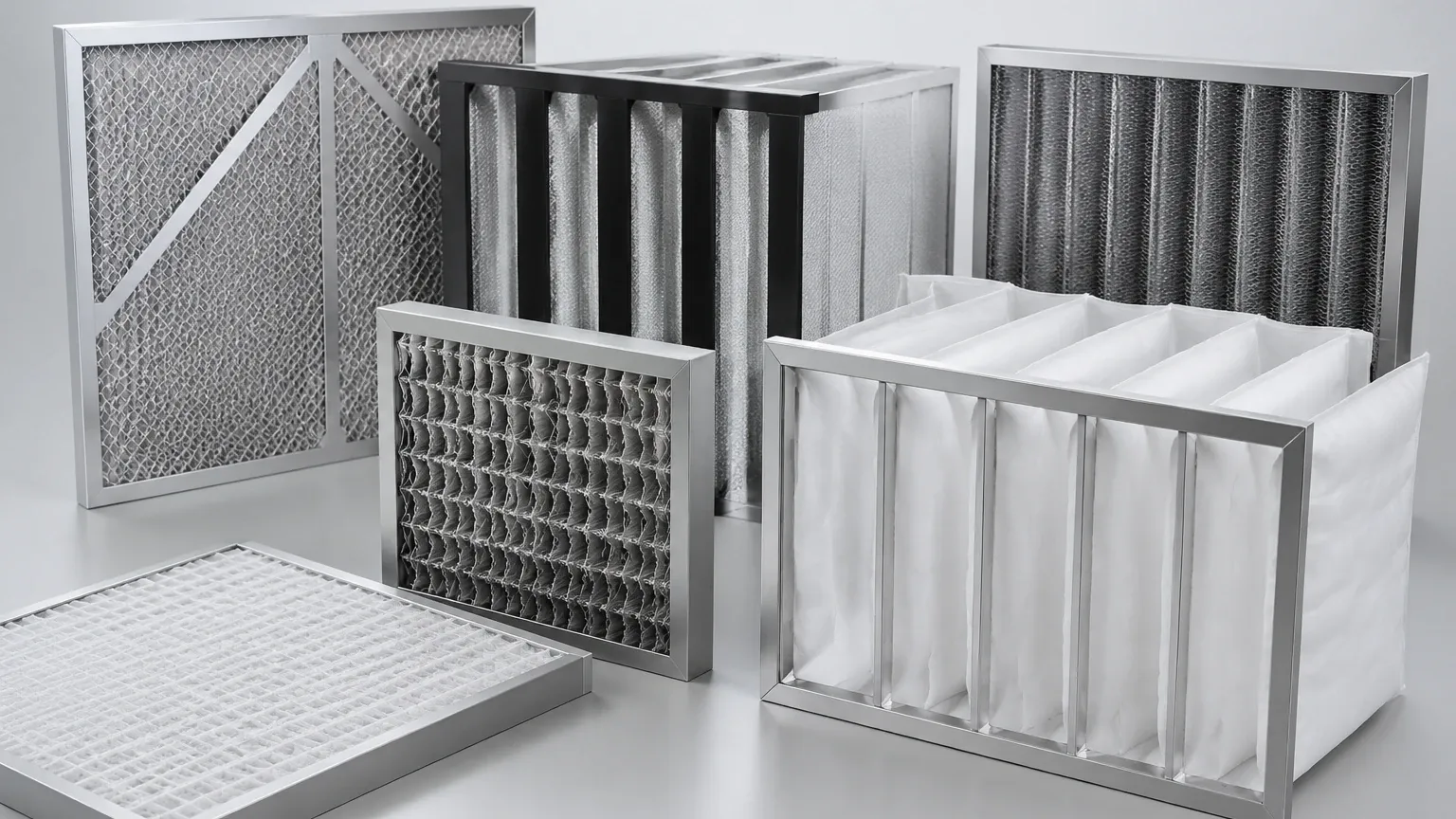
Customization and Structural Design for OEM Applications
Standard off-the-shelf filters rarely meet the specific needs of specialized industrial equipment. Customization is often required in terms of dimensions, frame thickness, and media density.
For OEM (Original Equipment Manufacturer) applications, the structural integrity of the filter frame is as important as the media itself. A flimsy frame can vibrate, causing noise and potential air bypass. Industrial-grade filters typically utilize rigid frames made of extruded aluminum or heavy-gauge stainless steel, with reinforced corners to withstand the mechanical stress of high-volume airflow.
Customization also extends to the filtration media. Engineers can specify the precise micron rating and weave type—such as plain weave, twilled weave, or Dutch weave—to target specific contaminants. This level of precision ensures that the filtration system is perfectly tuned to the requirements of the process air, whether it is for hydraulic cooling, chemical venting, or cleanroom intake.
Maintenance, Cleaning, and Life Cycle Management
The total cost of ownership (TCO) for AHU filtration is not merely the purchase price, but the sum of energy costs, labor for replacement, and disposal fees. Disposable filters generate significant waste and require recurring procurement cycles.
In contrast, stainless steel ahu filters offer a different maintenance profile:
1. Cleaning Protocols: Metal filters can be cleaned using ultrasonic baths, high-pressure water, or chemical solvents, depending on the contaminant. This restores the filter to near-original pressure drop levels.
2. Inspection Cycles: Regular differential pressure monitoring is the most effective way to determine maintenance timing. Installing manometers or digital pressure sensors across the filter bank allows for data-driven maintenance scheduling.
3. Durability: A well-maintained stainless steel filter can last for years, significantly reducing the environmental impact and the logistical burden of managing large inventories of disposable filters.
For facilities looking to optimize their maintenance operations, transitioning to cleanable metal components provides a predictable and sustainable filtration strategy.
Technical Verification for Procurement Teams
Before finalizing a purchase or specifying a filter for a new project, procurement and engineering teams should confirm several technical details with the manufacturer:
* Material Certification: Ensure that the stainless steel grade (e.g., 304, 316, 316L) is verified for the specific environment.
* Structural Limits: Confirm the maximum allowable pressure drop before the filter media or frame risks deformation.
* Filtration Accuracy: Request technical data sheets that specify the micron rating and efficiency percentages at various flow rates.
* Gasket and Seal Integrity: In bypass-sensitive applications, the quality of the gasketing material (such as EPDM, Silicone, or Viton) is crucial for ensuring a leak-proof fit within the AHU housing.
By focusing on these factual engineering requirements, organizations can ensure they are investing in filtration solutions that provide reliable performance, protect critical assets, and deliver a favorable return on investment. Whether for a standard HVAC upgrade or a specialized industrial process, the right ahu filter is a cornerstone of efficient facility management.
