


Sintered Metal Discs
In the landscape of industrial filtration and fluid dynamics, sintered metal discs represent a pinnacle of engineering durability and precision. These components are not merely filters but engineered porous structures designed to withstand extreme pressures, corrosive environments, and high temperatures that would compromise polymer or fabric-based media. For engineers and procurement specialists, understanding the technical nuances of sintered metal discs is essential for optimizing system performance and ensuring long-term operational reliability.
Sintered metal discs are manufactured through a process of thermal diffusion, where metal powders or multi-layer wire meshes are heated below their melting point. This metallurgical bonding creates a rigid, self-supporting structure with a controlled pore distribution. As industries move toward more demanding processing conditions, the role of these discs in chemical processing, pharmaceutical manufacturing, and aerospace applications continues to expand. This guide examines the technical specifications, material considerations, and selection criteria necessary for integrating these components into industrial systems.
Understanding the Sintering Process and Structural Integrity
The fundamental advantage of sintered metal discs lies in their manufacturing process. Unlike woven mesh that relies on mechanical interlocking, sintering creates a permanent bond at the molecular level between individual metal particles or wire strands. This process, often conducted in a vacuum or a controlled atmosphere furnace, ensures that the resulting disc maintains its shape and pore size even under significant mechanical stress.
There are two primary types of sintered media used for discs:
1. Sintered Metal Powder: These discs are formed by compacting spherical or irregular metal powders into a mold and then sintering them. This results in a tortuous path for the fluid, providing excellent depth filtration and the ability to capture particles within the matrix of the disc rather than just on the surface.
2. Sintered Wire Mesh: This involves laminating multiple layers of stainless steel wire mesh together. The layers are typically arranged to provide a balance between filtration accuracy, mechanical strength, and permeability. The sintering process locks the wires in place, preventing media migration—a common failure point in non-sintered filters where individual wires may shift under pressure.
For high-pressure applications, such as hydraulic systems or polymer melt filtration, the structural integrity provided by sintering is indispensable. The discs do not require internal support structures in many cases, allowing for a more streamlined design within filter housings. For more information on custom filtration components and engineering support, visit the Main Page.
Material Engineering: Selecting Alloys for Harsh Environments
Material selection is the most critical factor in determining the lifespan of sintered metal discs. Because these components are often used in aggressive chemical environments or high-temperature zones, the alloy must be chosen based on its resistance to oxidation, pitting, and stress corrosion cracking.
* Stainless Steel 316L: The industry standard for most filtration applications. The "L" denotes low carbon content, which improves weldability and resistance to intergranular corrosion. 316L offers excellent resistance to organic acids and chlorides, making it suitable for food and beverage, pharmaceutical, and general chemical applications.
* Stainless Steel 304: Often used in less demanding environments where cost-efficiency is a priority. It provides good corrosion resistance but is more susceptible to chloride-induced pitting than 316L.
* Monel (Nickel-Copper Alloy): Specifically chosen for applications involving hydrofluoric acid or seawater. Monel maintains its strength across a wide temperature range and is highly resistant to rapidly flowing brackish water.
* Inconel and Hastelloy: These superalloys are reserved for extreme conditions. Inconel is ideal for high-temperature oxidation resistance (up to 800°C or higher), while Hastelloy provides superior resistance to highly reducing or oxidizing acids, such as sulfuric or hydrochloric acid.
When specifying materials, engineers must consider the pH of the fluid, the presence of abrasive particles, and the potential for galvanic corrosion if the disc is in contact with dissimilar metals within the housing.
Filtration Performance and Pore Size Control
The performance of sintered metal discs is defined by their filtration rating, permeability, and dirt-holding capacity. Unlike surface filters, sintered discs often act as depth filters, where the interconnected porosity allows for the entrapment of contaminants throughout the thickness of the disc.
Pore Size and Distribution
Filtration ratings for sintered discs are categorized as either nominal or absolute. An absolute rating indicates the size of the largest particle that can pass through the disc, while a nominal rating represents the average pore size. In precision industries like semiconductor manufacturing or fine chemical processing, absolute ratings are mandatory to ensure process consistency. Sintered powder discs can achieve filtration ratings as fine as 0.2 microns, while sintered mesh discs typically range from 1 micron to several hundred microns.
Permeability and Pressure Drop
Permeability refers to the ease with which a fluid can pass through the porous medium. A common engineering challenge is balancing filtration efficiency with pressure drop (delta P). A finer pore size naturally increases the resistance to flow, requiring higher pump energy. Sintered metal discs are engineered to maximize the void volume (porosity) while maintaining structural strength, which helps in keeping the initial pressure drop low and extending the time between cleaning cycles.
Customization and Integration in Industrial Systems
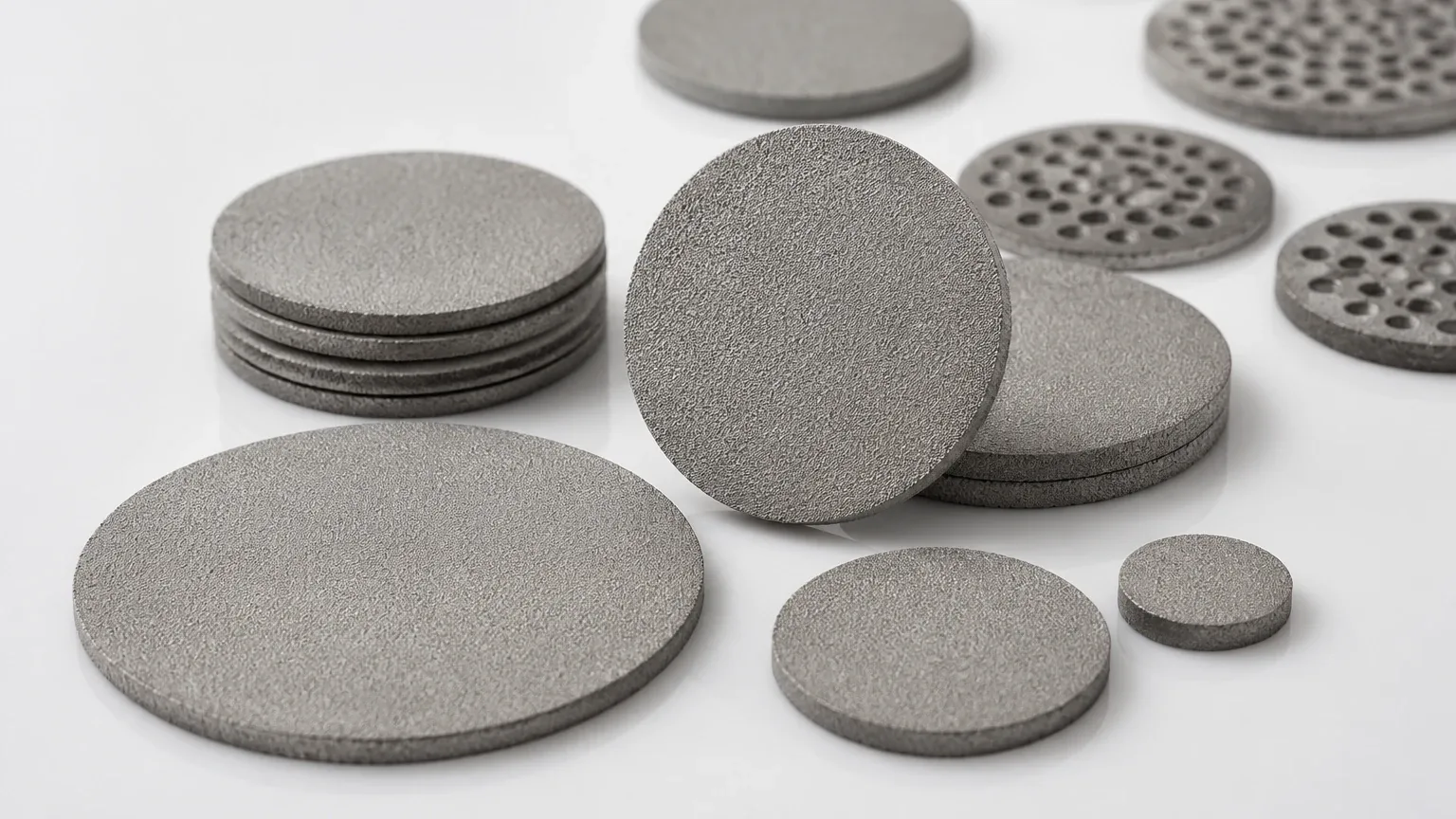
Industrial applications rarely follow a one-size-fits-all approach. Sintered metal discs are highly customizable to meet specific OEM requirements. Customization goes beyond simple diameter and thickness; it involves the engineering of the internal structure to meet specific flow characteristics.
* Multi-Layer Composites: For applications requiring both fine filtration and high mechanical strength, a disc can be manufactured with a fine-mesh filtration layer protected by coarser, stronger support layers on both sides. This protects the delicate filtration media from mechanical damage during backwashing or high-pressure surges.
* Edge Treatments and Framing: To ensure a leak-proof seal within a housing, sintered discs can be fitted with solid metal rims, gaskets, or specialized edge welding. This prevents "bypass," where unfiltered fluid escapes around the edges of the disc.
* Geometric Variations: While circular discs are standard, sintering technology allows for the production of oval, rectangular, or even conical shapes to fit specialized equipment footprints.
By working closely with a manufacturer like Kaifil, engineers can specify the exact porosity, alloy, and reinforcement needed for their specific fluid viscosity and flow rate. This level of customization is vital for optimizing the total cost of ownership, as a properly engineered disc will outlast generic alternatives by a significant margin.
Maintenance, Cleaning, and Life-Cycle Management
One of the primary economic justifications for choosing sintered metal discs over disposable filters is their cleanability. In many B2B industrial processes, the ability to reuse filtration components reduces waste and lowers long-term procurement costs. However, the effectiveness of the cleaning process depends on the nature of the contaminant and the structure of the disc.
Cleaning Methodologies
1. Backwashing/Backpulsing: This is the most common in-situ cleaning method. By reversing the flow of the fluid, particles trapped on the surface or within the pores are dislodged. This is highly effective for sintered mesh discs.
2. Ultrasonic Cleaning: For discs used in fine powder or high-viscosity applications, ultrasonic waves can be used in a cleaning bath to create cavitation bubbles that penetrate deep into the porous structure, removing sub-micron particles.
3. Chemical Cleaning: Soaking the discs in solvents, acids, or caustic solutions can dissolve organic or mineral deposits. This requires that the disc material (e.g., 316L or Hastelloy) be fully compatible with the cleaning agent.
4. Thermal Cleaning (Burn-off): In industries like polymer processing, discs may be heated in a controlled oven to carbonize and remove organic polymers. This process must be carefully controlled to avoid reaching the sintering temperature of the metal, which would alter the pore structure.
Establishing a regular maintenance schedule based on pressure drop triggers (e.g., when delta P reaches a pre-defined limit) is essential for preventing permanent pore plugging, which can render the disc unrecoverable.
Critical Considerations for Procurement and Engineering Teams
Before finalizing a purchase order for sintered metal discs, technical teams should confirm several key variables to ensure the product is fit for purpose. Failure to account for these can lead to premature component failure or process contamination.
* Operating Temperature: While the metal itself may withstand high heat, thermal expansion can affect the fit of the disc within its housing. Ensure the disc and housing materials have compatible coefficients of thermal expansion.
* Fluid Chemistry: Confirm the concentration of all chemicals, including trace elements, as these can accelerate corrosion at high temperatures.
* Mechanical Loading: Determine if the disc will be subjected to constant pressure or cyclic loading. Sintered structures are robust but can suffer from fatigue if not properly supported in high-vibration environments.
* Certification Requirements: For pharmaceutical or food and beverage applications, ensure the materials meet FDA or equivalent regulatory standards for food contact.
By addressing these factors during the design phase, companies can leverage the durability of sintered metal to achieve more efficient and sustainable industrial operations. Sintered metal discs remain a cornerstone of modern filtration, providing the precision of advanced engineering with the ruggedness of metallurgical bonding.
