


Sintered Metal Filter Manufacturer
In the landscape of industrial filtration, the transition from disposable media to permanent, high-performance solutions is often driven by the need for durability, chemical resistance, and precise particle retention. A specialized sintered metal filter manufacturer plays a critical role in this transition, providing the engineering expertise and manufacturing precision required to produce components that withstand extreme temperatures, high pressures, and corrosive environments. For engineers and procurement professionals, selecting the right manufacturing partner involves a deep understanding of sintering technology, material science, and the specific demands of the application.
Sintered metal filters are produced through a thermal process that bonds metal particles or layers of wire mesh together without melting them. This creates a rigid, porous structure with a highly controlled pore size distribution. Unlike polymer-based filters, these components offer exceptional structural integrity and can be cleaned and reused multiple times, making them a cornerstone in industries ranging from petrochemical processing to pharmaceutical manufacturing.
The Role of a Specialized Sintered Metal Filter Manufacturer
A professional manufacturer does more than simply supply a product; they serve as a technical partner in the design and optimization of filtration systems. The manufacturing process for sintered media is complex, requiring precise control over temperature, atmosphere, and pressure during the sintering cycle. A manufacturer like Kaifil utilizes advanced metallurgical techniques to ensure that the resulting filter media maintains its permeability while achieving the necessary mechanical strength.
When evaluating a manufacturer, technical teams must consider the provider's ability to handle custom specifications. Industrial applications rarely rely on "off-the-shelf" solutions. Instead, they require specific dimensions, filtration ratings, and end-fitting configurations. A reliable manufacturer provides comprehensive OEM support, from the initial material selection to the final testing of the finished component. You can Review product options and application support on the Kaifil Main Page to understand how these custom solutions are integrated into industrial workflows.
Engineering Fundamentals of Sintered Metal Media
To make an informed purchasing decision, it is essential to understand the two primary types of sintered metal media: sintered metal powder and sintered wire mesh. Each has distinct characteristics that suit different industrial requirements.
Sintered Metal Powder
Sintered powder filters are created by compacting metal powders (typically stainless steel, bronze, or nickel alloys) into a shape and then sintering them. This results in a "tortuous path" filtration structure. The depth of the media allows for high dirt-holding capacity and extremely fine filtration ratings, often down to 0.1 microns. These are ideal for gas filtration and applications where high precision is paramount.
Sintered Wire Mesh
Sintered wire mesh consists of multiple layers of woven wire cloth that are laminated and sintered together. This structure provides excellent permeability and is easier to clean via backwashing. The multiple layers—often including a fine filtration layer, a drainage layer, and a support layer—provide a balance between filtration accuracy and mechanical robustness. This type of media is frequently used in hydraulic systems and liquid filtration where high flow rates are required.
Critical Quality Metrics in Sintered Filter Production
Quality assurance in sintered metal manufacturing is defined by several technical parameters that determine the filter's performance and reliability in the field. A reputable manufacturer should provide data and verification for the following:
1. Pore Size and Distribution: The "absolute" filtration rating is determined by the largest pore in the media. Manufacturers use bubble point testing (per ISO 4003) to verify the maximum pore size and ensure consistency across production batches.
2. Permeability: This measures the ability of a fluid to pass through the filter media at a given pressure drop. High permeability is essential for energy efficiency and reducing the load on pumps and compressors.
3. Mechanical Strength: Sintered filters must resist collapse or bursting under high differential pressures. Manufacturers perform pressure tests to establish the maximum operating limits of the filter element.
4. Material Traceability: In regulated industries like food, beverage, and pharmaceuticals, material certifications (such as MTRs) are mandatory. Ensuring that the stainless steel or alloy used is of the specified grade (e.g., 316L) prevents premature failure due to corrosion.
Material Selection and Chemical Compatibility
The choice of material is perhaps the most significant factor in the longevity of a sintered metal filter. While stainless steel is the industry standard, specific environments may require more exotic alloys.
* 316L Stainless Steel: The most common material for sintered filters due to its excellent corrosion resistance and mechanical properties at elevated temperatures. It is suitable for most organic acids and general industrial applications.
* 304L Stainless Steel: Often used in less demanding environments or water treatment applications where cost-effectiveness is a priority.
* Hastelloy (C-276, C-22): Used in highly corrosive environments involving strong acids, such as sulfuric or hydrochloric acid, where stainless steel would fail.
* Inconel and Monel: Selected for high-temperature oxidation resistance or applications involving seawater and hydrofluoric acid.
A knowledgeable manufacturer will guide the engineer through the trade-offs between material cost and service life, ensuring that the selected alloy is compatible with the process fluid and cleaning agents.
Customization Options for Industrial Applications
Standardization is difficult in complex industrial systems. Therefore, the ability of a sintered metal filter manufacturer to provide custom engineering is vital. Customization typically covers several areas:
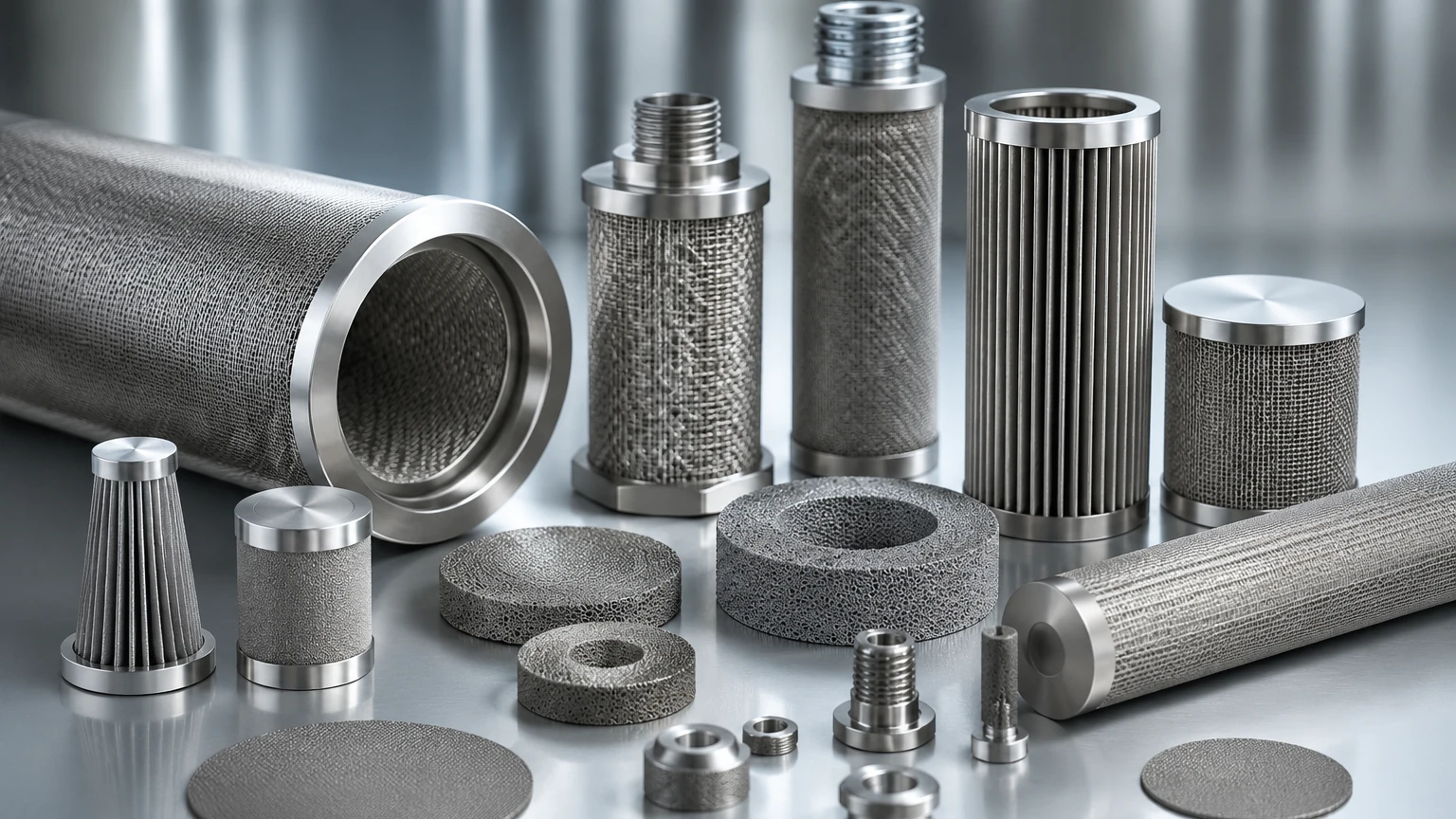
* Geometry and Form Factor: Filters can be manufactured as cylindrical cartridges, flat discs, conical shapes, or complex pleated structures. Pleating the sintered mesh increases the effective filtration area, which lowers the flux rate and extends the time between cleaning cycles.
* End Fittings: To ensure a leak-proof seal within the filter housing, manufacturers offer various fittings, including threaded connections (NPT, BSP), flange mounts, and specialized O-ring seals (222, 226 configurations).
* Support Structures: For high-pressure applications, internal or external support cores (perforated tubes) are added to prevent the media from deforming under stress.
By working closely with the manufacturer's engineering team, purchasers can ensure that the filter integrates seamlessly into existing hardware while meeting the specific flow and pressure requirements of the process.
Maintenance, Cleaning, and Service Life Considerations
One of the primary advantages of sintered metal filters is their cleanability. Unlike disposable cartridges that must be incinerated or sent to a landfill, sintered elements can be restored to near-original permeability through various cleaning methods. This significantly reduces the total cost of ownership over the life of the equipment.
Cleaning Methods
* Backwashing/Backpulsing: In liquid or gas systems, reversing the flow can dislodge surface-level contaminants. This is often automated for continuous operation.
* Ultrasonic Cleaning: The most effective method for removing fine particles trapped deep within the porous structure. High-frequency sound waves create cavitation bubbles that scrub the media surfaces.
* Chemical Cleaning: Using solvents, acids, or caustic solutions to dissolve specific types of fouling, such as polymers or organic deposits.
* Thermal Burn-off: Used for removing carbonized residues or plastics by heating the filter in a controlled atmosphere.
Manufacturers often provide guidelines on the maximum number of cleaning cycles and the specific pressures that should not be exceeded during backpulsing to avoid fatigue of the metal structure.
Total Cost of Ownership and Procurement Strategies
While the initial purchase price of a sintered metal filter is higher than that of a polymer or paper alternative, the total cost of ownership (TCO) is generally much lower in demanding applications. Engineers should evaluate the following when comparing costs:
1. Replacement Frequency: Sintered filters can last for years, whereas disposable filters may need replacement weekly or even daily.
2. Disposal Costs: Reducing the volume of contaminated waste leads to significant savings, especially when dealing with hazardous materials.
3. Downtime: Longer service intervals mean fewer system shutdowns for filter changes, increasing overall production efficiency.
4. Energy Consumption: A well-engineered sintered filter with high permeability maintains a lower pressure drop, reducing the energy required to move fluid through the system.
When sourcing from a sintered metal filter manufacturer, it is advisable to confirm their lead times, prototyping capabilities, and technical support availability. A partner who can provide rapid prototyping allows for field testing before committing to large-scale production, mitigating the risk of performance mismatches.
Conclusion
Selecting a sintered metal filter manufacturer is a strategic decision that impacts the reliability and efficiency of industrial processes. By focusing on technical expertise, material integrity, and customization capabilities, engineering and purchasing teams can secure filtration solutions that perform consistently under pressure. Whether the application involves high-temperature gas filtration or the protection of sensitive hydraulic components, the combination of advanced sintering technology and rigorous quality control ensures that the final product meets the highest industrial standards. For more information on tailored filtration components and engineering support, visit the Kaifil Main Page to explore the full range of custom stainless steel solutions.
