


Sintered Porous Metal Filter
In industrial filtration, the ability to maintain structural integrity under extreme thermal and mechanical stress is a critical requirement for process efficiency. A sintered porous metal filter represents a specialized class of filtration media engineered through powder metallurgy. Unlike traditional fabric or polymer-based filters, these components are designed to withstand high temperatures, corrosive chemicals, and high-pressure differentials while providing precise micron-level separation. For engineers and procurement teams, understanding the technical nuances of these filters is essential for optimizing system performance and reducing long-term operational costs.
The Engineering Principles of Sintered Metal Filtration
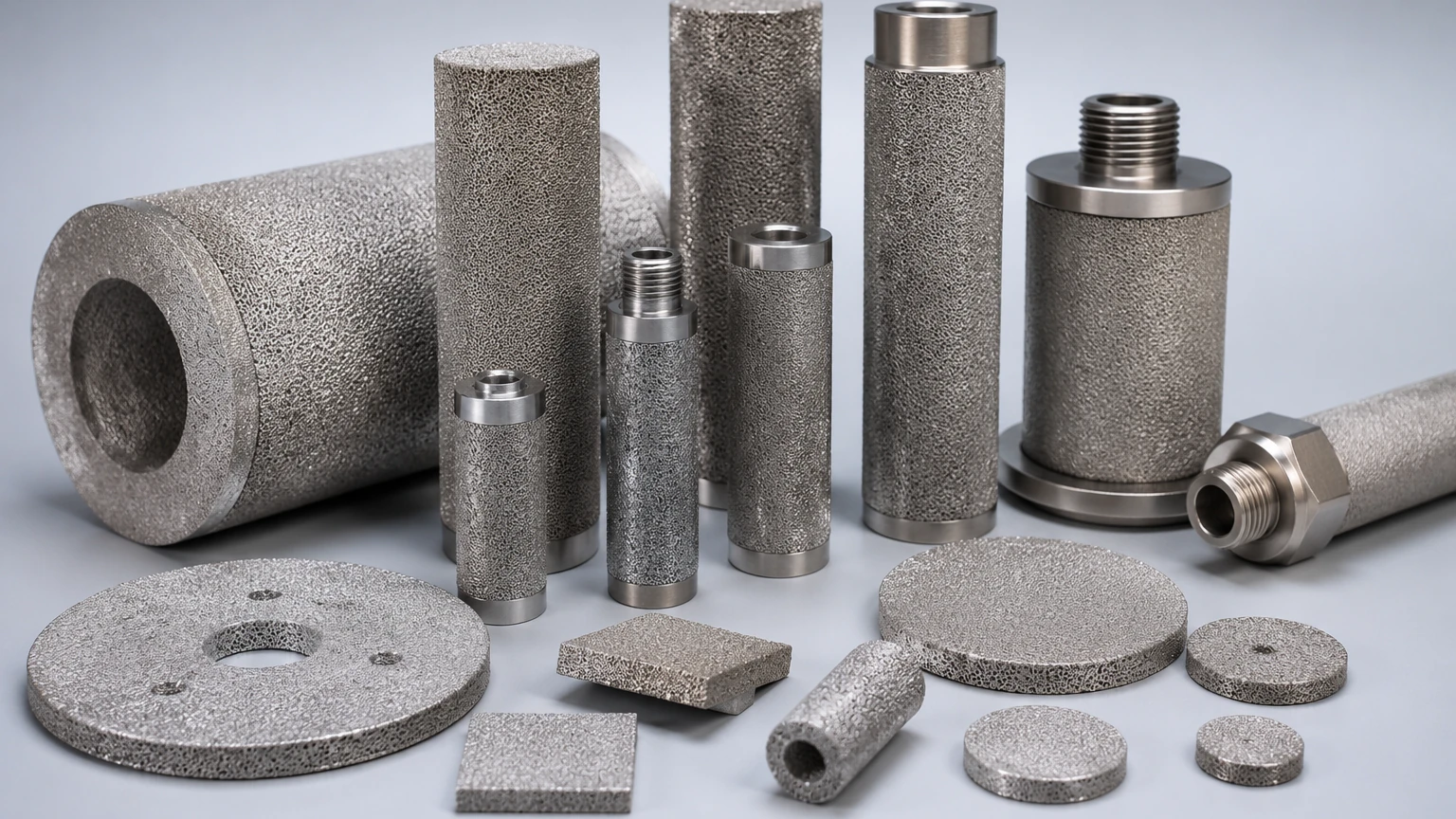
The manufacturing of a sintered porous metal filter begins with the selection of high-purity metal powders. These powders are compacted into a specific shape—such as a tube, disc, or plate—and then subjected to a sintering process in a controlled-atmosphere furnace. Sintering involves heating the material to a temperature just below its melting point. This causes the metal particles to fuse at their contact points through a process of molecular diffusion, creating a rigid, interconnected pore network.
This interconnected structure is what defines the performance of the filter. Because the particles are fused, the pore size remains stable even under significant pressure. This stability prevents "unloading," a common failure in depth filters where trapped contaminants are forced through the media as pressure increases. The resulting matrix provides a tortuous path for fluids, ensuring that particles are captured both on the surface and within the depth of the filter wall. For technical professionals, the primary advantage here is the combination of high porosity (often between 30% and 50%) and high mechanical strength, which allows for high flow rates with minimal pressure drop.
Material Science: Selecting the Right Alloy for Harsh Environments
Material selection is perhaps the most critical decision when specifying a sintered porous metal filter. The chemical and thermal environment of the application dictates the required alloy.
1. Stainless Steel 316L: This is the industry standard for most industrial applications. It offers excellent corrosion resistance, particularly against organic acids and many industrial chemicals. Its low carbon content (the "L" in 316L) minimizes carbide precipitation during welding, maintaining the integrity of the filter structure.
2. Nickel-Based Alloys (Inconel, Monel, Hastelloy): For environments involving extreme temperatures or highly aggressive acids (such as hydrochloric or hydrofluoric acid), nickel alloys are preferred. Inconel, for instance, maintains its mechanical properties at temperatures exceeding 800°C, where stainless steel would begin to oxidize or lose structural rigidity.
3. Titanium: Known for its high strength-to-weight ratio and exceptional resistance to seawater and chlorides, titanium sintered filters are frequently used in desalination and aerospace applications.
When evaluating these materials, engineers must consider the pH levels, the presence of oxidizing or reducing agents, and the peak operating temperatures. A mismatch in material selection can lead to premature failure via pitting, stress corrosion cracking, or general thinning of the pore walls, which compromises filtration accuracy.
Critical Performance Metrics: Efficiency, Flow, and Pressure
To ensure a sintered porous metal filter meets the requirements of a specific process, several performance metrics must be analyzed during the selection phase.
Micron Rating and Filtration Efficiency
Filtration ratings are typically classified as either "nominal" or "absolute." A nominal rating refers to the ability of the filter to retain a certain percentage of particles of a given size. An absolute rating, however, indicates the size of the largest spherical particle that can pass through the filter under specific test conditions. In high-precision industries like pharmaceuticals or semiconductor manufacturing, absolute ratings are mandatory to ensure consistent product quality.
Permeability and Pressure Drop
Permeability is a measure of how easily a fluid can pass through the porous structure. It is inversely proportional to the pressure drop across the filter. A well-designed filter maximizes permeability while maintaining the required micron rating. Engineers must calculate the "clean pressure drop" to ensure the system's pumps or compressors can handle the resistance. As the filter accumulates debris, the pressure drop increases; understanding the rate of this increase is vital for setting maintenance intervals.
Bubble Point Testing
This is a standard non-destructive test used to verify the integrity and pore size of a sintered porous metal filter. By submerging the filter in a liquid and increasing the air pressure inside, the pressure at which the first bubble appears (the bubble point) can be used to calculate the maximum pore size based on the surface tension of the liquid.
Design and Customization for Specialized Industrial Systems
One of the primary benefits of working with a manufacturer like Kaifil is the ability to customize the geometry and structural features of the filtration component. Industrial systems rarely use "off-the-shelf" solutions without some level of modification.
Customization options include:
* Geometry: Filters can be manufactured as seamless tubes, pleated cartridges to increase surface area, or flat discs for laboratory-scale equipment.
* End Fittings: To ensure a leak-proof seal within the housing, filters can be integrated with various fittings, such as NPT threads, flange mounts, or specialized O-ring seals (e.g., 222 or 226 configurations).
* Reinforcement: In high-pressure hydraulic or gas systems, the porous media may be reinforced with an internal or external perforated core to prevent collapse or bursting.
For engineers looking to integrate these components into existing systems, reviewing the Main Page of a manufacturer’s technical catalog can provide insights into available dimensions and connection types. Customization ensures that the filter does not become a bottleneck in the system and that it can be easily serviced without requiring extensive re-piping.
Operational Longevity and Cleaning Protocols
Unlike disposable polymer filters, a sintered porous metal filter is an investment intended for long-term use. The ability to clean and reuse these filters significantly impacts the total cost of ownership (TCO). Because the media is metallic and rigid, it can withstand aggressive cleaning cycles that would destroy other types of filters.
Physical Cleaning
* Backpulsing/Backwashing: This involves reversing the flow of the fluid (often using a gas pulse) to dislodge particles trapped on the surface of the filter. This is highly effective for surface-loading applications.
* Ultrasonic Cleaning: The filter is placed in an ultrasonic bath where high-frequency sound waves create cavitation bubbles. These bubbles implode on the surface and within the pores, effectively removing deep-seated contaminants.
Chemical Cleaning
* Solvent and Acid Washing: Depending on the contaminant, filters can be soaked in caustic solutions, acids, or specialized solvents to dissolve organic or mineral deposits. Because the filters are typically made of 316L or higher alloys, they are resistant to many of these cleaning agents.
* Hydrodynamic Cleaning: High-pressure water jets can be used to clean the exterior of the filter, though care must be taken not to damage the fine pore structure.
A properly maintained sintered filter can last for several years, even in continuous operation. The key is to establish a cleaning regimen based on the pressure drop threshold rather than a fixed time interval, as this accounts for variations in process fluid contamination levels.
Industrial Applications and Selection Strategy
The versatility of the sintered porous metal filter makes it a staple in several high-stakes industries.
* Chemical Processing: Used for catalyst recovery, where fine metal catalysts must be separated from the product stream at high temperatures. The filter's resistance to thermal shock is vital here.
* Food and Beverage: Employed in the carbonation of beverages and the filtration of steam used for sterilization. The material must be food-grade and capable of being cleaned-in-place (CIP).
* Pharmaceuticals: Used in the production of active pharmaceutical ingredients (APIs), where high-purity filtration and the absence of media migration are non-negotiable.
* Hydraulics: Protecting sensitive valves and actuators from particulate wear in high-pressure circuits.
When selecting a filter, the purchasing team should confirm the following with the manufacturer:
1. Operating Temperature and Pressure: What are the maximum and continuous limits?
2. Fluid Characteristics: What is the viscosity, and are there corrosive elements present?
3. Contaminant Profile: What is the particle size distribution of the solids being removed?
4. Regulatory Compliance: Does the filter need to meet FDA, 3A, or PED (Pressure Equipment Directive) standards?
By addressing these technical requirements early in the design or procurement phase, companies can ensure they select a sintered porous metal filter that provides the necessary filtration precision without compromising the reliability of the overall industrial process.
