


Sip Pharmaceutical
In the rigorous landscape of pharmaceutical manufacturing, maintaining a sterile environment is not merely a regulatory requirement but a fundamental pillar of product safety and efficacy. Sterilization-in-place, commonly referred to as SIP, is the process used to sterilize process equipment, piping, and filtration systems without the need for disassembly. For engineers and quality assurance professionals, understanding the nuances of sip pharmaceutical applications is critical, particularly when selecting the filtration components that must endure these demanding thermal and mechanical cycles.
Industrial filtration systems in pharmaceutical lines often serve as the final barrier against microbial contamination. However, these filters are also the components most vulnerable to the stresses of high-temperature steam. This guide examines the technical requirements, engineering considerations, and material selection criteria for filters used in SIP processes, providing a framework for optimizing system longevity and process integrity.
The Technical Fundamentals of SIP in Pharmaceutical Processing
SIP pharmaceutical operations typically utilize saturated steam as the sterilizing agent. The efficacy of the process relies on the relationship between temperature, pressure, and time. Most pharmaceutical protocols require equipment to reach a minimum temperature of 121.1°C (250°F) for at least 15 to 30 minutes, although some high-pathogen environments may require temperatures up to 135°C.
The goal of SIP is to achieve a Sterility Assurance Level (SAL), often defined by the F0 value, which quantifies the equivalent time of sterilization at a base temperature. For a filter to be considered "SIP-capable," it must not only withstand these temperatures but also maintain its structural integrity and filtration efficiency throughout hundreds of cycles. Unlike Clean-in-Place (CIP) processes, which use chemical detergents and mechanical action to remove soil, SIP is focused purely on the inactivation of microorganisms through thermal energy.
Engineering Considerations for Filter Durability
When a filter is integrated into a sip pharmaceutical loop, it faces several physical challenges that can lead to premature failure if the component is not engineered specifically for industrial use.
Thermal Expansion and Contraction
During the heating phase of SIP, the filter element and the filter housing expand at different rates depending on their mass and material composition. Stainless steel filter cartridges, particularly those manufactured from 316L, are preferred in these applications because they offer a predictable thermal expansion coefficient. If a filter is too rigid or poorly fitted, the thermal stress can lead to warping of the pleats or cracking of the end caps. Engineers must ensure that the housing design allows for this expansion without compromising the seals or gaskets.
Differential Pressure (Delta P)
One of the most common causes of filter failure during SIP is excessive differential pressure. As steam is introduced into the system, it may encounter resistance from the filter media, especially if the media is wet from a previous CIP cycle. If the pressure on the upstream side significantly exceeds the downstream side, the filter can collapse or "blow out." In sip pharmaceutical applications, it is standard practice to maintain a differential pressure of less than 0.3 bar (5 psi) during the sterilization phase to protect the media.
Condensate Management
Steam is only an effective sterilant if it remains in a saturated state. If steam cools and turns into condensate within the filter housing, it can create "cold spots" where sterilization temperatures are not met. Furthermore, condensate trapped within the pores of a wire mesh or sintered filter can create significant resistance to steam flow. Effective SIP system design requires strategic placement of steam traps and a slight incline in piping to ensure that condensate is continuously drained away from the filter element.
Material Selection: Why Stainless Steel is the Standard
While polymer-based filters (such as PES or PTFE) are common in single-use pharmaceutical applications, permanent and semi-permanent installations rely heavily on stainless steel filtration solutions. The choice of material is dictated by the need for repeated sterilization without degradation.
1. 316L Stainless Steel: This is the industry standard for sip pharmaceutical environments. The "L" denotes low carbon content, which minimizes carbide precipitation during welding, ensuring the filter remains resistant to corrosion at the high temperatures of steam sterilization.
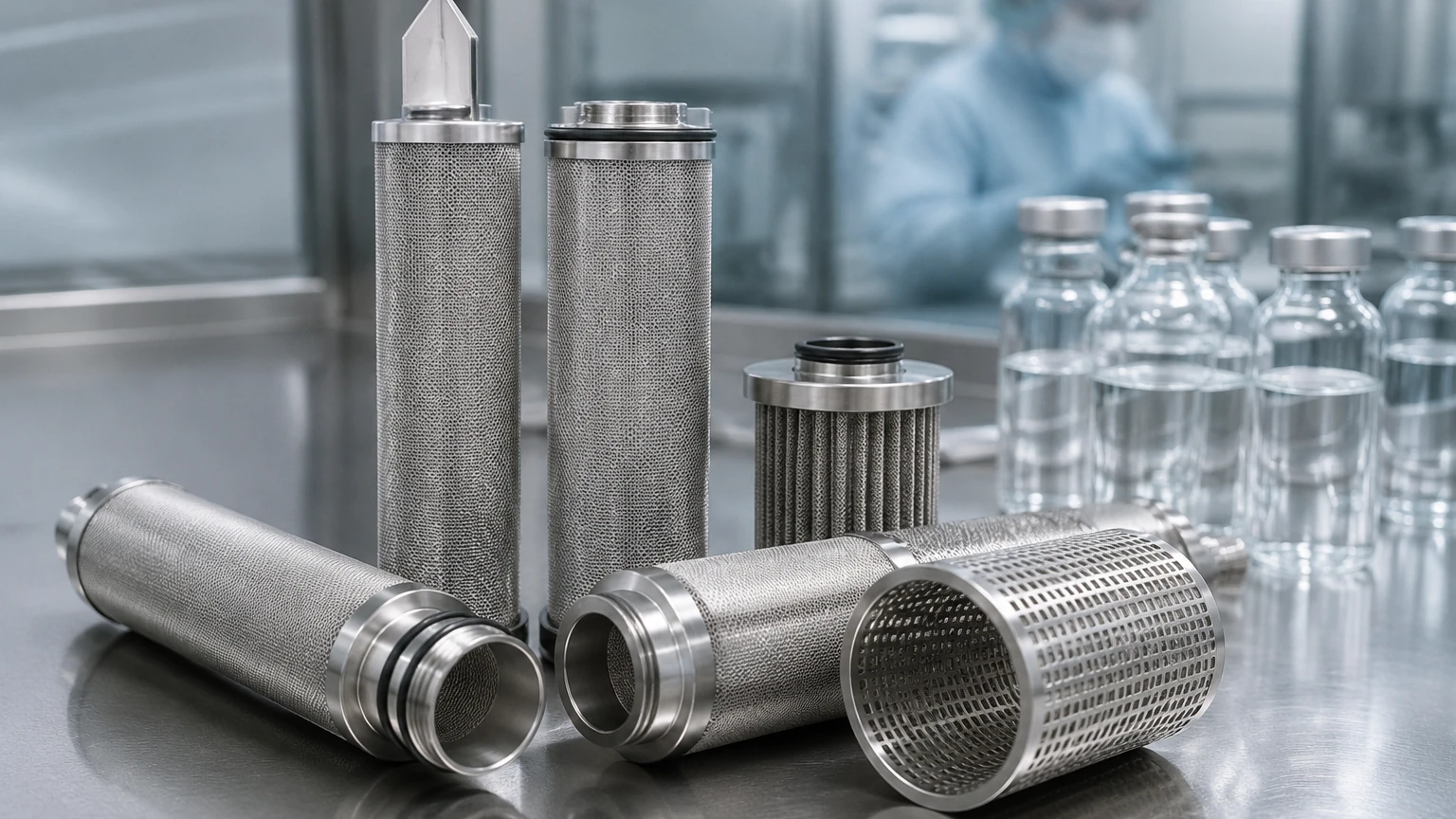
2. Sintered Metal Fiber vs. Wire Mesh: For high-pressure SIP cycles, sintered metal fiber provides a high dirt-holding capacity and excellent permeability. Woven wire mesh filters, on the other hand, offer precise pore size control and are easier to clean during the CIP phase that precedes sterilization. Both structures provide the mechanical robustness required to survive the transition from ambient temperatures to 135°C.
3. Surface Finish: In pharmaceutical contexts, the surface roughness (Ra) of the filter and its housing is critical. A surface that is too rough can harbor biofilms or trap air pockets that insulate bacteria from the steam. High-quality industrial filters for SIP are often electropolished to achieve an Ra of < 0.4 µm, ensuring that the steam makes direct contact with every surface.
Validation and Integrity Testing in SIP Environments
A critical component of sip pharmaceutical protocols is the validation of filter integrity. Engineers must be able to prove that the filter has not been damaged by the steam cycle. For hydrophobic air filters (used for tank venting during SIP), the water intrusion test or aerosol challenge is common. For liquid filters, the bubble point test or diffusion test is utilized.
In a B2B procurement context, it is essential to confirm the "SIP life" of a filter. This is the maximum number of sterilization cycles a filter can undergo before its integrity is likely to be compromised. A high-performance stainless steel filter may be rated for 100 to 500 cycles, whereas a disposable polymer filter might only be rated for 10 to 30. When calculating the total cost of ownership, the longevity of metal filters often outweighs the initial higher investment compared to disposables.
Common Risks and Mitigation Strategies
Even with high-quality components, several risks can jeopardize the SIP process. Understanding these risks allows engineers to implement better control strategies:
* Entrapped Air: Air is a poor conductor of heat compared to steam. If air is trapped within the filter housing, it can prevent the steam from reaching the required temperature at the filter surface. Automated venting valves are necessary to purge air at the start of the SIP cycle.
* Steam Quality: The use of "Clean Steam" or "Pure Steam" is mandatory in pharmaceutical SIP. Industrial-grade steam contains boiler chemicals and rust particles that can clog precision filters or contaminate the process. Using a dedicated culinary-grade or pharmaceutical-grade steam generator ensures that the filter is not fouled by the sterilizing agent itself.
* Cooling Phase Stress: The cooling phase after sterilization is just as critical as the heating phase. If the system is cooled too rapidly (e.g., by introducing cold process fluid immediately), the resulting thermal shock can cause mechanical fatigue. Controlled cooling using sterile compressed air is the recommended approach.
Customization and Selection Criteria for Purchasing Teams
When sourcing filters for sip pharmaceutical applications, purchasing teams and engineers should move beyond basic pore size specifications. To ensure the selected product is fit for purpose, the following information should be confirmed with the manufacturer:
* Cycle Rating: How many SIP cycles at 135°C is the filter rated for?
* Compliance: Does the filter meet USP Class VI plastics testing (for seals) and FDA requirements for food and drug contact?
* Structural Limits: What is the maximum allowable differential pressure at sterilization temperatures?
* Custom Fittings: Does the application require standard Code 7 or 226 fittings, or is a custom flange required for high-pressure reactor integration?
By focusing on these technical boundaries, facilities can reduce downtime caused by filter failure and ensure consistent compliance with global pharmacopeia standards. For those seeking to evaluate specific hardware configurations or technical specifications for their filtration systems, you can Review product options and application support to align your equipment with current industrial best practices.
Conclusion
Mastering sip pharmaceutical processes requires a deep understanding of how heat, pressure, and materials interact. Stainless steel filtration solutions provide the durability and precision necessary to withstand the rigors of repeated steam sterilization while maintaining the sterile boundaries required for pharmaceutical production. By prioritizing material quality, proper housing design, and rigorous integrity testing, manufacturers can optimize their SIP cycles, protect their products, and ensure long-term operational efficiency. Whether you are designing a new biotech facility or upgrading an existing chemical processing line, the selection of SIP-compatible filtration is a cornerstone of successful aseptic manufacturing.
