


Size a Pool Filter Cartridges
In industrial and large-scale commercial water treatment, the ability to correctly size a pool filter cartridges is fundamental to maintaining system hydraulic efficiency and water clarity. While the term "pool filter" often evokes residential imagery, the engineering principles governing these components are identical to those used in high-performance industrial filtration. For engineers and facility managers, selecting the appropriate cartridge size is not merely a matter of physical fit; it is a complex calculation involving flow rates, turnover requirements, particulate loading, and the physical properties of the filtration media.
Selecting an undersized filter leads to frequent maintenance cycles, increased energy consumption due to higher pressure drops, and potential bypass of contaminants. Conversely, an oversized system may represent unnecessary capital expenditure, though it generally offers superior filtration performance and longer service intervals. This guide examines the technical parameters required to accurately size filtration components for demanding environments.
The Fundamentals of Sizing for Industrial and Pool Filtration
The primary objective when you size a pool filter cartridges is to ensure that the effective filtration area (EFA) is sufficient to handle the system's flow rate without exceeding the manufacturer’s recommended flux rate. Flux rate, typically measured in gallons per minute per square foot (GPM/ft²), determines how hard the filter media is working.
In industrial water applications, lower flux rates are generally preferred. A lower velocity through the media allows for deeper particulate penetration and more efficient trapping of fine solids. When the velocity is too high—often the result of an undersized cartridge—particles are forced through the media or become deeply embedded, making the cartridge difficult to clean or causing a rapid rise in differential pressure.
To determine the required size, one must first establish the total volume of the water body and the required turnover rate. For commercial or industrial systems, the turnover rate is often dictated by local health codes or process requirements, typically ranging from four to six hours. Once the total flow rate (GPM) is established, the required square footage of the filter can be calculated based on the media type.
Calculating the Required Filtration Surface Area
The calculation to size a pool filter cartridges begins with the desired flow rate. For standard pleated polyester or synthetic media, the industry standard for maximum flow is often 0.375 to 1.0 GPM per square foot of media. However, for industrial-grade stainless steel wire mesh or precision metal filters, these values may vary based on the micron rating and the structural integrity of the mesh.
The Sizing Formula
The basic formula used by engineers is:
Total Square Footage = Total System Flow Rate (GPM) / Design Filtration Rate (GPM/ft²)
For example, if a facility requires a flow rate of 150 GPM and wishes to maintain a conservative filtration rate of 0.5 GPM/ft² to extend the life of the cartridges, the required total surface area would be 300 square feet. This total area can be achieved through a single large-diameter cartridge or a multi-cartridge housing configuration.
It is important to note that "nominal" size and "effective" size can differ. In pleated designs, the depth of the pleats and the spacing between them significantly impact the usable surface area. If pleats are packed too tightly, the water cannot reach the inner surfaces of the pleats, effectively reducing the EFA and leading to premature clogging.
Matching Cartridge Size with Pump Flow Rates
A common error in system design is a mismatch between the pump's output and the filter's capacity. When you size a pool filter cartridges, you must ensure the filter can handle the maximum potential output of the pump, not just the average operating flow.
If a high-head pump is used with a small filter, the resulting high velocity can cause "media migration" or structural failure of the cartridge core. Furthermore, as the filter collects debris, the resistance to flow increases. A correctly sized filter will have enough surface area to accommodate this accumulation without causing the pump to move outside its efficient operating range on the pump curve.
For those seeking high-performance alternatives to standard synthetic cartridges, reviewing technical specifications on the Main Page of specialized manufacturers like Kaifil can provide insights into how stainless steel media handles higher pressure differentials and flow velocities compared to traditional materials.
Material Engineering: Stainless Steel vs. Synthetic Media
In many industrial B2B applications, standard polyester cartridges are insufficient due to chemical incompatibility, high temperatures, or the need for frequent backwashing and reuse. This is where stainless steel filtration solutions become the preferred choice.
When sizing stainless steel cartridges, engineers must consider the following:
1. Micron Rating: Finer meshes (lower micron ratings) offer more resistance to flow. Therefore, a 10-micron stainless steel filter will require more surface area than a 100-micron filter to maintain the same pressure drop.
2. Durability: Unlike synthetic media that may deform under high pressure, stainless steel wire mesh maintains its pore structure. This allows for more precise sizing in high-pressure hydraulic or chemical processing systems.
3. Cleanability: Stainless steel cartridges can be ultrasonically cleaned or backwashed, meaning the initial sizing can be more aggressive if a robust cleaning regimen is in place.
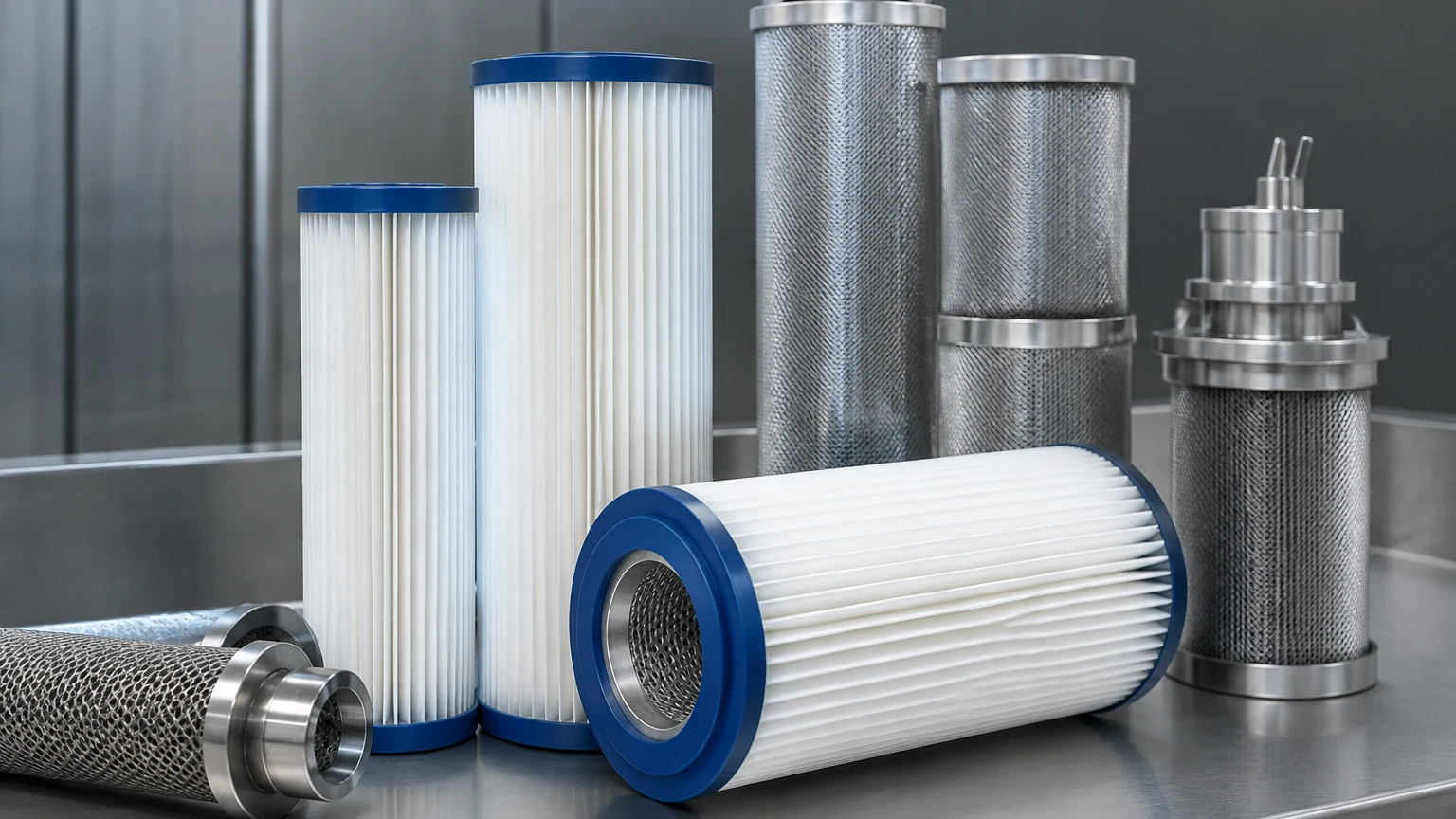
By utilizing custom-manufactured metal filters, engineers can often achieve higher flow rates in a smaller physical footprint than would be possible with traditional pool-style cartridges, provided the mesh geometry is optimized for the specific particulate profile of the fluid.
Engineering Considerations for Custom Filter Housing
Often, standard off-the-shelf sizes do not meet the specific constraints of an industrial facility. When you need to size a pool filter cartridges for a custom application, the dimensions of the housing (length and diameter) must be balanced against the required surface area.
Increasing the length of a cartridge is a common way to add surface area without increasing the footprint of the filter vessel. However, excessively long cartridges can suffer from uneven flow distribution, where the portion of the media closest to the outlet performs the majority of the work. Industrial designers often use internal flow distributors or perforated cores to ensure that the entire length of the cartridge is utilized effectively.
Customization also extends to the end-cap configurations. Whether the system requires a Double Open End (DOE), Code 7, or threaded connections, the seal integrity is paramount. A perfectly sized filter is useless if the bypass occurs at the gaskets due to poor fitment.
Evaluating Total Cost of Ownership (TCO)
When determining how to size a pool filter cartridges, the initial purchase price is only one component of the Total Cost of Ownership. A smaller, cheaper filter may seem attractive during the procurement phase, but the long-term costs often outweigh the savings.
Consider the following TCO factors:
* Labor Costs: Smaller filters require more frequent cleaning or replacement, leading to higher labor expenses and system downtime.
* Energy Costs: As a filter clogs, the pump must work harder to maintain flow. Larger filters stay "cleaner" longer, maintaining a lower average differential pressure and reducing electricity consumption.
* Waste Disposal: In many regions, the disposal of used synthetic cartridges is regulated. Permanent, cleanable stainless steel filters eliminate this waste stream, providing a more sustainable and cost-effective solution over a 5-to-10-year horizon.
Common Sizing Errors and How to Avoid Them
To ensure reliable performance, engineers should be wary of the following pitfalls during the sizing process:
* Ignoring Peak Debris Loads: Sizing a filter based on "clean water" conditions is a recipe for failure. The system must be sized to handle the worst-case scenario, such as seasonal algae blooms in outdoor pools or batch processing spikes in industrial plants.
* Overestimating Media Efficiency: Manufacturers often provide "nominal" micron ratings. If absolute filtration is required, the surface area must be increased to compensate for the tighter media required to achieve that rating.
* Neglecting Pipe Friction: The plumbing leading to and from the filter adds resistance. If the piping is undersized, even a correctly sized filter will underperform because the pump cannot deliver the required GPM.
For technical professionals, the selection process should always involve a review of the specific application requirements. Whether the goal is to optimize a commercial aquatic center or a pharmaceutical water loop, the precision of the filtration component is the deciding factor in system success. For more information on custom metal filtration components and engineering support, visiting the Main Page can provide the necessary data to make an informed decision.
In summary, to size a pool filter cartridges effectively, one must move beyond simple volume-based charts and instead focus on the hydraulic realities of the system. By calculating the EFA, respecting flux rates, and selecting materials like stainless steel that offer long-term durability, facilities can achieve superior water quality with minimal operational overhead.
