


Slotted Pvc Pipe
In the landscape of industrial fluid management and subsurface engineering, the slotted PVC pipe serves as a critical component for filtration, drainage, and extraction. While often overshadowed by high-performance metal alloys in heavy industrial processing, PVC (polyvinyl chloride) remains a primary material choice for applications where cost-effectiveness, chemical inertness to groundwater, and ease of installation are prioritized. For engineers and procurement specialists, understanding the technical nuances of slotted PVC—from aperture precision to structural load-bearing capacity—is essential for ensuring system longevity and filtration efficiency.
Industrial filtration often requires a balance between mechanical strength and chemical compatibility. While Kaifil specializes in precision stainless steel filtration solutions, the industry frequently utilizes slotted PVC as a complementary or preliminary stage in water treatment and environmental monitoring. This guide examines the engineering specifications of slotted PVC pipe, its application boundaries, and how it compares to high-precision metal alternatives found on our Main Page.
Understanding the Mechanics of Slotted PVC Pipe
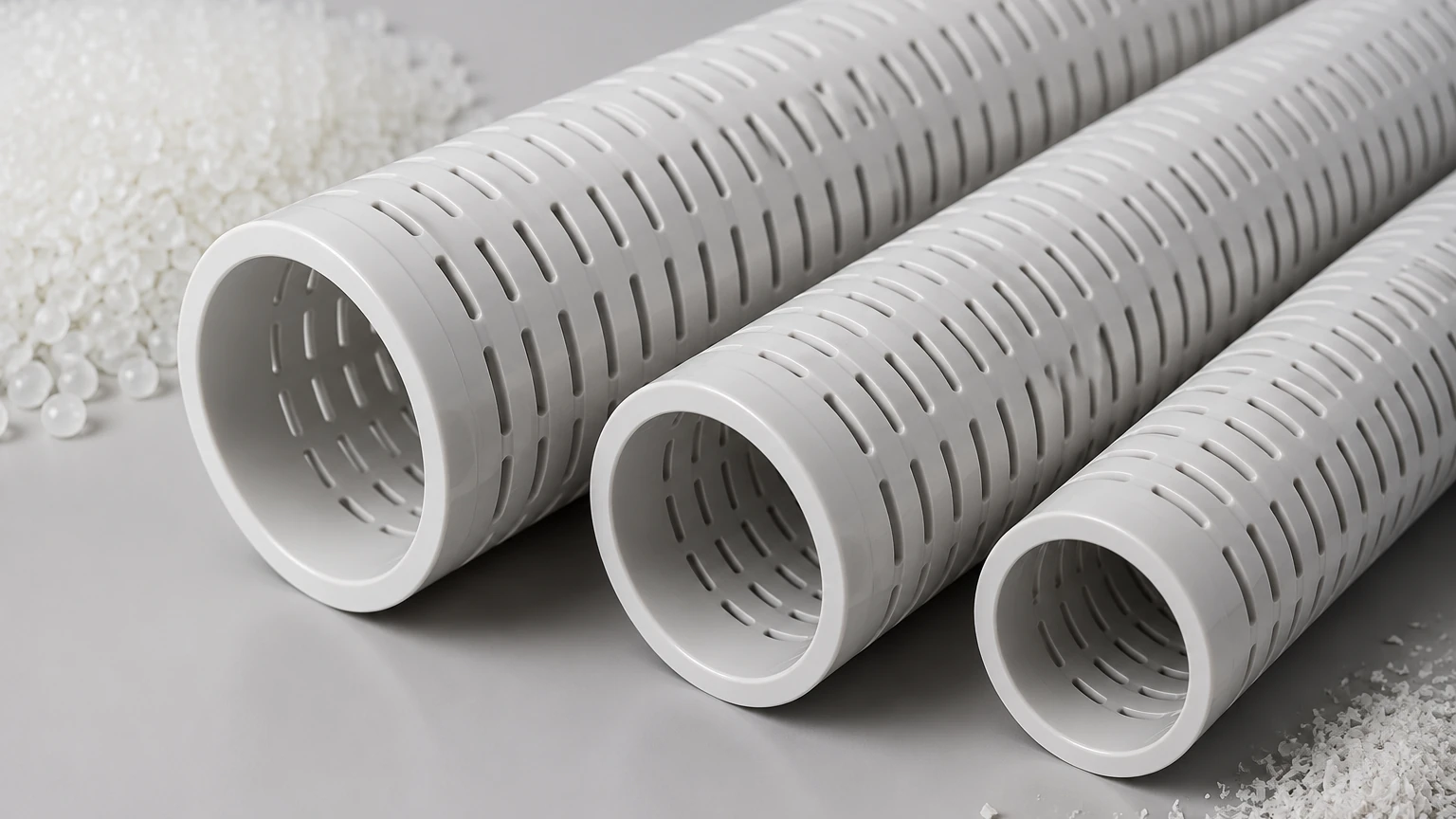
Slotted PVC pipe is essentially a standard thermoplastic pipe that has undergone a secondary machining process to create a series of longitudinal or transverse openings. Unlike perforated pipes, which typically feature circular holes, slotted pipes utilize narrow, elongated apertures. This design is intentional; slots are significantly more effective at preventing the infiltration of fine particulates, such as sand and silt, while maintaining a higher percentage of open area for fluid intake.
From a manufacturing perspective, the slots are created using high-speed circular saws or CNC milling machines. The precision of these cuts is paramount. In industrial applications, slot widths can range from as narrow as 0.006 inches (0.15 mm) to 0.250 inches (6.35 mm) or larger. The choice of slot width is dictated by the grain size distribution of the surrounding media (in well applications) or the specific particle size that must be excluded in a process stream.
Structural Integrity and Pipe Schedules
The most common grades of PVC used for slotting are Schedule 40 and Schedule 80. Schedule 40 is typically sufficient for shallow drainage and low-pressure applications. However, for deep-well casings or industrial processes involving higher external hydrostatic pressures, Schedule 80 is preferred due to its thicker wall. It is important for engineers to calculate the "collapse strength" of the pipe after slotting, as the removal of material naturally reduces the pipe's ability to withstand external loads.
Key Design Parameters: Slot Size and Open Area
When specifying a slotted PVC pipe, two primary metrics define its performance: the slot aperture and the total open area. These factors directly influence the flow velocity and the pressure drop (delta P) across the filtration interface.
Slot Width (Aperture)
The slot width must be selected based on the "bridge-forming" characteristics of the particles being filtered. In groundwater applications, the rule of thumb is often to select a slot size that retains approximately 90% of the filter pack material. If the slot is too wide, the system will suffer from "sand pumping," leading to pump wear and downstream contamination. If the slot is too narrow, the pipe may become prematurely blinded (clogged), necessitating frequent maintenance or chemical rehabilitation.
Open Area Calculations
The total open area is the sum of the surface area of all slots relative to the total surface area of the pipe section. A higher open area reduces the entrance velocity of the fluid. Lower entrance velocities are critical because they minimize turbulence and reduce the rate of encrustation and corrosion. Typically, industrial slotted PVC pipes aim for an open area between 3% and 12%. Engineers must balance this against the required tensile strength of the pipe string, especially in vertical installations where the pipe must support its own weight and the weight of the fluid column.
Industrial Applications and Environmental Use Cases
Slotted PVC pipe is utilized across a diverse range of sectors, each with specific technical requirements. Its primary advantage lies in its resistance to electrochemical corrosion, which often plagues carbon steel alternatives in buried environments.
Groundwater Monitoring and Water Wells
In environmental engineering, slotted PVC is the standard for monitoring wells. Because PVC is chemically inert, it does not leach metals into the water, ensuring that samples taken for laboratory analysis are representative of the actual groundwater chemistry. In production wells, it serves as the intake screen, allowing water to enter the wellbore while keeping the formation sand out.
Leachate Collection in Landfills
Landfill engineering requires robust drainage systems to manage leachate—the liquid that drains from waste. Slotted PVC pipe is often used here because it can withstand the highly corrosive and acidic nature of leachate that would rapidly degrade standard metallic pipes. In these environments, Schedule 80 PVC is almost exclusively used to handle the immense weight of the overlying waste.
Mining and Heap Leaching
In mining operations, specifically heap leaching, slotted pipes are used to collect mineral-rich solutions at the base of the ore piles. The pipe must be resistant to the specific chemicals used in the leaching process, such as sulfuric acid or cyanide solutions. While PVC is suitable for many of these applications, engineers must monitor temperature, as PVC loses structural rigidity as temperatures rise above 140°F (60°C).
Material Comparison: PVC vs. Stainless Steel Filtration
For many B2B buyers, the decision between slotted PVC and stainless steel filtration components is a matter of balancing initial CAPEX with long-term OPEX. While PVC is lower in cost, it has distinct physical limitations that may make stainless steel a more viable technical choice for demanding environments.
| Feature | Slotted PVC Pipe | Stainless Steel (304/316) |
| :— | :— | :— |
| Corrosion Resistance | Excellent (Non-metallic) | Excellent (Oxide layer) |
| Temperature Limit | Low (< 140°F) | High (> 800°F) |
| Mechanical Strength | Moderate | Very High |
| Slot Precision | Good | Superior (Laser/Wire Mesh) |
| Cleaning/Backwashing | Limited | Highly Effective |
| Lifespan | 10-25 years | 50+ years |
In high-pressure hydraulic systems or chemical processing plants where temperatures exceed the limits of thermoplastics, stainless steel wire mesh or wedge wire filters are the industry standard. These metal components, which you can explore further on our Main Page, offer higher burst pressures and can be precision-engineered to micron-level tolerances that are impossible to achieve with PVC slotting.
Engineering Challenges: Pressure, Temperature, and Durability
Designing a system around slotted PVC pipe requires a thorough understanding of its failure modes. Unlike metal, PVC is a viscoelastic material, meaning its properties change over time under constant load (creep) and vary significantly with temperature.
Temperature Derating
The pressure rating of a PVC pipe is typically calculated at 73°F (23°C). As the operating temperature increases, the pressure-carrying capacity decreases. For example, at 110°F, the pipe may only retain 50% of its original pressure rating. Engineers must apply derating factors during the design phase to prevent catastrophic pipe failure in industrial process loops.
Chemical Resistance and Environmental Stress Cracking
While PVC is resistant to many acids and bases, it is susceptible to certain organic solvents, esters, and ketones. Furthermore, exposure to UV radiation (if stored improperly on-site) can lead to embrittlement. In B2B procurement, it is vital to confirm the specific chemical composition of the fluid being filtered to ensure it does not catalyze environmental stress cracking (ESC) in the PVC matrix.
Mechanical Loading in Vertical Wells
In deep-well applications, the "hang weight" of the pipe string can be substantial. The slots act as stress concentrators. If the design does not account for the reduced cross-sectional area of the pipe, the pipe may stretch or snap at the slot lines during installation or during the development of the well. This is why high-performance filtration often transitions to metal components for the lower, high-stress sections of a well or filter housing.
Selection Criteria for Industrial Filtration Systems
When choosing between different slotted PVC pipe configurations, engineers should follow a structured evaluation process to ensure the selected product meets the application's demands.
1. Particle Size Analysis: Conduct a sieve analysis of the media to be filtered. The slot width should be small enough to prevent the majority of particles from passing through but large enough to allow for efficient fluid flow.
2. Flow Rate Requirements: Calculate the required GPM (gallons per minute). Ensure the total open area of the slotted pipe allows for an entrance velocity of less than 0.1 feet per second to minimize friction loss and prevent particle impingement.
3. Depth and Load: For subsurface applications, calculate the lateral earth pressure and hydrostatic pressure. Determine if Schedule 40 is sufficient or if the added wall thickness of Schedule 80 is required.
4. Compatibility: Verify the chemical compatibility of the PVC resin with the process fluid. Consider potential temperature spikes that could compromise the pipe's integrity.
5. Maintenance Access: Determine if the system will require backwashing or chemical cleaning. PVC can be sensitive to high-pressure jetting, which might be necessary to clear biofouling or mineral scaling.
Conclusion
Slotted PVC pipe remains a versatile and essential tool in the industrial filtration and drainage toolkit. Its ability to provide reliable, corrosion-resistant service in groundwater and low-temperature chemical environments makes it a staple for environmental and civil engineering projects. However, the limitations of PVC regarding temperature, extreme pressure, and ultra-fine filtration precision mean that it is often used in conjunction with, or replaced by, high-performance metal filtration solutions.
For engineers seeking the highest levels of durability and filtration accuracy, especially in demanding chemical or hydraulic applications, exploring customized stainless steel options is often the next logical step. By understanding the boundaries of slotted PVC, technical professionals can make informed decisions that optimize both performance and cost-efficiency. To learn more about precision filtration components and how they can be tailored to your specific industrial needs, visit our Main Page for detailed product specifications and engineering support.
