


Slotted Screen
In the realm of industrial filtration and solids-liquid separation, the slotted screen stands as a fundamental component designed for durability, precision, and efficiency. Unlike standard woven wire mesh, which relies on the intersection of wires to create apertures, a slotted screen utilizes longitudinal openings—often precision-engineered through wedge wire construction or specialized milling—to provide a high-strength filtration surface. For engineers and procurement teams in the chemical, food and beverage, and water treatment sectors, selecting the right slotted screen configuration is critical to optimizing flow rates while maintaining strict filtration accuracy.
At Kaifil, the focus on custom stainless steel filtration solutions ensures that these components are not merely off-the-shelf parts but engineered assets tailored to specific industrial demands. Understanding the technical nuances of slotted screens—from material metallurgy to slot geometry—is essential for ensuring long-term operational reliability and minimizing the total cost of ownership.
Understanding Slotted Screen Design and Construction
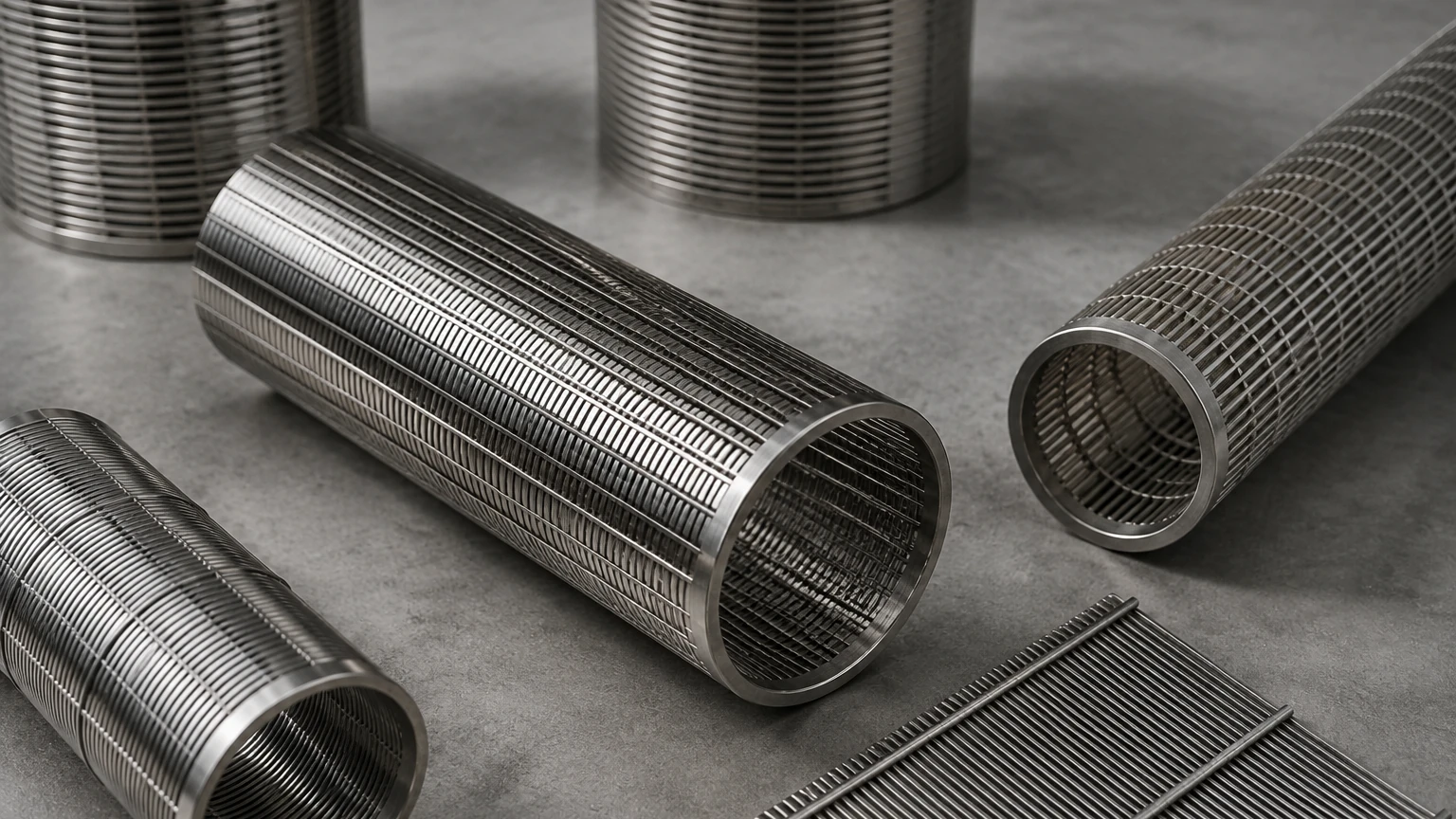
The performance of a slotted screen is primarily dictated by its physical construction. While there are several methods to produce these screens, the most prevalent in high-performance industrial applications is the wedge wire (or V-wire) design. This construction involves wrapping a profile wire around longitudinal support rods, with each intersection point being resistance-welded for maximum structural integrity.
The Geometry of the Slot
One of the most significant advantages of a wedge wire slotted screen is the "V" shaped opening. The slot is narrower at the surface and widens toward the interior. This geometry is intentional; it ensures that any particle small enough to pass through the initial opening will continue through the screen without becoming wedged or "blinded." In contrast, traditional perforated plates or square meshes often suffer from particles getting trapped within the thickness of the material, leading to rapid pressure drops and frequent maintenance requirements.
Structural Support and Orientation
Slotted screens can be configured with slots running either parallel or perpendicular to the flow, depending on the equipment design (e.g., centrifugal separators vs. static intake screens). The support rods provide the necessary collapse strength, which is a vital metric for deep-well applications or high-pressure hydraulic systems. Engineers must balance the frequency of support rods with the required open area to ensure the screen can withstand differential pressures without deforming.
Material Selection for Industrial Environments
The longevity of a slotted screen is heavily dependent on the alloy selected for its construction. Because these screens are often deployed in corrosive or high-temperature environments, stainless steel is the industry standard. Kaifil specializes in utilizing high-grade alloys to meet these rigorous demands.
* AISI 304 Stainless Steel: This is the most common material for general industrial use. It offers excellent corrosion resistance and mechanical strength for water treatment and standard food processing applications.
* AISI 316L Stainless Steel: For more demanding environments, such as chemical processing or marine applications, 316L is preferred due to the addition of molybdenum. This increases resistance to pitting and crevice corrosion, particularly in chloride-rich environments.
* Duplex and Super Duplex Alloys: In high-stress or highly acidic environments, duplex steels provide superior yield strength and enhanced resistance to stress corrosion cracking compared to standard austenitic steels.
When evaluating materials, engineers should also consider the surface finish. For the pharmaceutical and food industries, electro-polishing the slotted screen can reduce surface roughness, thereby preventing bacterial growth and making the cleaning-in-place (CIP) process more effective.
Key Performance Metrics: Flow Rate and Filtration Accuracy
When integrating a slotted screen into a system, two primary metrics must be analyzed: the slot width (filtration accuracy) and the percentage of open area (flow capacity).
Slot Width Precision
Slot widths are typically measured in microns or millimeters. In high-precision applications, such as sand control in oil wells or resin traps in water softeners, slot tolerances must be extremely tight. A deviation of even a few microns can lead to the passage of unwanted fines or the loss of expensive media. Modern manufacturing techniques allow for slot widths as small as 20 microns, providing a level of precision that rivals fine wire cloth while offering significantly higher mechanical durability.
Calculating Open Area
The open area of a slotted screen is the ratio of the total area of the openings to the total surface area of the screen. A higher open area results in lower entrance velocities, which reduces the pressure drop across the filter and minimizes the risk of erosion. However, increasing the open area often requires using thinner profile wires or fewer support rods, which can compromise the structural integrity. Finding the optimal balance is a core part of the engineering process when designing custom filtration components.
Applications Across Diverse Industries
The versatility of the slotted screen makes it a staple in numerous industrial sectors. Its ability to handle high solids loading and its ease of cleaning make it superior to many disposable filtration options.
Water and Wastewater Treatment
In water intake systems, slotted screens are used to protect pumps and downstream equipment from debris. Because of their non-clogging nature, they are ideal for passive intake screens in rivers and lakes. In wastewater treatment, they serve as primary filters for removing large solids and as underdrains in gravity filters.
Food and Beverage Processing
The food industry requires filtration solutions that are both sanitary and robust. Slotted screens are used in mashing tuns for brewing, juice extraction, and sugar processing. The smooth surface and precise openings allow for efficient separation of husks, pulp, and crystals without contaminating the final product.
Chemical and Petrochemical
In chemical reactors, slotted screens act as catalyst support grids. They must withstand high temperatures and aggressive chemical reactions while ensuring that the catalyst remains contained. In the oil and gas sector, they are used in well completions to prevent sand from entering the production stream, where they are known for their high collapse resistance.
Engineering Considerations for Customization
Choosing a slotted screen involves more than just selecting a slot size. To ensure the component performs as expected, several engineering factors must be confirmed before production begins.
1. Differential Pressure (ΔP): What is the maximum pressure the screen will face when it is partially fouled? The screen must be designed to withstand this pressure without mechanical failure.
2. Flow Velocity: High velocities can lead to impingement erosion on the screen surface. Selecting the right profile wire shape can help mitigate this effect.
3. Cleaning Mechanism: Will the screen be cleaned via backwashing, mechanical scraping, or manual removal? For example, a screen intended for mechanical scraping requires a very flat and smooth surface to prevent damage to the scraper blades.
4. Installation and Housing: The screen must fit precisely within the existing housing to prevent bypass. Custom end fittings, such as flanges, threaded connectors, or reinforced rings, are often necessary for a secure fit.
By addressing these factors during the design phase, companies can avoid costly downtime and premature replacement of filtration components. For more information on custom engineering and manufacturing capabilities, technical teams are encouraged to visit the Main Page to explore the full range of available filtration solutions.
Maintenance and Total Cost of Ownership
While the initial cost of a precision-engineered slotted screen may be higher than that of a standard mesh filter, the total cost of ownership is often significantly lower. The durability of stainless steel construction means these screens can last for years, if not decades, with proper maintenance.
Because slotted screens are inherently resistant to clogging, they require less frequent cleaning. When cleaning is necessary, the "V" shaped slot allows for highly effective backpulsing or backwashing. This efficiency reduces the consumption of cleaning fluids and minimizes the time the system must be offline. Furthermore, the ability to repair or refurbish certain types of heavy-duty slotted screens further extends their service life, providing a sustainable and cost-effective solution for industrial filtration.
Conclusion
The slotted screen is a sophisticated tool that plays a vital role in modern industrial processes. By providing a combination of mechanical strength, non-clogging geometry, and precise filtration, it meets the rigorous demands of sectors ranging from pharmaceutical manufacturing to heavy mining.
When sourcing these components, it is essential to partner with a manufacturer that understands the technical requirements of your specific application. From material certification to precision welding, every step in the manufacturing process impacts the final performance of the filter. By focusing on engineering excellence and customization, Kaifil provides the reliable filtration components necessary for maintaining efficient and continuous industrial operations. Whether you are designing a new system or looking to optimize an existing process, the technical data and customization options available on our Main Page serve as a comprehensive resource for professional filtration solutions.
