


Sparge Tube Design
In industrial process engineering, the efficiency of gas-liquid contact often dictates the overall productivity and cost-effectiveness of a system. Sparging, the process of injecting gas into a liquid through a porous or perforated medium, is a fundamental operation in chemical processing, pharmaceutical manufacturing, and water treatment. Effective sparge tube design is the critical bridge between theoretical mass transfer requirements and practical, durable hardware implementation.
For engineers and procurement teams, selecting the right sparge tube involves more than choosing a pipe with holes. It requires a deep understanding of fluid dynamics, material compatibility, and the specific requirements of the application, whether it is oxygenating a bioreactor, carbonating a beverage, or stripping volatile organic compounds from a solvent. As a specialist in custom stainless steel filtration and metal components, Kaifil provides the technical foundation necessary to optimize these systems.
The Fundamentals of Gas-Liquid Mass Transfer
The primary objective of most sparge tube applications is to maximize the mass transfer between a gas phase and a liquid phase. According to Henry’s Law and the principles of diffusion, the rate of mass transfer is directly proportional to the available surface area for contact. In the context of sparge tube design, this means that smaller bubbles are generally superior to larger ones.
When gas is forced through a sparge tube, it forms bubbles at the exit points (pores or holes). A smaller bubble size increases the total surface area for a given volume of gas. For example, a specific volume of gas dispersed into 1mm bubbles provides significantly more surface area than the same volume dispersed into 10mm bubbles. Furthermore, smaller bubbles rise more slowly through the liquid column due to lower buoyancy and higher drag relative to their volume. This increased residence time allows more time for the gas to dissolve or react with the liquid.
However, achieving fine bubble distribution requires careful consideration of the sparge tube’s surface characteristics. This is where the choice between sintered porous media and traditional drilled pipes becomes a pivotal design decision.
Key Engineering Parameters in Sparge Tube Design
Designing an effective sparge tube requires balancing several competing technical factors. Engineers must define the following parameters before moving into the manufacturing phase:
1. Pore Size and Porosity
In sintered metal sparge tube design, the pore size (often measured in microns) determines the initial size of the bubbles. Kaifil offers precision-engineered sintered stainless steel with pore ratings ranging from 0.5 to 100 microns. A finer pore size creates a dense cloud of micro-bubbles, which is ideal for high-efficiency oxygenation. Conversely, larger pores may be selected for applications where clogging is a concern or where high gas volumes must be delivered quickly.
2. Gas Flow Rate and Velocity
The volume of gas required per unit of time (SCFM or SLPM) dictates the surface area of the sparge tube. If the gas velocity through the pores is too high, bubbles will coalesce (merge) at the surface of the tube, forming larger, less efficient bubbles. This phenomenon, known as "jetting," negates the benefits of a fine-pore design. Proper design ensures that the exit velocity remains low enough to maintain discrete bubble formation.
3. Pressure Drop (Delta P)
The sparge tube acts as a flow restrictor. The pressure drop across the porous wall must be high enough to ensure uniform gas distribution along the entire length of the tube, but low enough to remain within the capabilities of the gas supply system. If the pressure drop is too low, gas may only exit from the end of the tube closest to the inlet, leading to uneven distribution within the tank.
Material Selection and Structural Integrity
Industrial environments often present challenges such as corrosive chemicals, high temperatures, and mechanical stress. Therefore, material selection is a cornerstone of sparge tube design. Stainless steel is the industry standard due to its durability and resistance to oxidation.
* 304 Stainless Steel: Suitable for general-purpose applications, such as water treatment and basic food processing.
* 316L Stainless Steel: The preferred choice for pharmaceutical and chemical processing. The "L" denotes low carbon content, which improves weldability and resistance to intergranular corrosion. It also offers superior resistance to chlorides and organic acids.
* Specialty Alloys: For highly aggressive environments involving high concentrations of sulfuric acid or high-temperature steam, alloys like Hastelloy or Inconel may be integrated into the design.
Beyond chemical resistance, the sparge tube must withstand the mechanical forces of the liquid environment. In large mixing tanks, the fluid velocity can be high, creating significant drag and potential vibration (vortex shedding) on the sparge tube. Design engineers must calculate the required wall thickness and support structures to prevent mechanical failure or fatigue over time.
Comparing Sintered Metal vs. Drilled Pipe Spargers
When evaluating sparge tube design, engineers typically choose between two primary technologies: drilled (perforated) pipes and sintered metal tubes.
Drilled Pipe Spargers
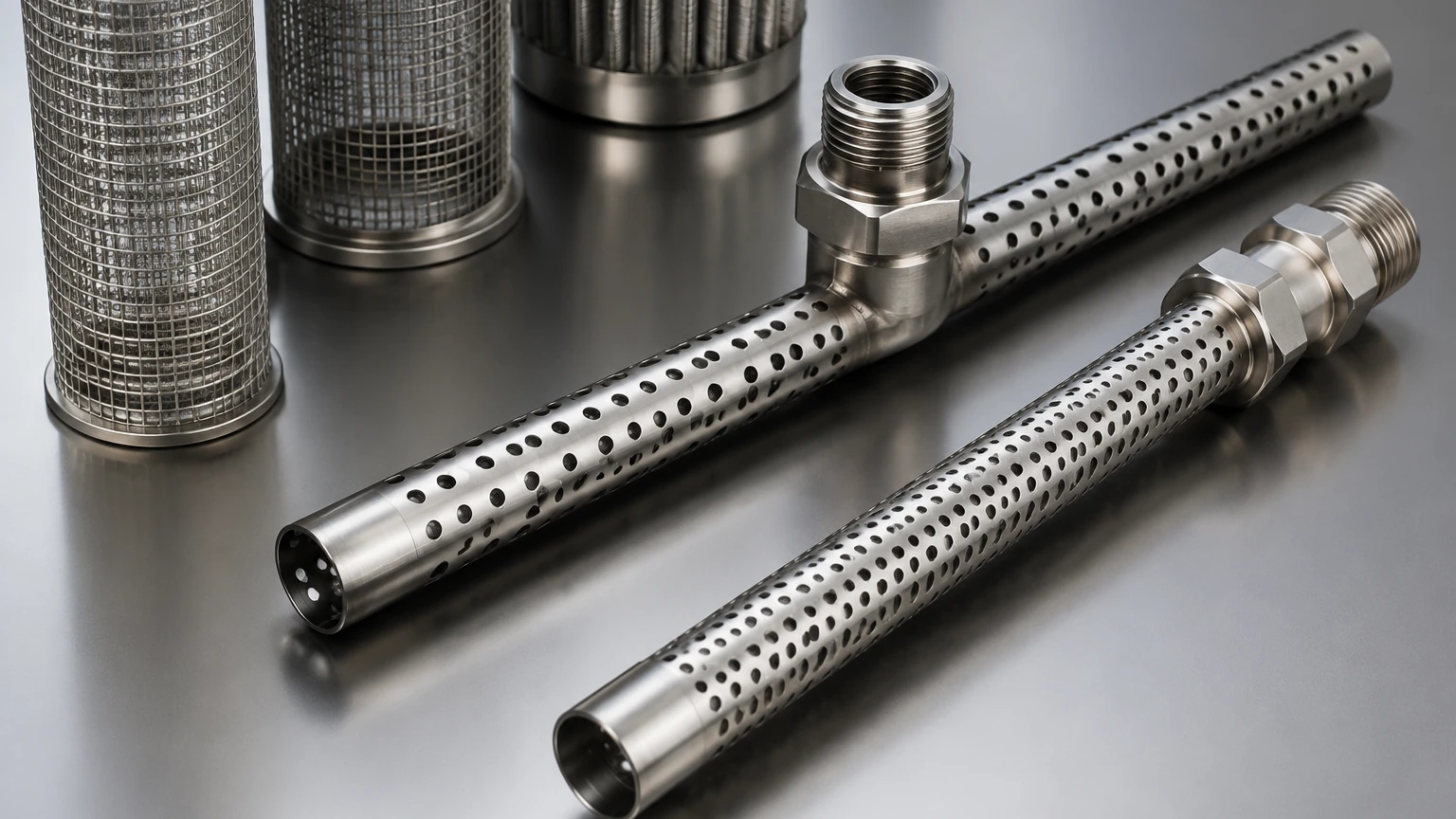
Drilled pipes are simple to manufacture and have a low initial cost. They consist of a stainless steel pipe with holes mechanically drilled at specific intervals. However, the minimum hole size achievable through drilling is usually around 1mm to 2mm. This results in large bubbles and relatively low mass transfer efficiency. Drilled pipes are most effective in applications where high gas volume is more important than efficiency, such as simple agitation or mixing.
Sintered Metal Spargers
Sintered metal sparge tubes are manufactured by compacting and heating stainless steel powder until the particles bond without melting. This creates a tortuous path of interconnected pores. The advantages include:
* Uniformity: Thousands of exit points ensure a perfectly even distribution of gas.
* Efficiency: The ability to produce bubbles in the micron range significantly reduces gas consumption.
* Cleanability: Sintered stainless steel can be cleaned and reused, making it a sustainable long-term investment.
For most high-performance industrial applications, the increased efficiency of a sintered design leads to lower operational costs, as less gas is wasted and reaction times are shortened. For more details on custom manufacturing options for these components, you can visit the Main Page of our technical resource center.
Optimizing Performance: Bubble Dynamics and Coalescence
Even a well-designed sparge tube can underperform if the surrounding environment is not considered. Bubble coalescence is the process where two or more bubbles merge to form a larger one. This occurs most frequently in the "near-field" area immediately surrounding the sparge tube.
To minimize coalescence, sparge tube design should incorporate:
* Increased Surface Area: Spreading the gas exit points over a larger area reduces the density of bubbles near the tube surface.
* Strategic Placement: Placing the sparge tube at the bottom of the vessel maximizes the rise distance. If an impeller is used, the sparge tube should be positioned so the gas is immediately drawn into the high-shear zone of the mixer, which further breaks down bubbles.
* Liquid Chemistry: The presence of surfactants or salts in the liquid can inhibit coalescence. Engineers should test the sparge tube performance with the actual process fluid whenever possible, as water-only tests can be misleading.
Maintenance and Longevity in Industrial Environments
A common concern with fine-pore sparge tube design is the risk of clogging. Clogging can occur from the outside-in (particulates in the liquid or biological growth) or from the inside-out (contaminants in the gas stream).
To ensure a long service life, the following maintenance strategies are recommended:
1. Gas Filtration: Always use a high-quality filter on the gas inlet line to prevent oil, rust, or scale from entering the sparge tube.
2. Clean-in-Place (CIP): Stainless steel sparge tubes are compatible with standard CIP chemicals. In pharmaceutical and food applications, the ability to sterilize the tube in place is essential.
3. Ultrasonic Cleaning: For stubborn clogs, sintered metal tubes can be removed and cleaned in an ultrasonic bath with appropriate solvents. This restores the original pressure drop and flow characteristics.
4. Backpulsing: In some continuous processes, a brief pulse of high-pressure gas or liquid in the reverse direction can clear surface accumulation without stopping the process.
Customization and OEM Solutions
No two industrial processes are identical. Standard "off-the-shelf" spargers often fail to meet the specific geometric or performance requirements of a custom reactor. Kaifil specializes in tailoring sparge tube design to meet these unique challenges. Customization options include:
* Geometric Configurations: From simple linear tubes and rings to complex manifolds and "spider" configurations that ensure coverage across large-diameter tanks.
* Fitting Integration: Custom NPT, BSP, or flange connections to match existing piping infrastructure.
* Hybrid Designs: Combining different pore sizes in a single unit to handle varying gas flow requirements.
By working closely with an experienced manufacturer, engineering teams can ensure that their filtration and sparging components are optimized for both performance and manufacturability. This collaborative approach reduces the risk of costly retrofits and ensures that the system meets its performance specifications from day one.
Conclusion
Successful sparge tube design is a balance of science and engineering. By focusing on pore size, gas velocity, material integrity, and maintenance requirements, technical professionals can significantly improve the efficiency of their gas-liquid processes. Whether the goal is to reduce gas consumption, speed up a chemical reaction, or ensure the highest levels of purity in a pharmaceutical batch, the sparge tube remains a critical component of the industrial stack.
For those seeking reliable, high-precision stainless steel filtration and sparging solutions, Kaifil offers the manufacturing expertise and technical support needed to turn complex requirements into high-performance hardware. To explore our full range of capabilities and product specifications, please refer to our Main Page.
